一味生姜半个医---《图经衍义本草》(1)
2、一味生姜半个医---《图经衍义本草》(1)
原创 杨子 道藏研究 2021-06-01
接上篇。继续介绍宋朝寇宗奭编撰的《图经衍义本草》。上次预告时说,打算先从与人们日常生活最相关的“菜部”开始,细想了下,我们常用的调味品生姜太重要了,所谓“一味生姜半个医”,意思是说如果会用生姜的话,可相当于半个医生的功能。所以,今天先从生姜说起。但生姜在本书中被归在了“草部中品之上”一卷。不属菜部,这个没关系,直接说生姜。
首先,生姜与干姜是不同的。这是最需要说明的一点,也不完全是本文部分段落中的所说“生姜晒干就是干姜”,生姜和干姜,在概念上有区别,生长过程和品质上也不同。从医的人都知道。但有些医书中说李时珍在《本草纲目》中首先单列出了干姜与生姜,这个说法是不对的。比如本书,就是宋朝的,已开始了单列二者,在李时珍之前。我所看到的资料显示,汉朝时人们就注意到了二者的药用区别。以前写过关内容。不再重复。由于干姜多出现在中药铺,生姜多出现我们的厨房,篇幅原因,只选生姜部分内容上传。
今天起,分两次上传本书中关于生姜这一节的大部分内容。当然这并不是全书关于生姜的所有内容。在其它各卷中,关于生姜配伍的经方、验方非常多,而且多数很是灵验,先不提。本篇先集中阅读这一小节中的部分内容。
下图为我点注原文的图片:
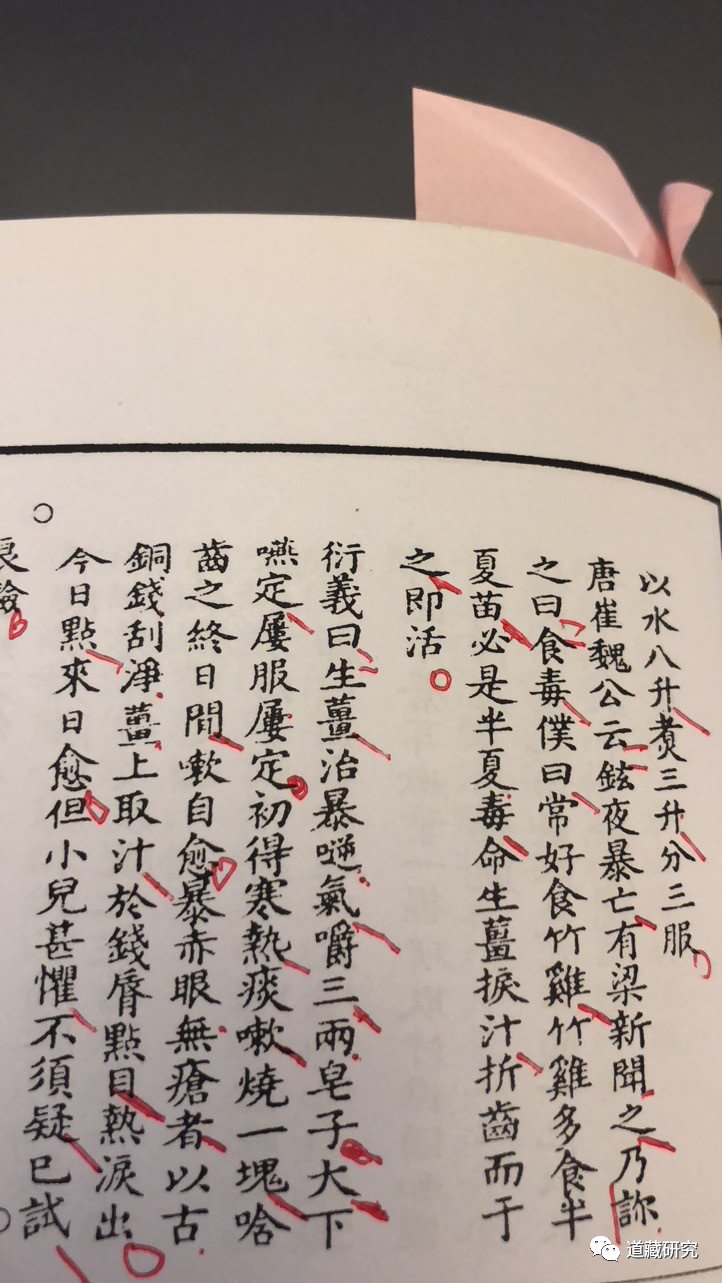
生姜
涪州 温州
味辛,微温。主伤寒头痛鼻塞,咳逆上气,止呕吐。久服去臭气,通神明。生犍为川谷及荆州、扬州,九月采。秦椒为之使,杀半夏、莨菪毒,恶黄苓、黄连、天鼠粪。
注:犍(qian2)为,今四川乐山市下属的犍为县。
《图经》曰:生姜,生犍为山谷及荆州、扬州,今处处有之,以汉、温、池州者为良。苗高二三尺,叶似箭竹叶而长,两两相对。苗青根黄,无花实。八九月采根,於长流水洗过,日晒为乾姜。
又《千金方》主痰澼,以姜附汤治之,取生姜八两,附子生用四两,四破之,二物以水五升,煮取二升,分再服。亦主卒风。禁猪肉、冷水。
崔元亮《集验方》载敕赐姜茶治痢方,以生姜切如麻粒大,和好茶一两碗,呷,任意,便差。若是热痢即留姜皮,冷即去皮,大妙。刘禹锡在淮南与李亚同幕府,李每与人药而不出方,或讥其吝。李乃情话曰:凡人患嗽,多进冷药,若见此方用药热燥,即不肯服,故但出药多效,试之信然。
注:这一段讲生姜可以治痢疾与咳嗽的案例。先提示一下要注意生姜去皮与不去皮的区别。后面的故事很好玩,需要翻译一下。刘禹锡在淮南时与李亚同事。李亚给别人治病,经常是只给药,不给方子,于是就有人说他小气。李大夫就很诚意地解释说:“凡是人有咳嗽之症的,都多服冷药,如果见我这方子里用了生姜,热燥之药,就不肯服用。所以不给方子,只给药,这样就更容易有疗效。世人试了,果然如此。”
忽然起《红楼梦》的一个情节,晴雯病了,贾宝玉让请医生,请了一位新的大夫。开了药离去。因为是新的医生,开的药不是宝玉常识中的药:
宝玉看时,上面有紫苏、桔梗、防风、荆芥等药,后面又有枳实、麻黄。宝玉道:“该死,该死!他拿着女孩儿们也像我们一样的治,如何使得!凭他有什么内滞,这枳实、麻黄如何禁得!谁请了来的?快打发他去罢!再请一个熟的来。”……一时,茗烟果请了王太医来。先诊了脉,后说的病症,与前相仿,只是方上果没有枳实、麻黄等药,倒有当归、陈皮、白芍等药,分量较先也减了些。宝玉喜道:“这才是女孩儿们的药,虽然疏散,也不可太过。旧年我病了,却是伤寒,内里饮食停滞,他瞧了,还说我禁不起麻黄、石膏、枳实等狼虎药。我和你们一比,我就如那野坟圈子里长的几十年的一棵老杨树,你们就如秋天芸儿进我的那才开的白海棠。连我禁不起的药,你们如何禁得起?”(《红楼梦·第五十一回》)
很显然,贾宝玉是通药理的,什么症大体用什么药,他有一些常识。所以不肯用那位新大夫的药,他们所熟悉王太医的药,倒是合了他的日常认知。所以他决定给晴雯用王太医的药。这是一个乌龙医案了。同样的症状,因为体质不同,会用不同的药,这是中医的特色。所以中医把脉很重要。那位新请来的大夫的药到底是不是可以对症治好晴雯的病,没法判断,因为那个大夫的方子给贾宝玉否了。但王太医的药,确实没有治好晴雯的病是事实。晴雯在病未好时被赶出贾府,最后死了。这是一个悲剧。
曹雪芹所有的诗、词、歌、赋中,水平最高的两首诗皆出自宝玉,一是宝玉给晴雯写的祭文《芙蓉女儿诔》(lei3),其次是写林四娘的《姽婳词》(gui3, hua4)。这两首诗除了展尽曹雪芹的才华之外,也写出了他对女性的最高赞美。《芙蓉女儿诔》,无论是文字还是感情,都是世间绝笔!我一直为晴雯之死惋惜、不平。但每读《芙蓉女儿诔》,就觉得一个人在死后有此祭文,也是没有白活。哪怕她是小说中人物,说明作者在情感上曾如此亏欠过一个女子,才会在文字上如此动情和卓越。人世间,没有比真情更美好、更值得礼赞的东西了。
在中国文学史上,西晋李密的《陈情表》、清代袁枚的《祭妹文》常被列为真挚感人的表情散文之首。在我看来,曹雪芹的《芙蓉女儿诔》和朱元璋的《皇陵碑文》一点都不逊色,这两篇文章在感人程度上没有被文学家排在前面,可能是因为《红楼梦》只是小说,晴雯只是小说中的一个身份低下的丫头,不是现实中的实际人物。儒家思想的读者,非常务实,讲现实存在,讲身份对等,所以不作入选;而朱元璋的《皇陵碑文》是帝王之作,儒家学者,忠敬为大,对帝王之作自然不敢妄评。我猜还有一种原因,就是《芙蓉女儿诔》词藻有些过于华丽,缺少了朴素平凡之态;而《皇陵碑文》则更是常人无法体味的帝王生命中那些翻天覆地的经历,所以无法移情换位到朱元障的立场上去思考,想也不敢想。而《陈情表》和《祭妹文》就是普通人在表达亲情,至亲之人的生离死别,容易产生共鸣。所以这两篇文章更出名。
说到晴雯之死,让人想起了《红楼梦》的王夫人。在这部小说中,我不太喜欢的人物中,王夫人是排在最前面的。王夫人身为主家太太,对丫头们讲话,过于刻薄,有些语言有失身份教养。有三个女孩子的命运由王夫人直接毁了---金钏、晴雯、彩霞;另外三个女孩因她出家了---芳官、蕊官、藕官。我觉得王夫人成天在念佛,真不知道她念的哪门子佛。但说来奇怪,读《红楼梦》的人,从没人批评过这样一个伪善的人。有地位的人可以草菅人命,而社会以为理所当然,连文学评论都不予置评。这是我们的价值观有问题。我可能终此一生,都在寻求一种理想中的公平与正义,现实中的公平与正义,我基本不报希望了。但内心对美好社会的向往一直没有停止过,哪怕是在文学作品中、在虚幻的梦中、在唠唠叨叨的文字中,都不曾停止对公正的期盼。
回到贾宝玉以自己的理念否决新请大夫的药方之事。
本文中讲的,也是这样的一件常发生的现象。就是一般通药理的人,都有用药常识,这位李亚大夫知道人们看到他的方子就不会按方抓药,所以他索性不给方子,只给药。作者记录“出药多效,试之信然”,试后发现果然生姜可以治咳嗽。
……
陶隐居云:乾姜,今惟出临海、章安,两三村解作之。蜀汉姜旧美,荆州有好姜,而并不能作乾者。又云:生姜,归五脏,去痰下气,止呕吐,除风邪寒热。久服少志少智,伤心气。如此则不可多食。
注:本段前半部分为干姜,后一半为生姜。因同为陶弘景说的内容,就一起放在这一部分了。我查了本书“干姜”那一段内容,果然没有陶弘景说的这些。这一段中的前半段应该剪切到“干姜”那部分去。
陶弘景说多吃生姜的负作用是“少志少智,伤心气”,因此说不可多食。我看了比较入心,因之前很多文献中看到生姜的各种好处,特别是我体寒,以前有手脚冰凉的老毛病,生姜祛寒,加上又经常看到生姜的种种好处,于是也学习孔子---“不撤姜食”,顿顿吃,后来果然好了,再没有手脚冰冷或睡觉时后背发冷现象。但确实也是智商不再如前。
从前,我的脑子里有一个书库一样,各种读过、背过的书在脑子里整齐排列,齐刷刷的,一个词汇或概念出现,相关文献,立即跳出来,象排列组合一样迅速重新组阵。所以我一贯不太使用工具书,因为我的脑子会自动检索。近几年,我明显觉得自己迟钝多了,记不清楚了。比如去哪个景区走走,看到一个楹联什么的,只是觉得熟悉,却不能像以前那样快速反应出相关的古诗词作者或它背后的典故了。这时候只能靠逻辑推理。
前一段在福州,和朋友聊天,他正在党校学习,晚上出来吃个饭得马上回去。席间,大家聊党史,他问:“你是研究道的,怎么对我党历史这么清楚?”答:“你党管我们呀,所以学习比你们还要自觉和认真呢”,于是大家笑。聊到陈独秀先生,他问陈哪年死的?我慢语说;“是1942年吧?不确定了,但我可以推算出来。”于是我就从陈独秀最后一次入狱那年开始推算,坐了几年牢,出狱后又几年死等等。这不是靠强记能力了,而是依据信息进行推理。
中国古代儿童教育都是强记,死记硬背,叫“背书如喝书”,这样有好处,就是反应速度快。乘法口诀就是一例。外国人觉得中国孩子都是神童,9乘以9等于多少?中国孩子都会不加思索地说81,外国孩子就要用纸笔推算半天。于是外国人觉得中国遍地神童,中国孩子也特别自信。但长大后就发现,很多世界级的数学家,还是西方人多。原因之一就是我们的逻辑思维能力没有得到充分开发。这是我们的教育值得反思的。
我女儿读小学的时候,有一个家庭作业,语文老师布置的,背课文的段落大意。孩子不记得原文,但可以把段落大意背得滚瓜烂熟。我很反对这个家庭作业,觉得这样并不能培养孩子的阅读理解和分析总结能力,反而起反作用,于是不让孩子背诵。孩子说:要背的,老师明天要检查。老师的话,比圣旨还灵。于是,天天做那种愚蠢的家庭作业。我心疼孩子的宝贵时间,但不能跟老师提意见啊。原因都懂。家长的另类躺平。
我们这一代人也深受这种教育方法的负面影响。小时候读书也是这样,老师把段落大意和中心思想看得非常重要,降低了阅读的趣味性,以致于读书或写作,一定要有中心思想才对。有结构、有层次、有中心的文章,那叫“八股文”,我们反对八股文一百多年了,也没有丢掉“八股文思维”,跳不出那个圈圈。我也曾碰到过,有人说我的文章各种内容杂在一起,中心思想不突出。然后一二三地指点。我笑而不答。懒得回答,懒得解释。不争论。闲了下楼遛个弯,非得有个目的才出门吗?窗前发个呆,非得有个什么意义吗?写点东西,就是打发时间,一定要有什么中心思想,或具有什么目标吗?这让生活很累。
生命,是一个过程,花自漂零水自流。就是人间美好。
多年前,阅读美国思想家爱默生的随笔,任何一篇文章,都很长,好多段落,一段接一段,直到最后。按我们语文老师的说法,是没章法、没程序、没层次,从头到尾,拉拉杂杂,柴堆一样。但读起来却让人思想很受启发,如果按我们的文法结构去解析,文章不成体统。但为什么这本书那么伟大?因为里面有思想。作者絮絮叨叨,谈论着与文章标题的大体相关的一些人性特点,不一定是哪一句话,就触动心灵,让人觉得震撼,或引起思考,并从中获得一种莫明的力量。为什么呢?人类对虚伪的厌恶是共同的,对真性情的渴望是一致的。凡是从内心深处发出的声音,无论对错,都是那么让人容易理解和感动。因为,人性是通情达理的。就算是那些虚伪的人,他们的内心所渴望的,也是真诚。
死记硬背的坏处就是会弱化逻辑推理能力。本公众号有一篇文章《为什么中国人不讲逻辑不讲理》,文中提到,我们这个民族的心文化,要远远强过脑文化,心力要强过脑力。以前我一直主张“博文强记”,现在不主张了,觉得对有些知识理解了,只要知道大致体系,靠检索就行。哲学思维和逻辑能力更重要!!这可能是我越来越理解西方哲学的原因吧。也可能是强记功能在弱化,原以为是居住环境造成的缺少天地灵气(楼层太高、环境太封闭),或是因为随着年龄增长,记忆力会逐步减退,于是觉得正常。读到这段,忽然想,是不是食姜过度的原因?陶弘景说食姜过多会导致智力下降,只是一个结论,并没列出具体试验数据。但在“疑古信古”的问题上,我以前偏向于“疑古”,现在更偏向于“信古”,相信古人。年龄越大,越相信古人的话语。
……未完待续
照例,两首道情,送给你:
《修真》
心明道法者,修真如掌翻;
言行无他事,随心顺自然。
不为琐事累,不为尘情牵;
淡然向虚空,体内已成丹。
YZ.2019.5.26
《三国演义》中,我最喜欢的人物中,周瑜是排在前面的。因为真性情。他有智慧,也有才华,也小性,比较本真、性情;诸葛亮虽然也聪明,馊主意太多,终损寿,小说把他神化到“近妖”,就不可爱了;刘备手握“皇叔牌”,怀揣“仁义”刀,脸皮厚如城墙,还被当正面人物宣传,更加剧其虚伪性;曹操也是真性情的,同周瑜一样,皆可爱。
据说,当时有民谣曰:“曲有误,周郎顾。”大概是周瑜有强迫症,听到人家谈错谱了,就忍不住要去纠正。于是李端写诗“欲得周郎顾,时时误拂弦”,描述当时一些女子为了要引起周瑜的注意,就故意弹错弦。我不太喜欢弹琴。主要是没闲时间和闲心情。偶尔弹一会,也只是为了给十指按摩活血。或是为了消遣,从来不是为了悦耳,不是为了艺术。
《庭院记》
树下起舞花作阵,桃面含情香有韵。
作诗唯恐不成行,扶琴还怕周郎问。
A Single Ginger Root, Half a Doctor--Tujing Yanyi Bencao (1)
30. A Single Ginger Root, Half a Doctor--Tujing Yanyi Bencao (1)
Originally published by Yang Zi, Daozang Research, 2021-06-01
Continuing from the last piece, with the Tujing Yanyi Bencao compiled by Kou Zongshi of the Song. When I previewed it, I said I would start from the "vegetable section," the most closely bound to daily life. On second thought, ginger, the seasoning we use constantly, is far too important--hence the saying "a single ginger root, half a doctor": used well, ginger can do the work of half a physician. So today I begin with ginger. In this book, though, ginger is classified in the scroll "herbs, middle grade, upper part," not the vegetable section. No matter; straight to ginger.
First, fresh ginger and dried ginger are not the same. This is the point most needing explanation, and it is not exactly what some passages below say, that "fresh ginger dried in the sun is dried ginger." Fresh ginger and dried ginger differ in concept, and they differ too in growing process and quality; every practitioner of medicine knows this. But some medical books claim that Li Shizhen in the Bencao Gangmu was the first to list dried ginger and fresh ginger separately. That claim is wrong: this very book is from the Song and had already listed the two separately, before Li Shizhen. From the material I have seen, as early as the Han people had noticed the difference in their medicinal use. I wrote about this before and will not repeat it. Since dried ginger mostly appears in the Chinese pharmacy and fresh ginger mostly in our kitchens, and for reasons of length, I will post only the fresh-ginger material.
Beginning today, I will post in two installments most of this book's section on fresh ginger. This is not, of course, all the book has to say about ginger: in its other scrolls there are a great many classic and proven prescriptions with ginger in combination, most of them remarkably effective; those can wait. This piece will concentrate on reading part of this one small section.
The picture below shows the original text with my annotations:
Fresh ginger
Fuzhou and Wenzhou
Pungent in flavor, slightly warm. Governs cold damage with headache and blocked nose, cough with rising qi; stops vomiting. Taken long, it removes foul qi and opens communication with the spirits. It grows in the river valleys of Qianwei and in Jingzhou and Yangzhou, and is gathered in the ninth month. Qin pepper acts as its envoy; it kills the poison of banxia and langdang; it is averse to huangqin, huanglian, and bat dung.
Note: Qian (qian2) wei is today's Qianwei County, under Leshan City, Sichuan.
The Tujing says: fresh ginger grows in the mountain valleys of Qianwei and in Jingzhou and Yangzhou; today it is found everywhere, the best from Han, Wen, and Chizhou. The stalks grow two or three feet high; the leaves resemble arrow-bamboo leaves but longer, set in facing pairs. The stalk is green, the root yellow, with no flowers or fruit. In the eighth and ninth months the root is gathered, washed in long flowing water, and sun-dried into dried ginger.
Also, the Qianjin Fang: for phlegm-racking illness, treat it with the ginger-and-fuzi decoction. Take eight liang of fresh ginger and four liang of raw fuzi, break it into four pieces; boil the two things in five sheng of water down to two sheng, and take it in two doses. It also governs sudden wind. Pork and cold water are forbidden.
Cui Yuanliang's Jiyan Fang records the imperially granted ginger-and-tea formula for dysentery: cut fresh ginger to the size of hemp seeds and take it with one or two bowls of good tea, sipping at will--it cures at once. In hot dysentery keep the ginger peel on; in cold dysentery peel it off--a marvel. Liu Yuxi served in the same bureau as Li Ya in Huainan. Li would give people medicine but never the prescription, and some mocked him for stinginess. Li then said in earnest: "Whenever people have a cough, they have mostly been taking cooling medicines; if they saw that this formula of mine used heating, drying drugs, they would refuse to take it. So I give out only the medicine, and it works often." People tried it, and it was indeed so.
Note: this passage tells of cases where ginger treats dysentery and cough. First, a reminder to mind the difference between peeled and unpeeled ginger. The story that follows is great fun and deserves translating. When Liu Yuxi was in Huainan he worked alongside Li Ya. When Li Ya treated people, he would often give only the medicine, not the formula, and so people called him stingy. Doctor Li then explained quite sincerely: "Whoever has a cough ailment has mostly taken cooling medicines; if they saw my formula contained ginger, a hot, drying drug, they would refuse to drink it. So I do not give the formula, only the medicine--and so it is the more likely to work. People in the world tried it, and indeed it was so."
It suddenly recalled for me an episode of the Honglou Meng: Qingwen fell ill, and Jia Baoyu sent for a doctor. A new doctor was brought in, who wrote a prescription and left. Being a new doctor, the drugs he prescribed were not the ones in Baoyu's common knowledge:
Baoyu looked it over: it listed perilla, jiegeng, fangfeng, jingjie, and other drugs, and after them zhishi and mahuang. Baoyu said: "The scoundrel! He treats the girls as he would treat the likes of us--how can that do! Whatever inner stagnation she may have, how could she bear zhishi and mahuang! Who sent for him? Send him off at once, and fetch one we know." ... Presently Mingyan did indeed bring Physician Wang. He felt the pulse first and then described the illness, much like the one before; only, sure enough, his prescription had no zhishi or mahuang, but had danggui, chenpi, baishao, and the like, and the amounts were somewhat reduced. Baoyu said with delight: "Now that is medicine for a girl. Dispelling and dispersing, yes, but it must not go too far. Last year when I was ill, it was cold damage, with food stagnation within; he looked at me and said even I could not bear such wolf-and-tiger drugs as mahuang, shigao, and zhishi. Compare me with you: I am like an old poplar that has grown for decades in a wild grave plot, while you are like the white crabapple just come into bloom that Yun'er brought me last autumn. If even I cannot bear these drugs, how could you?" (Honglou Meng, Chapter 51)
Clearly Jia Baoyu understood pharmacology: what drug suits what ailment, roughly--he had the common knowledge. That is why he refused the new doctor's prescription, while the drugs of Physician Wang, whom they knew, matched his everyday understanding. So he decided to use Physician Wang's medicine for Qingwen. This is a botched case history: the same symptoms, but with different constitutions, different drugs are used--that is the distinctive feature of Chinese medicine. This is why the pulse matters so much in Chinese medicine. Whether the newly invited doctor's drugs would actually have cured Qingwen's illness cannot be judged, because his prescription was vetoed by Jia Baoyu. But as a fact, Physician Wang's drugs did not cure Qingwen's illness. Qingwen was driven out of the Jia household before she had recovered, and in the end she died. It is a tragedy.
Of all Cao Xueqin's poems, songs, and fu, the two finest both come from Baoyu: one is the elegy Baoyu wrote for Qingwen, the "Furong Nüer Lei" (lei3); the other, the "Guihua Ci" (gui3, hua4), written on Lin Siniang. These two poems display Cao Xueqin's talent to the full, and carry, too, his highest praise of women. The "Furong Nüer Lei," in language and in feeling alike, is a masterpiece without peer under heaven. I have always grieved and bridled at Qingwen's death. But every time I read the "Furong Nüer Lei," I feel that for a person to have such an elegy after death, hers was not a life lived in vain--even if she is a figure in a novel. It shows that its author once owed a woman so much in feeling that in words he could be so moved, and so sublime. In this world, nothing is more beautiful, nothing more worth celebrating, than true feeling.
In the history of Chinese literature, Li Mi's "Chen Qing Biao" of the Western Jin and Yuan Mei's "Ji Mei Wen" of the Qing are often ranked first among sincere, moving essays of the heart. To my mind, Cao Xueqin's "Furong Nüer Lei" and Zhu Yuanzhang's "Huangling Beiwen" yield to them not an inch. That these two pieces are not ranked higher in movingness by the literary world may be because the Honglou Meng is only a novel, and Qingwen only a lowly maidservant in a novel, not a person in the flesh; readers of the Confucian mind are hard-headed realists, insisting on what exists and on equal stations, and so did not select them. The "Huangling Beiwen," being the work of an emperor, the Confucian scholars, loyalty and reverence above all, naturally dared not judge a sovereign's writing. I would guess one more reason: the "Furong Nüer Lei" is somewhat overly ornate in diction, missing the plain and the ordinary; while the "Huangling Beiwen" holds those heaven-and-earth-turning experiences of an emperor's life that ordinary people cannot enter into--they cannot put themselves in Zhu Yuanzhang's place to think, and would not dare even to imagine. But the "Chen Qing Biao" and the "Ji Mei Wen" are ordinary people expressing family feeling, the parting of life and death from those dearest, and so sympathy comes easily. Hence those two are the more famous.
Speaking of Qingwen's death, one thinks of Lady Wang in the Honglou Meng. Among the characters of that novel I dislike, Lady Wang stands foremost. As mistress of the house, she spoke to the maids too harshly; some of her words were beneath her station and breeding. The fates of three girls were directly ruined by Lady Wang--Jinchuan, Qingwen, Caixia; three more girls were sent to become nuns because of her--Fangguan, Ruiguan, Ouguan. I think Lady Wang chanted the Buddha's name all day long; I truly cannot tell which Buddha she was chanting to. Yet strange to say, of all who have read the Honglou Meng, not one has ever criticized such a sanctimonious hypocrite. Those with standing can treat human life as grass, and society takes it as right and proper; even literary criticism passes it over. Something is wrong with our values. I may spend the rest of my life seeking an ideal fairness and justice; for fairness and justice in the real world I have largely given up hope. But the longing in my heart for a good society has never stopped--not in literature, not in illusory dreams, not in my rambling words, never has the hoping for justice ceased.
Back to Jia Baoyu's vetoing the newly invited doctor's prescription by his own lights.
What this book tells of is just such a common phenomenon: people who generally understand pharmacology all have common knowledge about drugs. Doctor Li Ya knew that people, seeing his prescription, would not have it filled--so he simply gave no prescription, only the medicine. The author records "he gave out only the medicine, and it worked often; people tried it, and it was indeed so"--they tried it, and indeed fresh ginger could cure the cough.
...
Tao Yinju says: of dried ginger, today only Linhai and Zhang'an produce it, two or three villages that know how to make it. The ginger of Shu and Han was fine of old; Jingzhou has good ginger; but none of it can be made into the dried kind. He also says: fresh ginger returns to the five zang, brings phlegm down and qi down, stops vomiting, and removes wind evil, cold and heat. Taken long, it lessens resolve and wit and injures the heart qi. In that case, it must not be eaten in quantity.
Note: the first half of this passage is about dried ginger, the second half about fresh ginger. Because both are things said by Tao Hongjing, they are placed together in this section. I checked the "dried ginger" passage in this book, and sure enough, these remarks of Tao Hongjing's are not there. The first half of this passage should have been cut and moved to the "dried ginger" part.
Tao Hongjing says the drawback of eating too much fresh ginger is "less resolve and wit, and injury to the heart qi," and therefore it must not be eaten in quantity. This struck home for me, for I had read in many texts of ginger's manifold benefits. Being constitutionally cold--in the old days my hands and feet were always icy--and since ginger drives out cold, and since I kept reading of its many virtues, I followed Confucius, who "did not do without ginger at his meals," and ate it at every meal. Sure enough, I got better: no more icy hands and feet, no more cold back at night in bed. But it is also true that my wits are no longer what they were.
There was a time when my head was like a library: every book I had read or memorized stood in orderly ranks, row upon row; the moment a word or a concept appeared, the related texts would leap out at once and regroup as swiftly as permutations. That is why I never much used reference books--my brain did the retrieving by itself. In recent years I have grown noticeably slower, less clear. Visit some scenic spot, see a couplet on a pillar: I feel only that it is familiar, but I can no longer react at once with the old poem's author or the story behind it, as I once could. Then nothing is left but inference.
A while ago in Fuzhou, talking with a friend who is studying at the party school--out for dinner, he had to go straight back. Over the table everyone chatted about party history. He asked: "You study the Dao--how do you know our party's history so well?" I answered: "Your party governs us, so naturally we study it more conscientiously than you do," and everyone laughed. We came round to Mr. Chen Duxiu. He asked what year Chen died. I said slowly: "1942, wasn't it? I'm not sure anymore--but I can reason it out." And I reckoned it out from the year of Chen Duxiu's last imprisonment: how many years in prison, then how many years after release until his death, and so on. That was no longer strong memory at work, but inference built on information.
Education of children in ancient China was all strong memorization, learning by rote--"reciting books like drinking books"--and this has its benefit: speed of reaction. The multiplication table is one example. Foreigners think Chinese children are all prodigies. What is nine times nine? A Chinese child answers eighty-one without a blink; a foreign child must work it out on paper for half a day. So foreigners conclude that prodigies cover China, and Chinese children grow remarkably confident. But when they grow up, one finds that many of the world's great mathematicians are still Westerners. One reason is that our capacity for logical thinking was never fully developed. This is something our education ought to reflect upon.
When my daughter was in primary school, there was a homework assignment, set by the Chinese teacher: memorize the paragraph summaries of the texts. The child could not remember the original text, but could recite the summaries perfectly. I opposed that homework--I felt it could not train a child's reading comprehension and power of analysis and summary, but worked against them--and so would not let her memorize. The child said: "But I must--the teacher is checking tomorrow." The teacher's word worked better than an imperial edict. And so she did that foolish homework day after day. My heart ached for the child's precious time, but one could not raise it with the teacher. The reasons are understood by all. The parents' own form of lying flat.
Our own generation suffered deeply from the ill effects of this method of education too. When I was small it was the same: the teacher made paragraph summaries and central ideas supremely important, which drained the pleasure out of reading, so that an essay, to be right, had to have a central idea. A piece with structure, levels, and a center--that was called "eight-legged prose." We have opposed eight-legged prose for over a hundred years, yet we have never shed the "eight-legged habit of mind"; we cannot jump out of that little ring. I have met it too: someone said my essays jumbled all sorts of things together, with no outstanding central idea, and then pointed them out one, two, three. I smiled and did not answer. Too lazy to answer, too lazy to explain. No arguing. Must a stroll downstairs, taken in idle time, have a purpose before one may go out the door? Must a reverie at the window mean something? Writing a little something is just passing the time--must it have a central idea, or serve some goal? That makes life very tiring.
Life is a process; the flowers drift and fall of themselves, the water flows on of itself. That is the world's beauty.
Years ago, reading the essays of the American thinker Emerson: every one of them very long, many paragraphs, one after another, straight to the end. By our language teacher's standard, that is no structure, no program, no levels--start to finish rambling and miscellaneous, like a woodpile. Yet to read it stirs thought powerfully. Analyze it by our rules of composition, and the essay is a shapeless mess. Why, then, is that book so great? Because there is thought in it. The author rambles on, talking of this and that human trait roughly related to his title; and then some sentence, one never knows which, touches the heart, shakes one, sets one thinking, and one draws from it an inexplicable strength. Why? Mankind's loathing of hypocrisy is shared, and its hunger for true temperament is one. Every voice that rises from the depths of the heart, right or wrong, is so easy to understand, so moving. For human nature is reasonable. Even the hypocrites--what their hearts hunger for is, in truth, sincerity.
The harm of rote memorization is that it weakens the capacity for logical inference. This WeChat official account has a piece, "Why the Chinese Neither Follow Logic Nor Listen to Reason," which points out that in our people's culture, the culture of the heart is far stronger than the culture of the brain, and the power of the heart far stronger than the brain's. I used to champion "wide reading and strong memory"; I champion it no longer. For some kinds of knowledge, once understood, it is enough to know the general system and rely on retrieval. Philosophical thinking and logical ability matter more!! This may be why I understand Western philosophy better and better. Or it may be that my strong memory is weakening. I used to think it was the lack of Heaven-and-earth qi in my living quarters (floor too high, surroundings too sealed), or that memory simply declines with age, and so took it as natural. Reading this passage, I suddenly wondered: could it be from eating too much ginger? Tao Hongjing says eating too much ginger makes the wits decline--but that is only a conclusion; he lists no experimental data. Still, on the question of "doubting the ancients or trusting the ancients," I used to lean toward doubting; now I lean toward trusting. The older I grow, the more I believe what the ancients said.
...To be continued
As usual, two Daoqing chants, offered to you:
"Cultivating the Real"
With a heart clear in the Dao's method, cultivating the real is as easy as turning one's palm;
In word and deed, nothing else; following the heart, according with nature.
Not burdened by trifles, not entangled by worldly feeling;
Calmly facing the empty void--within the body, the elixir is already made.
YZ.2019.5.26
Among the characters of the Sanguo Yanyi, Zhou Yu stands near the front of those I like best--for his true temperament. He had wit and he had talent; he was also small-natured, but fairly unguarded and true to himself. Zhuge Liang was clever too, but full of crooked schemes, which in the end cost him years; the novel deified him to the point of "almost a demon," and there he stops being lovable. Liu Bei held the "imperial-uncle card" and carried the "benevolence-and-righteousness" knife, his face as thick as a city wall, yet was advertised as a positive character--which only doubled his hypocrisy. Cao Cao, too, had a true temperament; like Zhou Yu, thoroughly lovable. / They say there was a song of the day: "When the tune goes wrong, young Zhou turns to look." Zhou Yu, I suppose, had something compulsive about him: hearing someone play a wrong note, he could not help turning to correct it. Hence Li Duan's line "to win a glance from young Zhou, they plucked the wrong note time and again," describing how certain ladies of the day would deliberately play a wrong string to catch Zhou Yu's attention. I do not much care for playing the zither--chiefly for lack of idle time and idle mood. Now and then I play a little, but only to massage the ten fingers and stir the blood, or to pass the time; never to make something lovely to the ear, never for art.
"Record of a Courtyard"
Dancing beneath the trees, the flowers in battle array; the peach-blossom face holds feeling, the fragrance holds rhyme.
Writing verses, fearing they will not make their lines; touching the zither, still dreading young Zhou's glance.