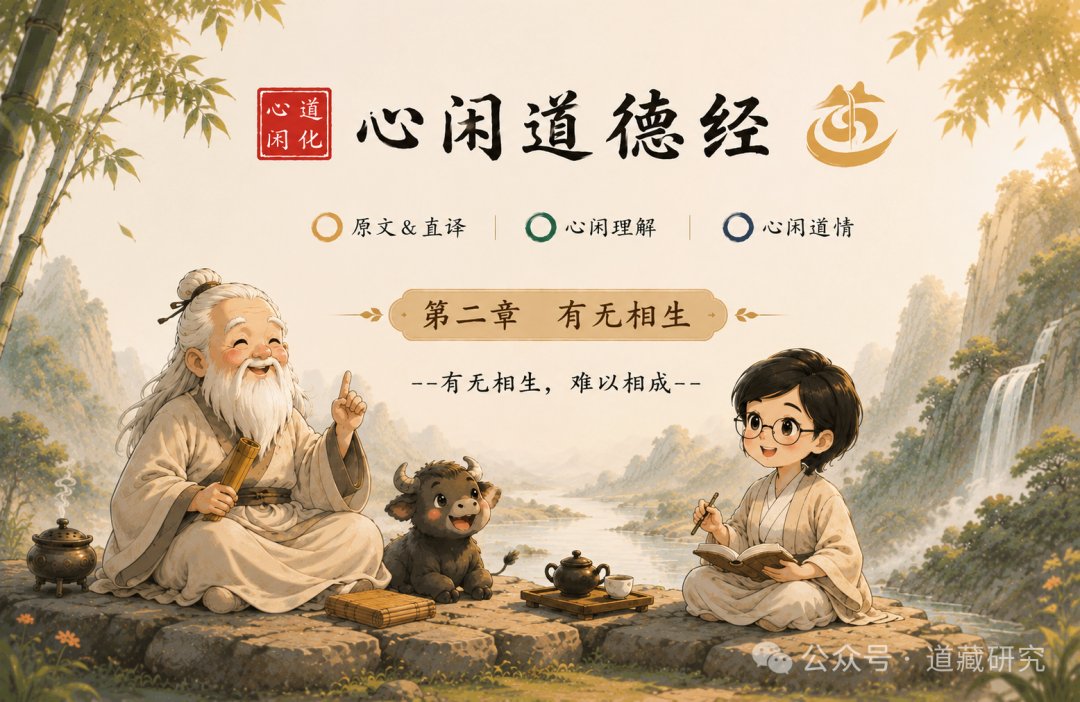
心闲道德经·第二章 有无相生
2、心闲道德经·第二章 有无相生
前注:今日,不想讲话。文章是之前写好的。直接上传。
一、原文与释义
原文
天下皆知美之为美,斯恶已。
皆知善之为善,斯不善已。
故有无相生,难易相成,长短相形,高下相倾,音声相和,前后相随。
是以圣人处无为之事,行不言之教。
万物作而弗始,生而弗有,为而弗恃,功成而不居。
夫唯弗居,是以不去。
译义
天下的人都知道什么叫“美”,那么“丑”的概念也就同时出现了。
大家都知道什么叫“善”,那么“不善”的概念也就同时出现了。

因此,有和无是相互生成的;
难和易,是相互比较才成立的;
长和短,是彼此对照才显现的;
高和低,是相互依存而形成的;
声音之间,因为彼此配合,才有和谐;
前与后,也总是在相互跟随中存在。
所以,真正懂得“道”的人,往往以“无为”的方式处理事情,以“不言”的方式教化众人。
万物生长变化,他不强行主宰;
创造了什么,却不据为己有;
做了事情,却不自恃其功;
事情成功了,也不把功劳据为自己的。
正因为他不居功,所以他的功绩反而不会消失。

二、心闲理解
这一章,其实是在讲宇宙最底层的一种运行逻辑。
老子发现,世界上的很多东西,并不是孤立存在的,而是彼此依存、彼此生成的。
没有“丑”,人就不会意识到什么叫“美”;
没有“低”,人也无法感知什么叫“高”;
没有寒冷,人很难真正理解温暖;
没有黑夜,白昼也不会显得明亮。
所以中国哲学特别重视“关系”。
它不像某些哲学体系那样,总在寻找一种绝对的、单边的答案。
中国古人更喜欢观察事物之间如何流转、如何变化、如何互相成就。
太极图为什么是一黑一白?
因为世界从来不是单边运行的。
春天里已经藏着秋意,花开时已经带着花落,
月最圆的时候,其实也已经开始走向亏缺。
这就是老子后来影响整个中国文化的一种思维:
物极必反。
阴阳互生。
盛极而衰。
循环往复。
所以《道德经》从来不只是一本“劝人谦虚”的书,它更像一本观察宇宙运行规律的书。
这一章里,还有一句特别容易被误解:
“圣人处无为之事。”
很多人一听“无为”,就以为什么都不做。
其实不是。
真正的“无为”,是不胡乱干预。
就像种树一样。
你不能今天拔一下看看长了没有,明天再拽一下看看高了没有。
很多事情,本身有它自己的节奏。

最厉害的医生,不是药越多越好。
而是知道什么时候该治,什么时候该养。
最厉害的管理者,也不是天天忙碌个不停。而是让整个系统自己运转起来。
低级管理靠控制。高级管理靠秩序。更高级的管理,靠“道”。靠团队的悟性与自觉创新。
老子最后说:
“功成而不居。”
很多人做了一点事,就急着证明自己。
反复强调“这是我做的”。生怕别人看不见自己的功劳。
但真正伟大的东西,往往都很安静。
太阳照耀万物,却从不邀功;大地承载众生,也从不要求感谢。
越接近“道”的东西,越自然。越真正强大的力量,往往越安静。
今天很多人的疲惫,并不完全来自劳累,而是来自不停比较。
别人比我成功。
别人比我年轻。
别人比我有钱。
别人比我更被认可。
于是人越来越紧。越来越多的人被裹挟着去“从众”,失去自我。
可老子这一章,其实一直在帮人“松”,把人找回自我认知与生命价值。
松掉执念。
松掉比较。
松掉那种必须时时证明自己的焦虑。
真正高级的人生,不一定永远站在最高处。
而是内心越来越稳定,越来越明白自己人生的方向。
你会发现,一个真正舒服的人,往往不是最张扬的人。
而是那个越来越自然的人。
这也是“道化心闲”一直想表达的一件事:
真正高级的生活,不是把人生过得越来越紧绷。
而是越来越自然,越来越从容。越来越有自己的特色与生命尊严。
三、心闲道情
道德经第二章
有无相生
天下皆知美为美,美中本有丑相随;
天下皆知善为善,善里也有不善陪。
有无本来彼此生,世事难易相互成;
长短若无相对照,怎知高下立其中。
山因谷底才高峻,海到深时不起风;
月满之时藏月缺,花开深处是枝空。
圣人不与世人争,处世无为似青松;
万物生化凭自然,不言之教起春风。
生而不有归天地,为而不恃淡其功;
正因大道不自夸,千秋犹似长明灯。
东海不言纳百川,昆仑不语自为峰;
道化心闲生清静,花香满院月满空。
后注:这个系列的文章上传后,同步上传该章道情到同名视频号。但今晚我在视频号上刚上传了一首《遮羞布》,所以。这首《有无相生》的道情,明天晚上再上传。又,不只一位读者朋友提醒我,在文章后面链接产品,我一直没学会怎么链接(哈哈,我写公众号超过十年了,还没学会这些)。大家若需要道家的本草产品,可前往“道化心闲官方旗舰店”(京东或天猫都有。或“道化心闲微信小店”。)出示关注截屏,可以有随单礼品,读者专享的。
心闲道德经·第二章 有无相生
前注:今日,不想讲话。文章是之前写好的。直接上传。
一、原文与释义
原文
天下皆知美之为美,斯恶已。
皆知善之为善,斯不善已。
故有无相生,难易相成,长短相形,高下相倾,音声相和,前后相随。
是以圣人处无为之事,行不言之教。
万物作而弗始,生而弗有,为而弗恃,功成而不居。
夫唯弗居,是以不去。
译义
天下的人都知道什么叫“美”,那么“丑”的概念也就同时出现了。
大家都知道什么叫“善”,那么“不善”的概念也就同时出现了。
因此,有和无是相互生成的;
难和易,是相互比较才成立的;
长和短,是彼此对照才显现的;
高和低,是相互依存而形成的;
声音之间,因为彼此配合,才有和谐;
前与后,也总是在相互跟随中存在。
所以,真正懂得“道”的人,往往以“无为”的方式处理事情,以“不言”的方式教化众人。
万物生长变化,他不强行主宰;
创造了什么,却不据为己有;
做了事情,却不自恃其功;
事情成功了,也不把功劳据为自己的。
正因为他不居功,所以他的功绩反而不会消失。

二、心闲理解
这一章,其实是在讲宇宙最底层的一种运行逻辑。
老子发现,世界上的很多东西,并不是孤立存在的,而是彼此依存、彼此生成的。
没有“丑”,人就不会意识到什么叫“美”;
没有“低”,人也无法感知什么叫“高”;
没有寒冷,人很难真正理解温暖;
没有黑夜,白昼也不会显得明亮。
所以中国哲学特别重视“关系”。
它不像某些哲学体系那样,总在寻找一种绝对的、单边的答案。
中国古人更喜欢观察事物之间如何流转、如何变化、如何互相成就。
太极图为什么是一黑一白?
因为世界从来不是单边运行的。
春天里已经藏着秋意,花开时已经带着花落,
月最圆的时候,其实也已经开始走向亏缺。
这就是老子后来影响整个中国文化的一种思维:
物极必反。
阴阳互生。
盛极而衰。
循环往复。
所以《道德经》从来不只是一本“劝人谦虚”的书,它更像一本观察宇宙运行规律的书。
这一章里,还有一句特别容易被误解:
“圣人处无为之事。”
很多人一听“无为”,就以为什么都不做。
其实不是。
真正的“无为”,是不胡乱干预。
就像种树一样。
你不能今天拔一下看看长了没有,明天再拽一下看看高了没有。
很多事情,本身有它自己的节奏。

最厉害的医生,不是药越多越好。
而是知道什么时候该治,什么时候该养。
最厉害的管理者,也不是天天忙碌个不停。而是让整个系统自己运转起来。
低级管理靠控制。高级管理靠秩序。更高级的管理,靠“道”。靠团队的悟性与自觉创新。
老子最后说:
“功成而不居。”
很多人做了一点事,就急着证明自己。
反复强调“这是我做的”。生怕别人看不见自己的功劳。
但真正伟大的东西,往往都很安静。
太阳照耀万物,却从不邀功;大地承载众生,也从不要求感谢。
越接近“道”的东西,越自然。越真正强大的力量,往往越安静。
今天很多人的疲惫,并不完全来自劳累,而是来自不停比较。
别人比我成功。
别人比我年轻。
别人比我有钱。
别人比我更被认可。
于是人越来越紧。越来越多的人被裹挟着去“从众”,失去自我。
可老子这一章,其实一直在帮人“松”,把人找回自我认知与生命价值。
松掉执念。
松掉比较。
松掉那种必须时时证明自己的焦虑。
真正高级的人生,不一定永远站在最高处。
而是内心越来越稳定,越来越明白自己人生的方向。
你会发现,一个真正舒服的人,往往不是最张扬的人。
而是那个越来越自然的人。
这也是“道化心闲”一直想表达的一件事:
真正高级的生活,不是把人生过得越来越紧绷。

而是越来越自然,越来越从容。越来越有自己的特色与生命尊严。

三、心闲道情
道德经第二章
有无相生
天下皆知美为美,美中本有丑相随;
天下皆知善为善,善里也有不善陪。
有无本来彼此生,世事难易相互成;
长短若无相对照,怎知高下立其中。
山因谷底才高峻,海到深时不起风;
月满之时藏月缺,花开深处是枝空。
圣人不与世人争,处世无为似青松;
万物生化凭自然,不言之教起春风。
生而不有归天地,为而不恃淡其功;
正因大道不自夸,千秋犹似长明灯。
东海不言纳百川,昆仑不语自为峰;
道化心闲生清静,花香满院月满空。
后注:这个系列的文章上传后,同步上传该章道情到同名视频号。但今晚我在视频号上刚上传了一首《遮羞布》,所以。这首《有无相生》的道情,明天晚上再上传。又,不只一位读者朋友提醒我,在文章后面链接产品,我一直没学会怎么链接(哈哈,我写公众号超过十年了,还没学会这些)。大家若需要道家的本草产品,可前往“道化心闲官方旗舰店”(京东或天猫都有。或“道化心闲微信小店”。)出示关注截屏,可以有随单礼品,读者专享的。
Xinxian Daodejing, Chapter 2: Being and Non-being Give Birth to Each Other
2. Xinxian Daodejing, Chapter 2: Being and Non-being Give Birth to Each Other
Prefatory note: Today I do not feel like talking. The article was written earlier. Uploading it directly.
I. Original Text and Explanation
Original text
When all the world knows the beautiful as beautiful, ugliness already is. / When all know the good as good, not-good already is.
Therefore being and non-being give birth to each other; difficult and easy complete each other; long and short shape each other; high and low incline toward each other; tone and sound harmonize with each other; front and back follow each other.
Therefore the sage dwells in the affairs of non-action and carries out the teaching of wordlessness. / The ten thousand things arise and he does not initiate them; he gives life and does not possess; he acts and does not presume upon it; the work is done and he does not dwell on it. / It is precisely because he does not dwell on it that it does not depart.
Translation of the meaning
All the people of the world know what "beauty" is, and thereupon the concept of "ugliness" appears at the same time. / Everyone knows what "goodness" is, and thereupon the concept of "not-good" appears at the same time.
Therefore being and non-being generate each other; / difficult and easy are established only through mutual comparison; / long and short appear only through mutual contrast; / high and low are formed by depending on each other; / among sounds, there is harmony only through mutual accord; / front and back, too, always exist in mutual following.
So the person who truly understands the "Dao" usually handles affairs in the manner of "non-action," and teaches the many in the manner of "wordlessness."
The ten thousand things grow and change, and he does not forcibly dominate them; / he creates something, yet does not take it as his own; / he does things, yet does not presume upon his merit; / the work succeeds, and he does not take the credit as his own.
Precisely because he does not dwell on his merit, his merit in fact never disappears.
II. Xinxian Understanding
This chapter is in fact about the most bedrock logic of how the universe runs.
Laozi discovered that many things in the world do not exist in isolation, but depend on one another and generate one another.
Without "ugliness," no one would become aware of what "beauty" is; / without "low," no one could perceive what "high" is; / without cold, it is hard truly to understand warmth; / without dark night, day would not seem bright.
That is why Chinese philosophy lays special weight on "relations."
It is not like certain philosophical systems, forever seeking one absolute, one-sided answer. / The ancient Chinese preferred to observe how things turn and pass among one another, how they change, how they bring each other to completion.
Why is the taiji diagram one part black and one part white? / Because the world has never run on one side only.
Within spring, autumn's meaning is already hidden; when flowers open, their falling is already carried in them; / when the moon is fullest, it has in fact already begun to turn toward waning.
This is a way of thinking by which Laozi later influenced the whole of Chinese culture:
Things reverse when pushed to the extreme. / Yin and yang generate each other. / Fullness at its peak turns to decline. / Round and round, in cycles, it returns.
So the Daodejing has never been merely a book "urging people to be humble"; it is more like a book that observes the laws by which the universe runs.
In this chapter there is also one line especially easy to misread:
"The sage dwells in the affairs of non-action."
Many people, the moment they hear "non-action," assume it means doing nothing at all. / It does not.
True "non-action" means not meddling at random.
It is like planting a tree. / You cannot pull at it today to see whether it has grown, and tug at it tomorrow to see whether it has gotten taller.
Many things have a rhythm of their own.
The greatest physician is not the one for whom the more medicine the better. / It is the one who knows when to treat and when to nourish.
The greatest manager, likewise, is not the one busy without pause every day. It is the one who lets the whole system begin to run on its own.
Low-level management relies on control. High-level management relies on order. Management at a still higher level relies on the "Dao" — on the team's insight and self-driven innovation.
Laozi says at the end:
"The work is done, and he does not dwell on it."
Many people, once they have done a little, rush to prove themselves, / repeating "I did this" over and over, terrified that others might fail to see their contribution.
But truly great things are usually very quiet.
The sun shines on the ten thousand things and never claims credit; the earth bears all living beings and never demands thanks.
The closer a thing is to the "Dao," the more natural it is. The truly stronger a force, the quieter it usually is.
Much of the weariness people feel today does not come wholly from toil; it comes from ceaseless comparison.
Others are more successful than I. / Others are younger than I. / Others are richer than I. / Others are more recognized than I.
And so people grow tighter and tighter. More and more people are swept along into "following the crowd," and lose themselves.
Yet this chapter of Laozi is, all along, helping people "loosen," bringing people back to self-knowledge and the value of their own lives.
Loosen the clinging. / Loosen the comparing. / Loosen that anxiety of having to prove oneself at every moment.
A truly elevated life does not necessarily stand forever at the highest point. / It is one in which the heart grows ever steadier, ever clearer about the direction of one's own life.
You will find that a person truly at ease is usually not the most flamboyant one. / It is the one who grows ever more natural.
This is also one thing that Daohua Xinxian has always wanted to express:
A truly elevated life is not one lived ever more tightly wound.
It is one ever more natural, ever more unhurried — with ever more character of its own, and ever more of the dignity of life.
III. Xinxian Daoqing chant
Daodejing, Chapter 2
Being and Non-being Give Birth to Each Other
All the world knows the beautiful as beautiful; within beauty, ugliness follows along; / all the world knows the good as good; within goodness, not-good keeps company too.
Being and non-being have always given birth to each other; the affairs of the world, hard and easy, complete one another; / without long and short set side by side, how could you know high and low standing there? / The mountain is lofty only because of the valley floor; when the sea reaches deep, no wind rises on it; / at the moon's fullest hour the waning is hidden; deep where the flowers open, the branch stands empty.
The sage does not contend with the people of the world; in non-action he carries himself like a green pine; / the ten thousand things live and transform by nature; the wordless teaching rises like a spring breeze. / He gives life yet claims nothing, returning it to Heaven and Earth; he acts yet presumes on nothing, his merit worn lightly; / precisely because the great Dao does not praise itself, for a thousand autumns it still burns like an ever-burning lamp.
The eastern sea says nothing and takes in a hundred rivers; Kunlun speaks not and is a peak all by itself; / Daohua Xinxian gives rise to clarity and stillness; flower-scent fills the courtyard, moonlight fills the sky.
Postscript: After the articles of this series are uploaded, the Daoqing chant for that chapter goes up in sync on the video account of the same name. But tonight I have just uploaded a "Zhexiu Bu" ("A Fig Leaf") on the video account. So. The Daoqing chant of "Being and Non-being Give Birth to Each Other" will be uploaded tomorrow evening. Also, more than one reader-friend has reminded me to link products at the end of the article; I still have never learned how to link (haha, I have written this official account for over ten years and still have not learned these things). If you need the Daoist herbal (bencao) products, you may go to the "Daohua Xinxian Official Flagship Store" (on JD or Tmall; or the "Daohua Xinxian WeChat store"), show your follow screenshot, and you can get a gift with your order — exclusive to readers.
Xinxian Daodejing, Chapter 2: Being and Non-being Give Birth to Each Other
Prefatory note: Today I do not feel like talking. The article was written earlier. Uploading it directly.
I. Original Text and Explanation
Original text
When all the world knows the beautiful as beautiful, ugliness already is. / When all know the good as good, not-good already is.
Therefore being and non-being give birth to each other; difficult and easy complete each other; long and short shape each other; high and low incline toward each other; tone and sound harmonize with each other; front and back follow each other.
Therefore the sage dwells in the affairs of non-action and carries out the teaching of wordlessness. / The ten thousand things arise and he does not initiate them; he gives life and does not possess; he acts and does not presume upon it; the work is done and he does not dwell on it. / It is precisely because he does not dwell on it that it does not depart.
Translation of the meaning
All the people of the world know what "beauty" is, and thereupon the concept of "ugliness" appears at the same time. / Everyone knows what "goodness" is, and thereupon the concept of "not-good" appears at the same time.
Therefore being and non-being generate each other; / difficult and easy are established only through mutual comparison; / long and short appear only through mutual contrast; / high and low are formed by depending on each other; / among sounds, there is harmony only through mutual accord; / front and back, too, always exist in mutual following.
So the person who truly understands the "Dao" usually handles affairs in the manner of "non-action," and teaches the many in the manner of "wordlessness."
The ten thousand things grow and change, and he does not forcibly dominate them; / he creates something, yet does not take it as his own; / he does things, yet does not presume upon his merit; / the work succeeds, and he does not take the credit as his own.
Precisely because he does not dwell on his merit, his merit in fact never disappears.
II. Xinxian Understanding
This chapter is in fact about the most bedrock logic of how the universe runs.
Laozi discovered that many things in the world do not exist in isolation, but depend on one another and generate one another.
Without "ugliness," no one would become aware of what "beauty" is; / without "low," no one could perceive what "high" is; / without cold, it is hard truly to understand warmth; / without dark night, day would not seem bright.
That is why Chinese philosophy lays special weight on "relations."
It is not like certain philosophical systems, forever seeking one absolute, one-sided answer. / The ancient Chinese preferred to observe how things turn and pass among one another, how they change, how they bring each other to completion.
Why is the taiji diagram one part black and one part white? / Because the world has never run on one side only.
Within spring, autumn's meaning is already hidden; when flowers open, their falling is already carried in them; / when the moon is fullest, it has in fact already begun to turn toward waning.
This is a way of thinking by which Laozi later influenced the whole of Chinese culture:
Things reverse when pushed to the extreme. / Yin and yang generate each other. / Fullness at its peak turns to decline. / Round and round, in cycles, it returns.
So the Daodejing has never been merely a book "urging people to be humble"; it is more like a book that observes the laws by which the universe runs.
In this chapter there is also one line especially easy to misread:
"The sage dwells in the affairs of non-action."
Many people, the moment they hear "non-action," assume it means doing nothing at all. / It does not.
True "non-action" means not meddling at random.
It is like planting a tree. / You cannot pull at it today to see whether it has grown, and tug at it tomorrow to see whether it has gotten taller.
Many things have a rhythm of their own.
The greatest physician is not the one for whom the more medicine the better. / It is the one who knows when to treat and when to nourish.
The greatest manager, likewise, is not the one busy without pause every day. It is the one who lets the whole system begin to run on its own.
Low-level management relies on control. High-level management relies on order. Management at a still higher level relies on the "Dao" — on the team's insight and self-driven innovation.
Laozi says at the end:
"The work is done, and he does not dwell on it."
Many people, once they have done a little, rush to prove themselves, / repeating "I did this" over and over, terrified that others might fail to see their contribution.
But truly great things are usually very quiet.
The sun shines on the ten thousand things and never claims credit; the earth bears all living beings and never demands thanks.
The closer a thing is to the "Dao," the more natural it is. The truly stronger a force, the quieter it usually is.
Much of the weariness people feel today does not come wholly from toil; it comes from ceaseless comparison.
Others are more successful than I. / Others are younger than I. / Others are richer than I. / Others are more recognized than I.
And so people grow tighter and tighter. More and more people are swept along into "following the crowd," and lose themselves.
Yet this chapter of Laozi is, all along, helping people "loosen," bringing people back to self-knowledge and the value of their own lives.
Loosen the clinging. / Loosen the comparing. / Loosen that anxiety of having to prove oneself at every moment.
A truly elevated life does not necessarily stand forever at the highest point. / It is one in which the heart grows ever steadier, ever clearer about the direction of one's own life.
You will find that a person truly at ease is usually not the most flamboyant one. / It is the one who grows ever more natural.
This is also one thing that Daohua Xinxian has always wanted to express:
A truly elevated life is not one lived ever more tightly wound.
It is one ever more natural, ever more unhurried — with ever more character of its own, and ever more of the dignity of life.
III. Xinxian Daoqing chant
Daodejing, Chapter 2
Being and Non-being Give Birth to Each Other
All the world knows the beautiful as beautiful; within beauty, ugliness follows along; / all the world knows the good as good; within goodness, not-good keeps company too.
Being and non-being have always given birth to each other; the affairs of the world, hard and easy, complete one another; / without long and short set side by side, how could you know high and low standing there? / The mountain is lofty only because of the valley floor; when the sea reaches deep, no wind rises on it; / at the moon's fullest hour the waning is hidden; deep where the flowers open, the branch stands empty.
The sage does not contend with the people of the world; in non-action he carries himself like a green pine; / the ten thousand things live and transform by nature; the wordless teaching rises like a spring breeze. / He gives life yet claims nothing, returning it to Heaven and Earth; he acts yet presumes on nothing, his merit worn lightly; / precisely because the great Dao does not praise itself, for a thousand autumns it still burns like an ever-burning lamp.
The eastern sea says nothing and takes in a hundred rivers; Kunlun speaks not and is a peak all by itself; / Daohua Xinxian gives rise to clarity and stillness; flower-scent fills the courtyard, moonlight fills the sky.
Postscript: After the articles of this series are uploaded, the Daoqing chant for that chapter goes up in sync on the video account of the same name. But tonight I have just uploaded a "Zhexiu Bu" ("A Fig Leaf") on the video account. So. The Daoqing chant of "Being and Non-being Give Birth to Each Other" will be uploaded tomorrow evening. Also, more than one reader-friend has reminded me to link products at the end of the article; I still have never learned how to link (haha, I have written this official account for over ten years and still have not learned these things). If you need the Daoist herbal (bencao) products, you may go to the "Daohua Xinxian Official Flagship Store" (on JD or Tmall; or the "Daohua Xinxian WeChat store"), show your follow screenshot, and you can get a gift with your order — exclusive to readers.