三分方,七分药;七分药里四分孝《食诫篇》(6)
6、三分方,七分药;七分药里四分孝《食诫篇》(6)
原创 杨子 道藏研究 2021-04-24
今天接着介绍陶弘景的《养性延命录》中第二章《食诫篇》的第6部分。下图为我点注的原文:
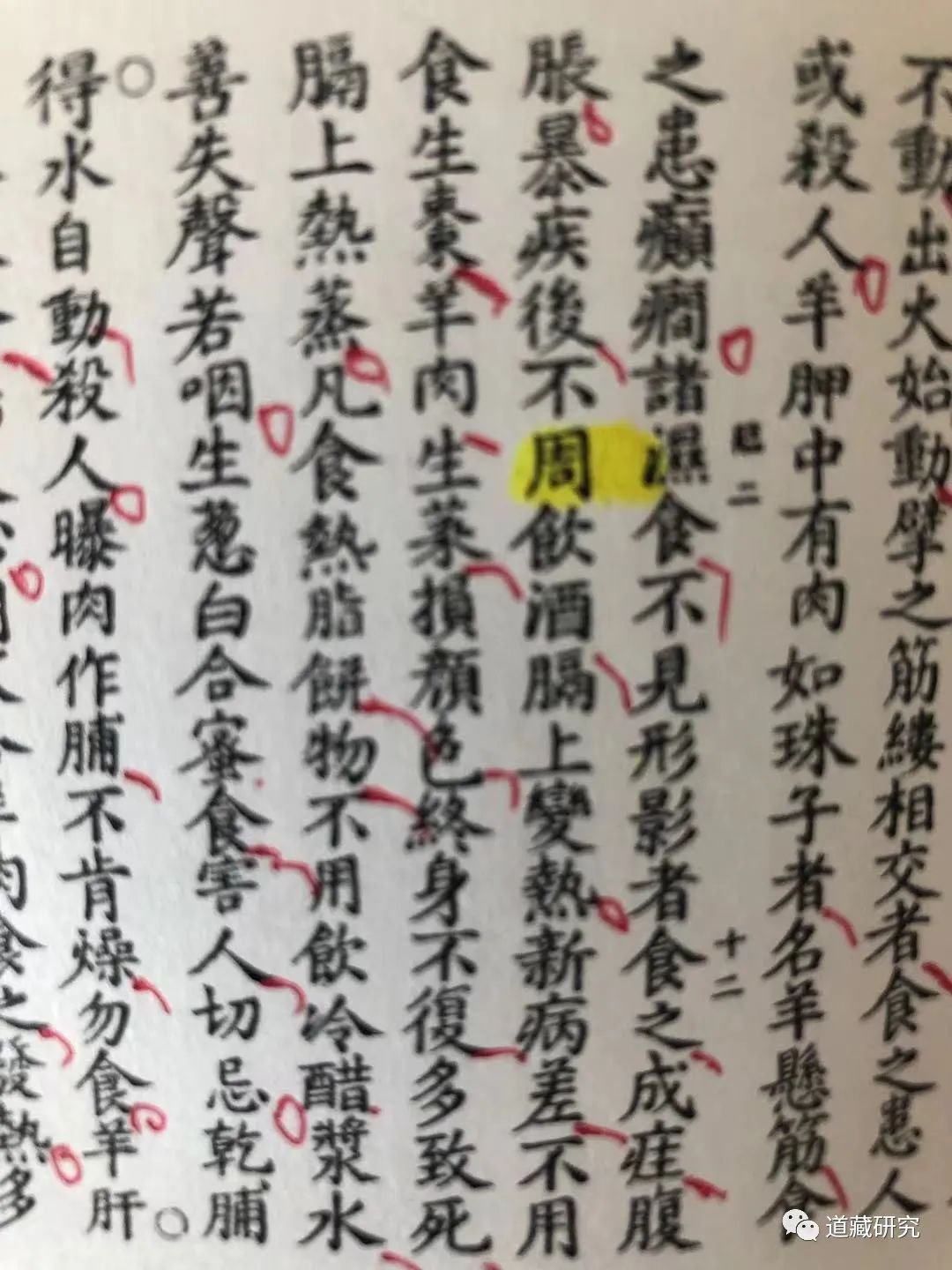
暴疾后不用饮酒,膈上变热。
注:“暴疾后不用饮酒”,这第一句就感觉不太通顺,《道藏》原文中,请看一下上面的图片,原文不是“用”,而是“周”,反复顺来顺去,就是“周”也不怎么通顺。相关文献资料显示,丁光迪先生校注本根据孙思邈的《千金要方》改为了“周”,在王文宏先生、崔志光先生、王家葵先生的校注中,也都改成了“用”字。我觉得也可能是《道藏》原文中的笔下误。但依然不好翻译。
大意是:大病治愈后的一段时间,不要饮酒,不然,会使膈膜发热。看来这个膈膜发热,是很不好的一种情况,会诱发各种疾病,所以古人特别重视这一点,什么样的情况会导致隔膜发热,都一一记录。之前的文中多处提到,不再重复。
新病差,不用食生棗(zao3,枣)、羊肉、生菜,损颜色,终身不复,多致死,膈上热蒸。
注:“新病差”,不好理解,但前面段落有提过成语“久病初差”,意思是病情有好转。大意是刚刚病愈,不要吃生枣,羊肉和生菜,吃了损伤面容颜色,以致终身不能康复,吃多的时候还可能因此死亡,或患膈膜上热气熏蒸病。这一点也是人们日常经常犯的禁忌。生病了,啥都吃不下,亲人们心疼坏了,病稍稍好转一点,可以吃点东西了,赶紧炖羊肉汤,补补,坏事了。这就是中医说的“虚不受补”,身子弱的人不益大补。羊肉是火力大的,容易上火的食品。羊,字形上与羊的两角相形有关,发音上与“阳”字同音。中国文字真是高深。

我们上海的邻居一家,很是良善。邻居家的奶奶对我女儿疼爱有加,她经常一手牵着自己的孙女,一手牵着我女儿,去买零食,并骄傲地跟小区邻居说:“我俩孙女!”孩子常寄在他们家吃喝玩乐,我们家的钥匙、车钥匙等都在他们家有一套备存(天津的邻居也一样。我所到之处,都是邻居给予亲情和安全感的,忘记钥匙都是去邻居家取)。“远亲不如近邻”这句话,我是最有体会的。我对邻居感情之深,超越语言。
为了孩子读书,有一年,我们又从天津迁回上海。回到家,开门,放下包。第一件事,就是直奔邻居家。却看到了邻家爷爷半躺在沙发上,气色大不如前。一问方知得了癌症。那是一位修养慈爱的老干部了,一生都和和气气,怎么就得了癌症?我一时呆住了,很难过,不知道怎么说。于是安慰说:“好好调养,化疗是消耗的,要注意饮食营养……”话音未落,奶奶和全家人都说,“就是‘喫挖特了’呀”(上海话,意思是吃坏了)。说是自从确诊,家里就变着花样吃,啥好吃啥,鱼啊、肉啊,甲鱼、羊肉等等,顿顿不断,后来医生说“补反了”,病情加重了……
不久,老爷子过世了。至今,我不敢电话去和他们家人谈及。怕伤心。在我的印象中,他是那位慈祥的老爷爷,总是跟我们家小狗说:“欢欢,走,爷爷带你下楼玩儿去”,于小狗欢快地跟着他下楼。我有时想,人与人之间的亲情,真的不是以“家”来论的。老爷子病后生前那种大补的饮食方法,却是值得我们引以为戒的。

凡食热脂饼物,不用饮冷醋、浆水,善失声若咽。生葱白合蜜食害人,切忌。
注:凡吃热油脂饼,不要同时喝以醋调和的冷饮,容易使咽喉受损而造成声音嘶哑甚至失声。生葱白不要与蜂蜜合着吃,那样吃会伤害人,切忌!切忌!。这一点我前一段发的文章中有提过,不再重复。
干脯得水自动,杀人。曝肉作脯,不肯燥,勿食。

注:浸泡在水里的干肉会自行动作的,不能吃,吃了会致人死命。晒肉做成肉脯,一直不干的,那块肉不能吃。这两条我开始不能理解,后查了肉脯制作工艺,推理一下似乎明白了。肉脯是将肉弄碎,干燥后压制而成的。估计生肉里可能有寄生虫,古人制作肉脯可能是晒干或风干的,压制后再上火烘烤。这一过程中,可能会有寄生虫杀不死的现象。如果有寄生虫,上火烘烤时,为求生,那些聪明的虫子会躲在最坚硬的里层,或有筋的地方,不会动。但如果放到水中,寄生虫开始活动,所以,这样的肉脯就有问题,吃了可以要人命。因为这样顽强生命的寄生虫,到了人体内,那就是大祸害。
还有,就是晒干的肉做的肉脯,如果不晒干透,里面有水分,寄生虫还有生存空间,还活着,所以也不能吃。于是我就联想到现在有人吃烤羊肉串或其他烤肉的人,说容易拉肚子,是因为烧烤这个烹饪工艺,就是肉遇火或烘烤高温迅速出油,容易在表层产生一层焦衣,对内部产生保护,表面上看起来熟了,但不足以全部杀死最里层的寄生虫。所以,吃烤肉时,一定要拿生大蒜一起食用,可以同步消毒灭虫。一些上了年纪的人,越来越不喜欢吃烤肉,牙齿不好或许是一个原因,但更深层次的原因是,他们大半辈子的饮食经历,正潜在地告诉他们哪些食物可能有风险,这是人的意识对食物本能的认知。

翻译这段时,我也不由自主地想到了腊肉,于是查了一下制作流程,在腌制后下水煮时,一般要求的温度不超过80度,这就是风险,有些生命力顽强的寄生虫可能杀不死。所以,尽量不要生吃腊肉。包括一些生鱼干等等,凡是肉类的东西,寄生虫都比较顽强,尽量不要给小孩子吃。聪明的寄生虫最爱钻人脑子。凉拌菜,无论荤素,都加点蒜汁是有道理的,调味,更消毒杀菌。有时加点醋,也是消毒并清理肠道的作用。中国人的吃,真是大有学问。
肝勿合椒食,伤人心。胡瓜合羊肉食之发热。

注:羊的肝脏不能混合着花椒、胡椒吃,那样吃了会损伤人心。羊肉本身火力大,肝主火,更厉害,椒类的香料都是升阳气的,合在一起火力十足,不烧心才怪。胡瓜,查了资料,就是现在的黄瓜,不能和羊肉一起吃,会使人发热。这么说我们很多常识缺乏,我看到饭店里羊肉还经常配凉拌黄瓜,从道理上看,一个热性,一个凉性,中和一下挺好的。但就是不明白为什么美食过后身体不舒服。原来如此。古人都告诉我们了,只是这些书我们不重视。
如果人人都把古人的养生书当成必读书,可以少生很多病,每个家庭省几十万医疗费没问题。最近看到一段小视频,说有人调查统计,很多老年人在生命的最后28天,会花掉他一生80%的积蓄。听起来很可怕,调查方法从何而来不得而知,估计调查对象可能是偏于某个群体吧。但想了想,如果最后死在ICU,短期内花掉一生大部分积蓄可不是个困难的事。ICU,好家伙!谁进去谁知道(领导干部待遇的患者不在此列)。入院就不要谈钱了,说钱如纸并不过份。很多人因为进了ICU,花尽自己的所有积蓄,还给子女留下一笔医疗债务,网上太多的文章在说“因病致贫”。因为一些贵重的药品,并不在医保范围,而抢救的时刻,或生命的最后时刻,亲人是不会心疼钱的。近些年,国家花了不少力气在解决这个问题,越来越多的药品在纳入医保范围。但ICU有多受罪,实在不忍下笔。

听说,ICU与普通门诊之间,小医院与大医院之间,县城医院与大城市医院之间的业务关系,就是一个不可描述的产业链。一线业务医生,中间提供救护车的专业团队(转院必须乘坐),接手的医生,医药、医疗设备提供商等等,完整的体系,心照不宣的利益合作。一些三、四线城市的医院,或许早晚会有一次大的整顿。农民和那些弱者的生命没有尊严,死也就死了,他们不懂专业,也投诉无门,愤怒悲伤也只能忍着,靠时间慢慢的抚平伤口。但日子久了,政府会收拾。最近北京一名三甲医院的肿瘤医生实名举报肿瘤治疗中的不德和对生命的无视,引起社会高度关注,有关部门说会严肃调查。这就是社会的自净功能。当一个群体中有操守的人,实在受不了同行的行为时,会牺牲自己对行业内的生存机会,勇敢挑脓包。这就是职业良知。我们这个社会实在不缺有良知的人,但实在缺少有胆量的人。或者说,我们的社会对有胆量的人保护不够,使得大多数人不敢对不德说“不”。
这种事情不是某一个领域专有。去年曾听一位业内朋友说,他们从福州过来厦门调查一个事情,一个小和尚实名举报他们的当家大和尚,“不会念经,并过度收受信众的红包”。经查实,果然,那位有众多信徒的“法师”, 除了“阿弥陀佛”四个字之外,真的不会一句佛经。一个和尚不会念经,让人唏嘘不已。

本公众号的读者群可能普遍富有一些,或许觉得“因病致贫”的说法有些夸张。但试想一下,农村,农民的收入与现在医院的消费水平挂钩对比一下,就不难理解。社会地位及机遇的原因,我们中大多数的人生活得到改善,长期的不愁温饱,会使我们淡忘生之艰辛,不知不觉间变得喜欢批评、指责和对弱者的漠视,就是因为很少移情换位到对方的立场去思考一下,从而慢慢的淡漠了本有的同情心。其实,在中国大部分的农村和偏远山区,很多人过的日子,不是城里生、城里长的人可以想像的艰难和心酸。
……(此处略去四段)
关于羊肉,很重要。因为本章中之前有详细说千万不能吃“羊悬筋”,这里就不提了。咱们接着聊羊肉。
因为怕羊肉的膻味,我一般不吃羊肉,尽管知道自己是体寒的体质,吃羊肉汤非常适合,特别是冷的。张仲景在《金匮要略》中记载了一个著名的药膳:“当归生姜羊肉汤”,
组方:当归三两(9g),生姜五两(15g),羊肉一斤(500g)。用法:上三味,以水八升,煮取三升,温服七合,日三服。功用:补养精血,散寒止痛。
主治:寒疝腹中痛及胁痛里急者;产后腹痛,腹中寒疝,虚劳不足。

当然,这是个底方。根据不同的情况,可以适当地加减化裁。很是灵活方便。中国的食疗方子,是不是可以打包申请一下人类文明遗产呢?又滋补身体又治病的药膳,真是一种神奇的发明创造。这是我们文化中的瑰宝,更是中华民族对全世界营养饮食及健康长寿的伟大贡献。
就这个方子而言,可是我们文化中国宝级的滋补佳品,好处多多,体寒的人最适合了,特别是产妇,补养精血,散寒止痛。
……
古人的观点,伺候病人、伺候月子一定是最至亲的人,是有道理的。
比如煎药这件事,在古代都是“孝子熬药”。最孝顺的孩子去给父母熬药,我特别赞同这个“熬”字。虽然“煎、熬”二字差不多,但细品来,“煎”字总觉得有些焦灼烦躁之意,而“熬”字,则有一些期待在其中,即有“熬盼”的意思。一个小火炉,红通通的火,加是子女孝感动天的虔诚,强化了药力,武火炖、文火煨,孝子的心力和本草一起接受水火的煎熬,经过漫长的过程,最后,一锅汤水浓缩为一小碗粘稠的中药,喝起来格外的苦,苦到粘牙,这种煎药就是抓出了本草的精华。而“良药苦口”正是由此而来。
如果是不孝顺的孩子或不亲的人煎药,就没有耐心,大火烧开,滚上几滚子,马马虎虎,就行了,药汤稀稀拉拉的一大碗,还很清澈,好喝,又不苦,就是不管用,背后还嘀咕医生没本事。

“三分方,七分药;七分药里四分孝”,说的就是,一个好方子要管用,关键是靠药力,包括熬药技术。中药最讲究道地药材,就是这个原因。人们常说,中国人普遍信中医,年纪越大越信。但人们生了病,一般不到西医宣布不治了,还不去找中医。为什么?嫌慢。人们也知道,不是中医的方子不好,而是现在中药材的功效不如从前了。所以,恢复中医与重视中草药是同步的。而一副药能不能拿病,还有一个关键,就是熬药,这个是最容易忽略的环节。如果喝中药不管用,别全部怪中医和本草,选对熬药人也是很关键的。
这就是古人为什么要坚持一定要“孝子熬药”的原因,一个“熬”字,说倾尽孝心,道尽亲情……
Three Parts Prescription, Seven Parts Medicine; of the Seven Parts of Medicine, Four Parts Filial Devotion "Food Precepts" (6)
19. Three Parts Prescription, Seven Parts Medicine; of the Seven Parts of Medicine, Four Parts Filial Devotion "Food Precepts" (6)
Originally published by Yang Zi, Daozang Research, 2021-04-24
Today I continue presenting Part 6 of the second chapter, "Food Precepts," of Tao Hongjing's Yangxing Yanming Lu. Below is a photo of the original with my punctuation and notes:
After a sudden illness do not drink wine; it turns into heat above the diaphragm.
Note: "After a sudden illness do not drink wine"--this first sentence already feels not quite smooth. In the Daozang (Daoist Canon) original, please look at the picture above: the text does not read "yong" but "zhou"; yet turn it over and over, and "zhou" is not smooth either. Related reference material shows that Mr. Ding Guangdi's collated and annotated edition, on the basis of Sun Simiao's Qianjin Yaofang, emended it to "zhou," while in the collations of Mr. Wang Wenhong, Mr. Cui Zhiguang, and Mr. Wang Jiakui, all emend it to the word "yong." I suspect it may be a copyist's slip in the Daozang (Daoist Canon) original. But even so it is not easy to translate.
The gist is: for a spell after a serious illness has been cured, do not drink wine, or it makes the diaphragm hot. It seems this heating of the diaphragm is a very bad state that induces all sorts of illnesses, which is why the ancients set such store by it, recording one by one every sort of circumstance that can make the diaphragm hot. I have mentioned it in several places in earlier pieces; I will not repeat it.
When a new illness has just improved, do not eat raw jujubes, mutton, or raw vegetables; it damages the complexion, which never returns for the rest of one's life, in many cases brings death, and steams heat above the diaphragm.
Note: "A new illness just improved" is not easy to grasp, but an earlier passage mentioned the idiom "a long illness first taking a turn," meaning the illness has improved. The gist: just after recovering, do not eat raw jujubes, mutton, or raw vegetables; eating them injures the color of the face so that one never recovers for life, and eating much of them may even bring death, or the illness of hot qi steaming above the diaphragm. This too is a taboo people constantly break in daily life. When someone is ill and can eat nothing, the family is beside itself with worry; then the illness improves a little and the patient can take a bite, so they hurry to stew mutton soup to "tonify"--and that spoils it. This is what Chinese medicine calls "the deficient cannot receive tonics": a weak body should not have heavy tonification. Mutton is a food of great fire-power, apt to raise internal heat. The character for sheep is shaped after the two horns of a sheep, and in sound is homophonous with the word "yang." Chinese writing is truly profound.
Our neighbors in Shanghai were a most kindly family. The grandmother next door doted on my daughter; she would often lead her own granddaughter with one hand and my daughter with the other to buy snacks, and say proudly to the neighbors in the compound: "My two granddaughters!" The child was often left in their house to eat and play, and they kept a spare set of our house and car keys (the neighbors in Tianjin were the same; everywhere I have lived, it is neighbors who have given me family feeling and a sense of safety, and whenever I forgot my keys I went to the neighbors to fetch them). Of the saying "a distant relative is not as good as a near neighbor" I have had the fullest experience. My feeling for neighbors runs deeper than words.
For the sake of the child's schooling, one year we moved back from Tianjin to Shanghai. Home, open the door, put down the bags. The very first thing was to go straight to the neighbors' house. But there I found the grandfather next door half lying on the sofa, his color much faded. Asking, I learned he had cancer. He was a cultivated and kindly old cadre, gentle and agreeable all his life--how had he come to cancer? I was struck dumb for a moment, very sad, not knowing what to say. So I comforted him: "Do take care with your recuperation; chemotherapy is draining, you must mind the nutrition in your diet..." Before the words were out, the grandmother and the whole family said, "It is just 'chieh wa te le' ah" (Shanghainese, meaning the eating did him in). Since the diagnosis, they said, the family had cooked every which way, the best of everything, fish, meat, soft-shelled turtle, mutton and so on, meal after meal without a break; later the doctor said "the tonifying went the wrong way," and the illness grew worse...
Not long after, the old gentleman passed away. To this day I do not dare phone the family and speak of it, for fear of wounding them. In my memory he is that kindly old grandfather, always saying to our little dog: "Huanhuan, come, grandpa will take you downstairs to play," and the pup frisking along downstairs after him. I sometimes think the affection between people truly is not measured by "family." But the way of heavy tonics in his diet after he fell ill is something we would do well to take warning from.
Whenever one eats hot fatty cakes, one should not drink cold vinegar or starch water with them; it readily costs one the voice, as if something stuck in the throat. Raw scallion whites eaten together with honey harm a person; strictly avoid it.
Note: Whenever eating hot fatty cakes, do not at the same time drink cold drinks mixed with vinegar; it easily injures the throat and leaves one hoarse or even voiceless. Raw scallion whites must not be eaten together with honey; eating them that way harms a person. Strictly avoid it! Strictly avoid it!. I mentioned this in a piece I posted a while ago and will not repeat it here.
Dried meat that moves of itself when it gets water kills a person. Meat set out in the sun to make preserved meat that refuses to dry must not be eaten.
Note: Dried meat that stirs of itself when soaked in water must not be eaten; eating it will cost a person his life. Dried meat made from meat set out in the sun, if it will not dry, that piece of meat must not be eaten. These two I could not understand at first; later I looked into how preserved meat is made, reasoned it through, and seem to have understood. Preserved meat is made by mincing meat, drying it, and pressing it. I suppose raw meat may contain parasites; the ancients probably made preserved meat by sun-drying or air-drying, then pressed it and roasted it over fire. In that process there could be parasites not killed. If there are parasites, then when it goes over the fire to roast, the clever creatures, seeking to live, will hide in the hardest inner layer or in the sinewy places, and will not move. But put it in water and the parasites begin to stir--and so such preserved meat is trouble, and eating it can cost a life. Because parasites of such stubborn vitality, once inside the human body, are a great calamity.
Then too, preserved meat made from sun-dried meat, if it is not dried through and still holds moisture, leaves the parasites room to live, still alive, and so it too must not be eaten. This makes me think of people today who eat grilled lamb skewers or other roast meats and say it easily gives them diarrhea: it is because in roasting, the meat meets fire or high heat and quickly renders its fat, easily forming a charred skin on the surface that protects the inside; on the surface it looks cooked, but it is not enough to kill every parasite in the innermost layer. So when eating roast meat, be sure to eat raw garlic along with it, which disinfects and kills the parasites at the same time. That some older people grow less and less fond of roast meat may have something to do with their teeth, but the deeper reason is that a lifetime's experience of food is quietly telling them which foods may carry risk--this is the mind's instinctive knowledge of food.
Translating this passage, I could not help thinking of cured meat, so I looked up its making: after salting, when it is boiled in water, the temperature is generally required not to exceed 80 degrees--that is the risk; some parasites of stubborn vitality may survive. So try not to eat cured meat raw, including raw dried fish and the like; in anything of meat, the parasites are hardier, so try not to give them to small children. Clever parasites most love to bore into the human brain. With cold dressed dishes, whether meat or vegetable, adding a little garlic juice makes sense--for the flavor, and still more to disinfect and kill germs. Sometimes adding a little vinegar too serves to disinfect and clear the gut. There is truly great learning in the Chinese way of eating.
Liver must not be eaten together with pepper; it harms a person's heart. Hu gua eaten together with mutton brings on fever.
Note: A sheep's liver must not be eaten mixed with Sichuan pepper or black pepper; eating it that way injures a person's heart. Mutton itself is of great fire-power, and the liver governs fire and is stronger still; peppery spices all raise yang qi, so together the fire is full-blast--no wonder it burns the heart. Hu gua, I looked it up, is the cucumber we have today; it must not be eaten with mutton, for it makes a person feverish. Which shows how much common knowledge we lack: I see restaurants still serving mutton alongside cold dressed cucumber, and in principle one hot and one cool, balancing each other nicely. And then one cannot think why the body feels unwell after a fine meal. So that is why. The ancients told us all of it; it is only that we set no store by these books.
If everyone made the ancients' books on nourishing life required reading, a great many illnesses could be avoided, and every family saving several hundred thousand in medical bills would be no problem. Recently I saw a short video saying that, by someone's survey and statistics, many old people in the last 28 days of life spend 80 percent of all the savings of a lifetime. It sounds frightening; where the survey method came from is unknown, and I suspect the sample may have leaned toward a particular group. But thinking it over, if one ends in the ICU, spending most of a lifetime's savings in a short time is no hard thing. The ICU--good heavens! Whoever goes in knows (patients with the treatment accorded leading cadres excepted). Once admitted, do not speak of money; to say money is like paper is no exaggeration. Many people, because they went into the ICU, used up all their savings and left their children a medical debt besides; too many articles online speak of "impoverishment through illness." Because some costly drugs are not within the medical insurance scope, and at the moment of rescue, or at the last moment of life, family will not grudge the money. In recent years the state has spent no little effort on this problem, and more and more drugs are being brought into medical insurance. But how much suffering the ICU holds I truly cannot bear to write down.
I hear that the business relations between the ICU and ordinary outpatient care, between small hospitals and large hospitals, between county hospitals and big-city hospitals, form an industry chain that cannot be described: front-line doctors, the professional teams in the middle providing ambulances (a transfer must go by ambulance), the doctors who take over, the suppliers of drugs and medical equipment, and so on--a complete system, a tacit partnership of interests. In some third- and fourth-tier cities, sooner or later there may be a great rectification. The lives of peasants and of the weak have no dignity; they die and that is that, for they do not understand the profession and have nowhere to complain, and their anger and grief can only be borne, slowly smoothed by time. But when enough days have passed, the government will set things right. Not long ago an oncologist at a grade-A tertiary hospital in Beijing reported under his real name the unvirtuous conduct and disregard for life in cancer treatment, which drew close public attention, and the authorities said they would investigate seriously. This is society's function of cleansing itself. When people of principle in a group truly can no longer bear the conduct of their colleagues, they sacrifice their own chances of getting on in the trade and bravely lance the boil. This is professional conscience. Our society truly does not lack people of conscience, but truly lacks people of courage. Or rather: our society does not protect the courageous enough, so that most people dare not say "no" to what is unvirtuous.
This sort of thing is not the property of any one field. Last year an acquaintance in the trade told me they had come from Fuzhou to Xiamen to look into a matter: a young monk had reported under his real name the abbot, their head monk, for "not knowing how to chant the sutras and taking too many red envelopes from the faithful." When they checked, sure enough, that "Dharma master" with his many devotees, apart from the four Chinese characters for "Amitabha," truly could not recite a single line of scripture. A monk who cannot chant the sutras--one cannot help but sigh.
The readership of this WeChat official account is probably rather well off on the whole, and may feel the phrase "impoverishment through illness" is something of an exaggeration. But just try setting the income of the countryside and of peasants against the level of hospital costs today, and it is not hard to understand. Because of social position and opportunity, most of us have seen our lives improve, and long freedom from worry over food and clothing makes us forget the hardship of living; unawares we grow fond of criticizing, of blaming, and of indifference to the weak, simply because we seldom shift our feeling into the other's place and think from that standpoint, and so little by little we dull the compassion we originally had. In fact, in much of China's countryside and remote mountains, many people live a hardship and a heart-soreness that those born and raised in cities cannot imagine.
...... (four paragraphs omitted here)
About mutton: it is important. Because earlier in this chapter I explained in detail that on no account must one eat "the sheep's hanging sinew," I will not bring it up here. Let us go on talking about mutton.
Because I fear the muttony smell, I generally do not eat mutton, though I know my constitution is cold-natured and mutton soup suits me very well, especially in cold weather. Zhang Zhongjing records a famous medicinal dish in Jingui Yaolue: "Danggui Shengjiang Yangrou Tang,"
Composition: danggui three liang (9g), fresh ginger five liang (15g), mutton one jin (500g). Usage: the three ingredients above, with eight sheng of water, boil down to three sheng; take seven ge of the warm decoction, three times a day. Function: to supplement and nourish essence and blood, disperse cold, and stop pain.
Indications: cold-shan with abdominal pain, flank pain, and abdominal tightness; postpartum abdominal pain, cold-shan in the belly, and deficiency debility.
Of course, this is a base formula. According to different circumstances one may add, subtract, and modify it appropriately; it is most flexible and convenient. Might China's dietary-therapy formulas be packaged up and applied for as a heritage of human civilization? A medicinal dish that both nourishes the body and treats illness is truly a wondrous invention. It is a treasure of our culture, and still more the great contribution of the Chinese nation to the nutrition, diet, health, and long life of the whole world.
As for this particular formula, it is a national-treasure-grade tonic of our culture, with benefits beyond count, most suited to the cold-natured, and especially to women after childbirth: it nourishes essence and blood, disperses cold, and stops pain.
......
The ancients' view that tending the sick and tending a woman in her lying-in month must be done by the very closest kin has good reason behind it.
Take the decocting of medicine. In ancient times it was always "a filial son decocts the medicine"--the most filial child went to decoct it for the parents. I especially approve of that word "ao." Though the two words "jian" and "ao" are much alike, savored closely, "jian" always carries a hint of scorched anxiety, while "ao" holds a measure of expectancy, the sense of "ao pan," waiting through. A little stove, red-glowing fire, and added to it the sincerity of a child's filial devotion that moves heaven: it strengthens the power of the drug. Boiled over fierce fire, simmered over gentle fire, the filial son's heart-strength and the materia medica undergo the trial of water and fire together; through the long process, at last a pot of liquid is reduced to one small bowl of thick, sticky Chinese medicine, extraordinarily bitter to drink, so bitter it clings to the teeth. This is decocting that has drawn out the essence of the materia medica. And "good medicine is bitter in the mouth" comes precisely from this.
If an unfilial child or someone not close decocts it, there is no patience: a blazing fire to bring it to a boil, a few rolls, careless and done. The decoction is a big thin, watery bowl, quite clear, easy to drink and not bitter--and simply does not work; and behind your back they mutter that the doctor is no good.
"Three parts prescription, seven parts medicine; of the seven parts of medicine, four parts filial devotion" speaks of this: for a good formula to work, the key lies in the strength of the medicine, and that includes the art of decocting. Chinese medicine sets the greatest store by genuine regional medicinal materials--for just this reason. People often say the Chinese generally trust Chinese medicine, and the older they grow the more they trust it. Yet when people fall ill, as a rule they do not go to Chinese medicine until Western medicine has declared the case incurable. Why? Because it is slow. People also know it is not that Chinese prescriptions are bad, but that the efficacy of Chinese medicinal materials today is not what it was. So restoring Chinese medicine and valuing Chinese herbs go hand in hand. And whether a dose of medicine can bring the illness under control has one more key--decocting--and this is the link most easily overlooked. If Chinese medicine does not work, do not blame Chinese medicine and the materia medica for all of it; choosing the right person to decoct it is crucial too.
This is why the ancients insisted it must be "a filial son decocting the medicine." The one word "ao" speaks filial devotion poured out to the full, and tells family feeling to the end......