古人的生发、白转黑“换髭法”
3、古人的生发、白转黑“换髭法”
上一篇文章分享了一些古人生发的方子,后台大家问的最多的是白转黑。今天就说说古人乌发的一些方法。
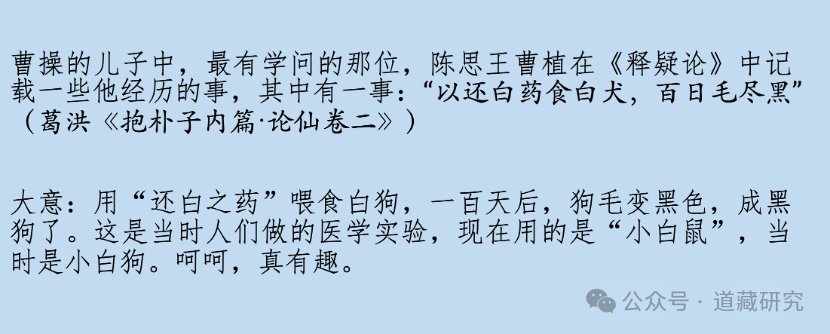
这个插图,是本公众号过去文章的截屏。里面曹植记录的小白狗服用了“还白药”,一百天变成了小黑狗。我于是好奇这个“还白药”的配方。查找了好几年,我经常把从《道藏》中查到的相关文献互参。
古人乌发,大体以下几种方法:物理方法、白转黑换发、本草染发、本草洗发、食疗乌发。今天先说前两种。
一 物理方法
简单说,就是通过导引、按摩、梳理等方式,对头皮施加外力,促进头皮的血液循环,改善头皮生态,促进毛囊健康,从而助力生发乌发。
比如南北朝时期的陶弘景,在《养性延命录》中就记载不少好方法。我在《握固之法---导引按摩篇第五(1)》中有介绍他的握固养生理论。他说握固是“固精、明目、留年、还白之法”,这简直就是全能养生。握固,就是把四指握住大拇指,这是生命的本能。婴儿在娘胎中,及出生后一段时间都一直是握固状态,因为人的魂魄藏在大拇指的内侧,藏魂守魄最是养生。在道门,胎息与握固是都是属于模仿胎儿形态的炼养方法,外国人在修练时表述为“fetal breathing and clenching exercise”。另外,道士日常修行及道场仪式中,也常用握固法,以达到收魂制魄、保精固神的功效。
在养生学的概念里,握固是生命力的一种状态。胎儿及婴儿,虽然筋骨都软软的,但小拳头都是紧攥着,牢牢守住自己的魂魄,表现了极强的生命力。这就是老子说的:“骨弱筋柔而握固”,人的生命到了尽头,就握不起来了,所以才说是“撒手而去”。道家修炼的方法中,胎息握固,就是不断还原婴儿的状态,老子描述的一种得道的境界:复归于婴儿,复归于朴。
陶弘景记录的“还白之法”之一,就是握固。下图截屏过去的内容解释一下握固。握固可以让白头发变黑,需要长期持续的坚持。偶尔握一两下是没用的。
另外,他还说:
晨夕以梳梳头满一千梳,大去头风,令人发不白。梳讫,以盐花及生麻油搓头顶上,弥佳。如有神明膏,搓之甚佳。(《养性延命录卷下》《华阳陶隐居集》)
注:早晚梳头一千梳,可以让头发不白。梳完再涂点麻油,亮油油的,像是涂了神明膏。古代的麻油除了食用,还可当头油或点灯用的。现代人吃的营养太丰富了,年轻人头上本来就油腻多,早不需要头油了。烫染受损发质,如果毛躁,一般用护发素解决,也不用头油了。但他这个早晚梳头一千下可保头发不白的方法,却是值得借鉴的。
李时珍也曾说过“指梳百会,犹如春雷惊百虫”,爱养生的人都知道百会穴在哪里,李时珍意思是用手指去梳理百会,象是春雷一样,能唤起头皮的生命力。都是通过物理方式让头皮更健康。
三 换发
古人说的白转黑,两种处理方式,一种通过食疗生发(后面我会分享古方),另一种是通过本草洗发水,把已经白的头发慢慢转成黑色,这种方法没有特别速效的,需要耐心,本草洗发的最大优势就是安全,以及对头皮的修复与调养,头皮好了,头发好才有可能。就如土壤修复与庄稼生长的关系。
白转黑有一种比较快的方法,就是把白发拔掉,在白发生长的毛囊中植入营养本草,改变毛囊的生长素,于是那个毛囊再生出来的头发就成了黑色的。如果不作植入,即使是拔掉白发,再生出来的头发,依然是白色的。因为毛囊根底的生长素已是白色的。那么他们是怎么植入的呢?
“换髭法”
“莲子草(一两)、没石子(五枚)、母丁香(十枚)、猪粪灰(一两)、酸石榴皮(一枚),上都捣,罗为末,用生姜自然汁和,瓷盒内盛,以东引柳枝子,点于白髭下,点药了,便拔。”
注:这个方子中的本草都比较易得。东引柳枝子,就是往东边方向生长的柳枝子。这个是有道理的。我曾读到过一个东晋葛洪《肘后备急方》中的生发方子,用的是“东行槡根”,我开始还纳闷,槡根就槡根了,怎么还东行槡根呢?后来看得方子多了,总结出了共性,就明白了,东行,就是往东边伸展的,为什么向东生长的更有用呢?因为太阳从东方升起,向着太阳生长的,都是生命力旺盛的。家里养花、院子里种菜的朋友可以观察一下自己养的植物,是不是有这样的特点。凡是朝着太阳的向上伸展枝叶,都是比较茁壮的。这里的东引柳枝子,就是这个原因。只是一看到有猪粪灰,就知道这个原材料不容易得了。在古代,猪,作为家畜,是很常见的,所以猪粪很容易见到。现在不容易了。这个实验,我没做过。
这个方子因为有猪粪,估计大家不想试。那就分享一个单味本草的方子,下图是我点注的《道藏》原文:
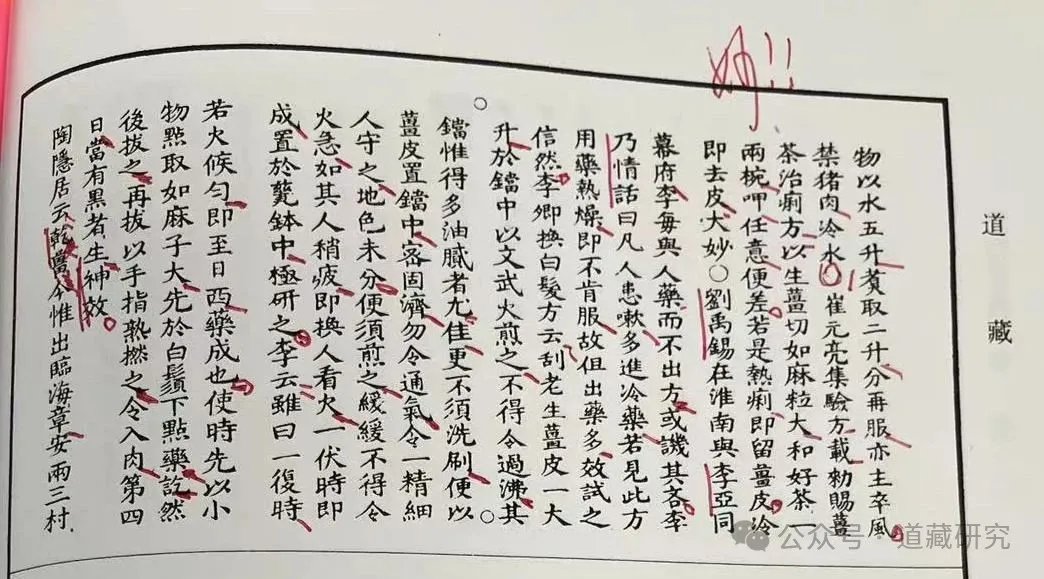
换白变黑方
“老生姜皮一斤。”“至于油腻不洁锅中。密盖之。勿令通气。令一精细人。曙色未分。便须缓煎之。尽一日。药成。置于瓷钵中细研。欲换时。以物点取药。如麻子大。先于白霆发根下。点药入肉。第四日当有黑者生矣”。(《太平圣惠方》)
大意:用老生姜皮一斤,放在油腻的锅中,密封放置。从早上清晨始慢慢煎,煎整整一天。放在瓷钵中细细研磨。想要换头发时,用点取麻子大小的量,先把药点在毛囊处,揉一揉,让头皮吸收。第四天应当有黑发长出来了。
这个方子中,生姜皮,是易得的。请记得炮制关键,要放到“油腻不洁”的锅中,可不要用干净锅啊。这个是关键。其他的,照着做就是了。你看看,读《道藏》是不是很好玩?四天,就能长出黑头发了。神奇吧!是不是有想试一试的冲动?中国的道士们,就是最爱动手做实验的一群人。他们不是坐而论道的那一群人,而亲自动手做产品研发的人。古代称为丹道。那些道士们,成天各种辛苦地配制、试验,他们炼出的不仅仅有丹药,而且还有食品,甚至是武器。比如,淮南王炼丹时,炼成了豆腐,我们现在还在服用这个“丹”;比如,道士清虚子在炼丹药时,炼出一味“会着火的药”,取名“火药”。后来这个方法被民间掌握了,做成了美丽的烟花爆竹,传到西方后,他们做成了火炮。发明端是重要的,但真正决定命运的是应用端,东西方对“火药”的不同应用,从此改写了人类文明史。我们是不是应该给清虚子补个诺贝尔奖?中国道家对人类科学的贡献,远未得到应有的公正评价。我半生皆尽全力,无论是通过文字方式,还是通过产品方式,都是在向大家介绍中国道家文化的科学及实用。
乌须发。
(出本草方)以胡桃瓤和胡粉为泥。拔去白须发。以纳孔中。其毛皆黑。
注:这个方子就简单多了,不多说,有兴趣可试试。
治发不生。
以羊屎灰,淋取汁洗之,三日一洗,不过十度即生。
注:哈哈,屎又来了。看过本公众号之前文章的应该都知道,生发离不开屎,鸽子屎、羊屎、猪粪等等。是不是“粪”有肥力的原因呢?古人认为头皮就像是土地,头发就像是庄稼,若想要庄稼长得壮,土地先得收拾好。而通过各种手段让头皮吸收本草的营养,就是给土地增加“肥力”。这本是一个生发方子,应该是发到前一篇文章中的内容。今天翻笔记看到“不过十度即生”,就想分享出来。也算简单,十次就能生出头发,也可以。羊是食草性动物,肠胃干净得很,羊屎本来也不臭,再烧成了灰,成了头发的营养肥料了。
孙真人《食忌》生发方。
取侧柏叶,阴乾作末,和油涂之。
注:这也是个生发的方子。药王孙思邈的方子,有天然的公信力。据《云笈七签》记载,孙真人曾使用侧柏叶和桑白皮,配合寅时采集的露水煎汤沐发,此法有助于延缓白发的生长。我们的洗发水中,也有相关的本草,只是不同的发质,配伍不同。关于桑白皮,相关信息太多,我回头专章介绍这味本草的故事和用法。
我喜欢试验孙真人的方子,我们产品的配方,也都优先采用药王的验方配制。一个原因是他是道士,我知道修道要付出比常人多出多少倍的艰辛,知道研究道需要多少学术功底,所以对道家的配方有天然的信任;第二个原因,孙思邈活得时间长,在那个年代142岁,就是神仙寿命了(到现在也是顶级寿命),他的养生方法有实用性,值得研究;第三个原因则是药王的《大医精诚》那篇文章我自幼诵读,与三年级时读的小说《杨家将》一样,对我的影响极大,从精神上的佩服,灵魂上更认可。随着岁月流逝,我渐渐觉得杨家将的忠,过于悲壮与心酸、心寒,至今看到戏曲《杨家将》的部分片断,还是忍不住落泪。让人无法平静,但又割舍不下。但《大医精诚》,却诠释了一种极高的职业道德和普世价值。我一直坚信,如果我们所有的医生都以《大医精诚》的境界去工作,这社会上就没有医患纠纷了。那该是多么美好的社会啊!
生眉毛药
皂角刺焙乾、鹿角烧灰存性,各等分,为细末,生姜汁调涂眉上,一日一次,则眉毛自然生矣。《仙传外科集验方》)
注:这是个生眉毛的方子。在《古人的生发方子分享》一文中,我贴出了爷爷手抄的《验方群集》中的一个生眉毛、须发的方子,里面就一个单味药---皂刺。从这个方子的情况看,皂刺确实有生发功效。古人是用其穿透性的原理。但因人异时移,方子的有效怀需要大量的试验与求证。道化心闲的养发水,就是用两咱治剂在不断的对照试验中定方的,研究与实践古代道家的验方,是一件很有趣的事。
《梅师方》:治年少发白,拔去白发。
以白蜜涂毛孔中,即生黑者。发不生,取梧桐子捣汁涂上,必生黑者。
注:这个方法就更简单,白蜜、梧桐子也易得。不过这个方子的是治少年发白。古人认为中老年白发是正常现象,不是治疗重点。当我们的第一款本草洗发水出来时,一位朋友说:“介入新的赛道啦?”我当时很惊讶,什么介入新赛道啊,我是修道的,不与任何人去比赛,何况我也知道世面上的洗发水多如牛毛,这完全是一片红海。只是觉得《道藏》中的好方子,若不能让社会受益,只是我自己从中取乐,秘而不藏,总感觉格局不够,我向来反对“秘不外传”的作派,《道藏》的书中,有不少好的内丹方法,都是晦涩难解的暗语,还要让道门弟子指天发誓不能传到道门之外。我看到这些时就觉得很丢脸。好好的内丹理论,不能发扬光大,搞得神神秘秘,就是这么被少部分小格局的人给闷得窒息。祖师爷强调过:
大道至简!大道朴素!
我看到谁搞复杂化、莫测化、故作高深化,就忍不住要嘟囔几句。一分神,神仙气质立即消散怠尽,功力白费,又得重新聚气。但读多了相关的案例,也开始理解道门中人为什么不让外传,真的不是人人适合的,他们是慈悲,不愿害人。比如有些丹药,有的人吃了长命百岁,有些人服了就一命呜呼。历史上,不少皇帝见道家人长寿,就让道士们给自己炼丹,哪知道士们平时在山上,全年无休,四时修炼、吸取天地精华,修就了一副金刚不坏身,方能服食丹药。而皇帝一生不出宫门,称孤道寡,心灵寂寞;与大臣斗心斗智,烦恼无限;三宫六院,锦衣玉食,脂粉熏天,精疲力竭;这精神状态和身子骨怎么经得起金石丹药呢?皇帝自己吃死了,道士就遭殃了,近几百年,不明真相的人也把丹道文化给打入了冷宫。同样的丹药,服后差异很大,那是因为体质不同,不通医道的人,很可能会好心办坏事。所以道门中人才有“秘不外传”之说。举个例子:
疫情期间,当时整个社会都恐慌不知所措,我在家查各种治瘟疫的方子。其中,看到苏东波的书中有这么一段:
……谷多学好方,秘惜此方,不传其子。余苦求得之。谪居黄州,比年时疫,合此药散之,所活不可胜数,巢初授余,约不传人,指江水为盟。余窃隘之,乃以传蕲水人庞君安时。安时以善医闻于世,又善著书,欲以传后,故以授之。亦使巢君之名,与此方同不朽也。(明 王如锡《东波养生集》)
苏东坡的朋友巢谷,博学,喜欢收集好方子,曾有一个治瘟疫的方子《圣散子方》,很珍惜,连自己儿子都不传。苏东坡苦苦相求才得到。对方让他对着江水发誓,不能告诉别人。苏东坡并不理解巢谷的远见与苦心,还认为他不够格局。于是就把子子传给了一个爱写医书的庞君安,想让巢谷与这个方子扬名后世。
黄州瘟疫时,苏东坡用这个方子救活了无数人。后他到杭州任职,时逢瘟疫,又用这个方子治活了很多人。这个方子名声大燥,于是人们开始无脑的乱用,在开封瘟疫时,吃死了很多人。这个方子,从此也就没人再敢用。这些说明了巢谷当初的顾虑是有道理的。因为黄州(湖北黄冈)和杭州的地理环境相似,温热潮湿,而四十年后的开封,又是另一番地理和瘟疫原因,情况不同了,所以酿成了祸端。
大道至简,大道慈悲!
扯远了。
我贴出这个能使青少年白转黑方子的原因,是因为曾看到过一位高三班主任拍的视频,学生们趴在桌上午休时,他拍摄孩子们的头发,大部分都白了。看了让人心疼又心酸。我们的考试制度啊……唉,想想孩子们年轻轻的,头发愁白了,哪一位妈妈的心不痛呢?我记得女儿读中学时,长青春痘,什么药都不管用,孩子漂亮的脸,被痘痘折磨得痛苦不堪,把我心疼得啊,无法描述。也就是那时候,我开始资助一位皮肤科工作的朋友研究治痘的面霜。这一晃,十多年过去了。那位朋友已不再研究,他把基本方给了我。于是我们的生物材料团队在之前的基础上继续进行。但孩子早已过了青春期,皮肤光洁白晳,不再需要祛痘的面霜了。而我当时做这件事的初衷,只是想为孩子解决痘痘。每一位妈妈都会本能地认为孩子就是自己的心头肉。
爱,就是动力。
慈悲,就是生产力。
说到这里,我想到一个故事:
一个人病了,百药不治。听说一位奇人有奇方,于是就去寻求助。对方告诉他:“你的病,不治之症。唯有你母亲的心,可以治得了”。这个人回家,沉默。他母亲再三催问,他才慢吞吞地说:“只有娘的心,可以治我的病”。他母亲一句话也没说,立即转身到厨房,拿刀挖出了她的心,递给了儿子。这个儿子,捧着妈妈那颗心,恍恍惚惚往前走,突然脚底被什么绊到,摔倒了,他手里捧着的心,也掉到了地上。他吓得不知所措。这时,那颗心突然说话了:
“儿啊,你摔疼了吗?”......
……
The Ancients' Hair-Growing, White-to-Black "Huanzi Fa"
43. The Ancients' Hair-Growing, White-to-Black "Huanzi Fa"
My last piece shared some of the ancients' hair-growing formulas; what most people asked about in the backend was white-to-black. Today let us speak of some of the ancients' methods for blackening the hair.
This illustration is a screenshot from an earlier piece in this WeChat official account. In it, Cao Zhi records a little white dog that, given the "huanbai yao" — the return-to-black medicine — turned into a little black dog in a hundred days. So I grew curious about the formula of this "huanbai yao." I have been searching for years, often cross-checking the related texts I find in the Daozang (Daoist Canon) against one another.
The ancients' hair-blackening falls, broadly, into these methods: physical methods; swapping the hair from white to black; dyeing with herbs; washing with herbs; and dietary therapy for black hair. Today let us speak of the first two.
One: Physical Methods
Simply put, it means applying external force to the scalp through daoyin, massage, combing, and the like, promoting the scalp's blood circulation, improving the scalp's ecology, fostering the health of the follicles, and thereby helping hair to grow and darken.
Tao Hongjing of the Northern and Southern Dynasties period, for instance, recorded quite a few good methods in the Yangxing Yanming Lu. In my piece "The Method of Wogu --- Daoyin and Massage, Part 5 (1)" I introduced his theory of nourishing life by wogu, the clenched grip. He said wogu is "the method of securing the essence, brightening the eyes, retaining the years, and returning white to black" — practically an all-purpose life-nourisher. Wogu means clenching the four fingers around the thumb; it is a life instinct. An infant in the womb, and for a time after birth, remains in the wogu state, because a person's hun and po souls are stored on the inner side of the thumb, and storing the hun and guarding the po is the very best nourishing of life. In the Daoist school, embryonic breathing and wogu both belong to the refining methods that imitate the form of the fetus; foreigners practicing them describe it as "fetal breathing and clenching exercise." Daoist priests, moreover, often use the wogu method in their daily practice and in ritual services, to gather the hun, subdue the po, protect the essence, and secure the spirit.
In the concepts of the study of nourishing life, wogu is a state of vital force. The fetus and the infant, though muscle and bone are soft, keep their little fists tightly clenched, firmly holding on to their own souls — a display of powerful vitality. This is what Laozi meant by "bones weak, sinews soft, yet the grip is firm"; when a person's life reaches its end the grip can no longer close, which is why we say "the hand opens and one departs." Among the Daoist methods of cultivation, embryonic breathing and wogu are the constant return to the infant state — a stage of attaining the Dao that Laozi described: return to being an infant, return to the uncarved block.
One of the "methods of returning white to black" that Tao Hongjing recorded is precisely wogu. The screenshot below, from earlier content, explains wogu. Wogu can turn white hair black, but it takes long and sustained persistence. Clenching once or twice now and then is useless.
Besides this, he also said:
Morning and evening comb the hair a full thousand strokes; this greatly drives off head-wind and keeps the hair from whitening. When the combing is done, rub salt crystals and raw sesame oil on the crown of the head — even better. If you have Shenming Gao, rubbing it on is excellent. (Yangxing Yanming Lu, lower juan; Huayang Tao Yinju Ji)
Note: A thousand strokes of the comb morning and evening can keep the hair from whitening. After combing, rub on a little sesame oil — glossy and shining, as if Shenming Gao had been applied. In ancient times sesame oil, besides being eaten, also served as hair oil or lamp oil. Modern people eat far too richly; young heads are already oily and have long had no need of hair oil. For hair damaged by perm or dye and gone frizzy, the usual answer is conditioner — again no need of hair oil. But this method of his, a thousand strokes morning and evening to keep the hair from whitening, is well worth borrowing.
Li Shizhen also said, "Combing Baihui with the fingers is like spring thunder startling the hundred insects." Anyone who loves nourishing life knows where the Baihui acupoint is. Li Shizhen meant that combing Baihui with the fingers, like spring thunder, can rouse the scalp's vitality. All of it is making the scalp healthier through physical means.
Three: Swapping the Hair
The ancients' white-to-black has two lines of handling. One is growing hair through dietary therapy (later I will share the old formulas); the other is using herbal shampoo slowly to turn already-white hair black. There is nothing especially fast-acting in this method; it takes patience. The great advantage of herbal washing is safety, together with the repair and tending of the scalp — only when the scalp is well is good hair possible. It is like the relation between restoring the soil and the growth of crops.
There is one rather quicker way to turn white to black: pluck out the white hair and implant nourishing herbs into the follicle where it grew, altering the follicle's growth substance, and the hair that follicle regrows then comes out black. Without the implanting, even if you pluck the white hair, what grows again is still white, because the growth substance at the root of the follicle is already white. So how did they implant it?
The "Huanzi Fa" (the whisker-swapping method)
"Lianzicao (one liang), moshizi (five pieces), mu dingxiang (clove fruit) (ten pieces), pig-dung ash (one liang), and sour pomegranate rind (one piece) — pound all these together and sift to a powder, mix with the natural juice of fresh ginger, and keep it in a porcelain box. With an eastward-growing willow twig, dab it under the white whiskers; when the medicine has been dabbed on, pluck them out at once."
Note: The herbs in this formula are all fairly easy to come by. A willow twig that "draws east" is a willow twig growing toward the east. There is reason in this. I once read a hair-growing formula in Ge Hong's Eastern Jin Zhouhou Beiji Fang that used "eastward-going mulberry roots." At first I wondered: mulberry roots are mulberry roots — why eastward-going mulberry roots? Later, after reading many formulas and finding the common thread, I understood: eastward-going means stretching toward the east. Why is what grows eastward more useful? Because the sun rises in the east, and whatever grows toward the sun is vigorous in life. Friends who keep flowers at home or grow vegetables in the yard can observe their own plants: is it not so? Whatever stretches its branches and leaves upward toward the sun is the sturdier. The eastward-drawn willow twig here is for this very reason. Only, the moment you see pig-dung ash, you know the raw material is no longer easy to get. In ancient times the pig, as a domestic animal, was very common, so pig dung was easy to see. Not so now. This experiment I have not done.
Since this formula contains pig dung, I expect nobody wants to try it. So let me share a single-herb formula; the image below is the Daozang (Daoist Canon) original text with my annotations:
The Formula for Swapping White into Black
"One jin of old ginger peel." "Put it into a greasy, unclean pot. Cover it tightly. Do not let air through. Have a careful, precise person, while the dawn light is not yet divided, begin to simmer it slowly. After a full day the medicine is done. Place it in a porcelain bowl and grind it fine. When you wish to make the swap, with something take up the medicine, the size of a hemp seed, and first dab the medicine into the flesh beneath the roots of the white hair. On the fourth day something black should grow." (Taiping Shenghui Fang)
The gist: take one jin of old ginger peel, put it in a greasy pot, seal and set it. From early morning begin simmering slowly, simmering a whole day. Put it in a porcelain bowl and grind it very fine. When you want to swap the hair, take up a hemp-seed-sized amount, dab it on the follicle, rub it a little, and let the scalp absorb it. On the fourth day black hair should have grown out.
In this formula, ginger peel is easy to get. Remember the key to the processing: it must go into a "greasy, unclean" pot — do not use a clean pot! That is the key. As for the rest, just follow along. You see — isn't reading the Daozang (Daoist Canon) great fun? Four days, and black hair grows. Marvelous, no? Do you feel an urge to try it? China's Daoist priests have always been the crowd that most loves doing experiments with their own hands. They are not the ones who sit and talk about the Dao; they are the ones who personally do product research. In antiquity it was called the alchemical Way. Those Daoists spent their days laboring at all sorts of compounding and testing, and what they refined out was not only elixirs but also foods — even weapons. For instance, when the King of Huainan refined elixirs he refined tofu, and we are still taking this "elixir" today. For instance, when the Daoist Qingxuzi was refining an elixir he refined out a "medicine that catches fire," and named it "fire medicine" — gunpowder. Later the method was mastered by the common folk and made into beautiful fireworks and firecrackers; passed to the West, they made it into cannon. The end that invents matters, but what truly decides fate is the end that applies. The different uses of "fire medicine" in East and West from then on rewrote the history of human civilization. Should we not give Qingxuzi a make-up Nobel Prize? The contribution of China's Daoists to human science has far from received its fair and just appraisal. For half my life I have given my utmost — whether through words or through products — to introducing to everyone the science and the practicality of China's Daoist culture.
Blackening the beard and hair.
(From Bencao Fang) Knead walnut kernel with hufen (lead powder) into a paste. Pluck out the white whiskers and hair and pack it into the holes. The hairs that come are all black.
Note: This one is much simpler; not much to say. Anyone interested may try it.
For hair that will not grow.
Pour water through sheep-dung ash, collect the filtrate, and use it to wash the hair — one wash every three days; in no more than ten washes the hair grows.
Note: Haha — dung again. Anyone who has read the earlier pieces in this WeChat official account should know by now: growing hair cannot do without dung — pigeon dung, sheep dung, pig dung, and so on. Could it be that "dung" has fertilizing power? The ancients thought of the scalp as soil and the hair as the crop: if you want the crop to grow sturdy, the soil must first be put in order. And making the scalp absorb the nourishment of herbs by whatever means is precisely "fertilizing" the soil. This was originally a hair-growing formula and really belonged in the previous piece. Today, flipping through my notes and seeing "in no more than ten washes it grows," I wanted to share it. Simple enough, too — ten times and the hair grows; that will do. The sheep is a grass-eating animal, its stomach and gut very clean; sheep dung never smelled much to begin with, and burned to ash it becomes a nourishing fertilizer for the hair.
A hair-growing formula from Sun the True Man's Shiji.
Take cebai (arborvitae) leaves, dry them in the shade, make a powder, mix with oil, and apply.
Note: This too is a hair-growing formula. A formula of Sun Simiao, the King of Medicine, carries natural authority. According to the Yunji Qiqian, Sun the True Man once used cebai leaves and mulberry root bark, boiled in dew gathered at the yin hour, to wash the hair; the method helps slow the growth of white hair. Our shampoo contains the related herbs too — only, for different hair types the combining differs. As for mulberry root bark, there is too much to tell; another day I will devote a chapter to the story and use of this herb.
I love trying out Sun the True Man's formulas, and our products' recipes likewise give first place to the King of Medicine's proven formulas. One reason is that he was a Daoist: I know how many times over the hardship of cultivating the Dao exceeds an ordinary person's, and how much scholarship the study of the Dao demands — so I have a natural trust in Daoist formulas. The second reason is that Sun Simiao lived long: 142 years, in that age, was an immortal's span (a top-tier lifespan even now); his methods of nourishing life have practical value and are worth studying. The third reason is that from childhood I recited the King of Medicine's essay "Da Yi Jingcheng" ("On the Perfect Sincerity of the Great Physician") — it influenced me as profoundly as the novel "The Generals of the Yang Family" that I read in the third grade: admiration in spirit, and deeper recognition in soul. As the years have passed I have come to feel that the loyalty of the Yang Family Generals is too tragic, too bitter, too chilling; to this day, watching certain scenes from the opera "The Generals of the Yang Family," I still cannot help shedding tears. It will not let a person be calm — and yet I cannot let it go. But "Da Yi Jingcheng" expounds a moral standard of the very highest kind, a universal value. I have always believed that if all our doctors worked at the level of "Da Yi Jingcheng," there would be no doctor-patient disputes in this society. What a beautiful society that would be!
Medicine for growing eyebrows
Dry-roast soap-pod thorns; burn deer antler to ash preserving its nature; equal parts of each, ground to a fine powder, mixed with ginger juice and painted on the brows once a day — the eyebrows will then grow of themselves. Xianchuan Waike Jiyan Fang)
Note: This is an eyebrow-growing formula. In the piece "Sharing the Ancients' Hair-Growing Formulas" I posted an eyebrow- and beard-growing formula from the Yanfang Qunji my grandfather copied out by hand, with a single ingredient — soap thorn. From this formula's case, soap thorn really does have hair-growing power: the ancients used its piercing, penetrating principle. But with people different and times changed, the formula's effectiveness needs a great deal of testing and verification. Daohua Xinxian's hair tonic had its recipe fixed only through constant controlled trials of two preparations; studying and practicing the old Daoists' proven formulas is a most interesting business.
Mei Shi Fang: for hair whitening in the young — pluck out the white hair.
Paint white honey into the pore, and black hair grows at once. Where no hair grows, pound wutong (parasol-tree) seeds, apply the juice, and black hair is sure to grow.
Note: This method is simpler still, and white honey and wutong seeds are easy to get. But this formula is for whitening hair in the young. The ancients held that white hair in middle and old age is a normal phenomenon, not a focus of treatment. When our first herbal shampoo came out, a friend said: "Entering a new racetrack, are we?" I was astonished. What new racetrack? I cultivate the Dao; I race with no one. And I knew perfectly well that there are countless shampoos on the market — a fiercely competitive market. It was only that I felt, if the good formulas in the Daozang (Daoist Canon) could not benefit society but only gave me my own private amusement, kept close and hidden, my reach was somehow too small. I have always opposed the manner of "never transmitting beyond the gate." In the books of the Daozang (Daoist Canon) there are quite a few good inner-alchemy methods, all written in obscure, hard-to-crack code, and disciples of the Daoist school are made to swear to Heaven not to pass them outside the gate. When I read these things I feel ashamed. Fine theories of inner alchemy, unable to flourish, made so mysterious — smothered to the point of suffocation by a small handful of small-minded people. The Patriarch stressed it:
The great Dao is utterly simple! The great Dao is plain!
Whenever I see someone complicating things, making them unfathomable, putting on deep-and-lofty airs, I cannot help grumbling a few words. One moment's distraction and the immortal bearing instantly scatters and is spent, the cultivated power wasted, and one must gather the qi all over again. But having read many such cases, I have also begun to understand why people of the Daoist school will not transmit outward: truly, it does not suit everyone; theirs is compassion — they do not wish to harm. Some elixirs, for instance: one person eats one and lives to a hundred; another takes it and breathes his last. In history, not a few emperors, seeing that Daoists lived long, had Daoist priests refine elixirs for them. Little did they know that the Daoists on their mountains, on duty all year without rest, cultivating through the four seasons, drawing in the essence of Heaven and Earth, had refined a diamond-indestructible body — only so could they take elixirs. An emperor, though, never leaves the palace gates his whole life: calling himself the Orphaned One, lonely at heart; matching wits and scheming against his ministers, vexations without end; three palaces and six courts, silks and jade foods, a fog of rouge and powder, worn to exhaustion — how could a frame and spirit like that withstand elixirs of metals and stones? The emperor eats himself to death, and the Daoist priests pay for it. In recent centuries, people who do not know the truth have likewise banished the culture of the alchemical Way to the cold palace. The same elixir, taken, works very differently — that is because constitutions differ; someone who does not understand the Way of medicine may very well mean well and do harm. That is why people of the Daoist school speak of "never transmitting beyond the gate." For example:
During the pandemic, when the whole of society was panicked and at a loss, I was at home looking up formulas of every kind against pestilence. Among them I came upon this passage in Su Dongpo's book:
...Gu was widely learned and loved good formulas; he treasured this one secretly and would not transmit it even to his son. I importuned him bitterly and obtained it. Banished to Huangzhou, in years when pestilence was rife, I compounded this medicine and distributed it, and those it saved cannot be counted. Chao at first gave it to me only on a vow not to pass it on, swearing by the river waters. I privately thought him narrow, and so transmitted it to Pang Anshi of Qishui. Anshi is famed in the world for his medicine, and good too at writing books, wanting to hand it to posterity, so I gave it to him — so that Master Chao's name, together with this formula, might likewise never decay. (Wang Ruxi of the Ming, Dongpo Yangsheng Ji)
Su Dongpo's friend Chao Gu, a man of wide learning who loved collecting good formulas, once had a formula against pestilence, the Shengsanzi Fang, which he treasured so much he would not transmit it even to his own son. Only after Su Dongpo's bitter pleading did he get it. The other made him swear by the river waters not to tell anyone. Su Dongpo did not understand Chao Gu's far sight and painstaking intentions; he even thought him lacking in reach. So he passed the formula on to one Pang Anshi, who loved writing medical books, wanting Chao Gu and this formula to win fame with posterity.
When pestilence struck Huangzhou, Su Dongpo used this formula to save countless lives. Later, posted to Hangzhou and meeting pestilence again, he used it to cure a great many more. The formula's name blazed abroad, and people began using it brainlessly and at random; when pestilence came to Kaifeng, many people died after taking it. From then on no one dared use the formula again. All this shows that Chao Gu's original scruples had reason in them. For Huangzhou (Huanggang, Hubei) and Hangzhou are geographically alike, warm, damp and humid, while Kaifeng forty years later was another matter of geography and pestilence — the circumstances had changed, and so disaster was brewed.
The great Dao is utterly simple; the great Dao is compassionate!
I have wandered far from the point.
The reason I posted this formula that can turn the young's white hair black is a video I once saw, taken by a homeroom teacher of a graduating class: while the students lay napping at their desks, he filmed the children's hair — most of it had gone white. It hurt and grieved one to see. Our examination system, ah... sigh. Think of it: children so young, their hair worried white — what mother's heart would not ache? I remember when my daughter was in middle school and broke out in acne; no medicine did any good, and the child's pretty face was tormented by it beyond bearing. How it pained me — beyond describing. It was just then that I began funding a friend working in dermatology to research an anti-acne cream. In a blink, more than ten years have passed. That friend no longer does the research; he gave me the base formula. So our biomaterials team has carried on from that foundation. But the child is long past adolescence, her skin smooth and fair, no longer needing the anti-acne cream. And my original purpose in doing it was only to solve my child's acne. Every mother instinctively holds her child to be the very flesh of her heart.
Love is the driving force.
Compassion is productivity.
Speaking of which, a story comes to mind:
A man fell ill, and a hundred medicines did not cure him. He heard that a certain extraordinary man had an extraordinary formula, and went to seek his help. The man told him: "Your illness is incurable. Only your mother's heart can cure it." The man went home, silent. Only after his mother pressed him again and again did he slowly say: "Only Mother's heart can cure my illness." His mother said not a word; she turned at once to the kitchen, took a knife, cut out her heart, and handed it to her son. Carrying his mother's heart in his hands, the son walked on in a daze; suddenly his foot caught on something, he fell, and the heart he was carrying dropped to the ground. He was terrified, at a loss. Just then, that heart suddenly spoke:
"My child, did you hurt yourself when you fell?"......
......