鳗鱼治白癜风---《图经衍义本草》32-9
4、鳗鱼治白癜风---《图经衍义本草》32-9
原创 杨子 道藏研究 2021-06-06
这一章,原不在上传规划中,但由于之前回复读者留言,答应过要上传治白癜风的方子。所以今天把《道藏》中关于鳗鱼的部分知识上传,特别是里面的偏方、验方。能为大家做点有意义的事,本是道家心愿。无论认识与否,温暖不过人帮人。
本篇原文载于《图经衍义本草》第三十二卷第九章,内行人看我注的编号,便可轻松查到原文及出处。大家读习惯了,知道一些编号、代码等,这样我们就会有更多的默契。如此,说明性文字可少一些,从而节约时间和精力。
《图经衍义本草》一个很重要的特点,就是有图片。下面是我点注的《道藏》原文本章内容,先看下古人画的鳗鱼:
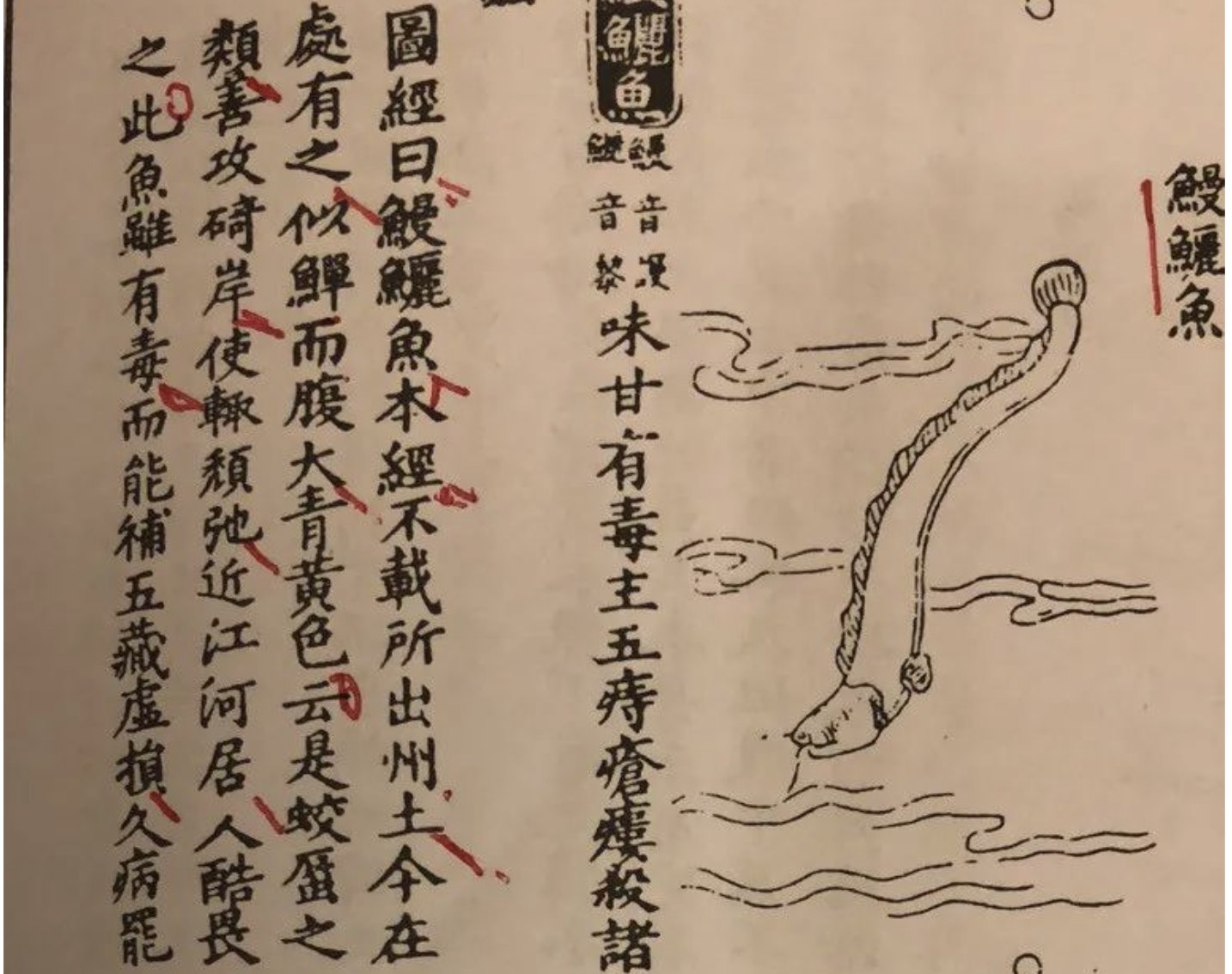
鳗鲡鱼鳗音曼,鲡音黎
味甘,有毒。主五痔,疮瘘,杀诸虫。
《图经》曰:鳗鲡鱼,《本经》不载所出州土,今在处有之。似鳝而腹大,青黄色。云是蛟蜃之类,善攻碕岸,使辄颓弛,近江河居人酷畏之。此鱼虽有毒,而能补五脏虚损,久病罢瘵,人可和五味,以米煮食之。患诸疮痔漏及有风者长食。歙州出一种,背有五色纹,其功最胜。出海中者名海鳗,相类而大,功用亦同。海人又名慈鳗,又名猧狗鱼。
注:此段说得很明白,鳗鱼有毒,但能滋补五脏的虚劳损伤。人常说:“是药三分毒”,中医用的就是中药的毒性治病的,正所谓“以毒攻毒”。所以,一个东西有毒并不可怕,关键的是如何利用其毒性为人类的健康服务。本书中很多常用菜,也都写着有毒,这个菜有毒,那个菜也有毒,而我们都在天天食用。开始看着有点担心,但看多了,就觉得很寻常。古人说的有毒,有时候就是一些食后的不适症,或过敏症。牛奶喝多了也中毒(一般是发湿疹)。啥东西吃多了,都不好。适量,均衡,还是靠谱的饮食方案。天生万物,相生相克。找到与我们的体质相生的食物,避开与自己体质相克的食物,就是最方便的养生。
陶隐居云:能援树食藤花,形似鳝,取作臛食之。炙以熏诸木竹,辟蛀虫。膏,疗诸瘘疮。又有鳅音秋,亦相似而短也。
注:陶弘景说鳗鱼会爬到树上吞食藤花,而且用了“援树”一词,很形象,长长的鳗鱼,顺着树干,援引而上,很有画面感。读书,只要静下来,潜心沉在文字中,就会融入入到文字中去,成为书中的一个角色,或主角,或观众,总之是“读进去”,进到书中去,我们会发现,没有不好看的书,也没有读不懂的书。凡是说读不懂的,多是沉不下心来,或对书中的知识没那么渴求。很多金融书,特别是炒股票的书,很是枯燥、没趣,甚至都是炒股失败的人,写了用来谋生的。但特别畅销,多半韭菜都会把一些所谓的《投资秘要》、《成长股秘密》、《快速致富》等等当成圣经一样研读。原因就是他们相信里面藏有财富密码。如果我们相信古籍中藏着健康密码,那么真正注重健康的人,会发现古籍中的中医、中药书根本不难看懂。陶弘景对鳗鱼的记录比较短,烤了可以熏木竹等,说明有防虫作用。而鳗鱼膏可治各种瘘疮,却是其较常用的功效。这一点,后面的引证中,会多次出现。
《日华子》云:海鳗,平,有毒。治皮肤恶疮疥,疳匿,痔瘘。又名慈鳗、猧狗鱼。又云:鳗鱼,平,微毒。治劳补不足,杀传尸疰气,杀虫毒,恶疮,暖腰膝,起阳,疗女人产尸疮虫痒。
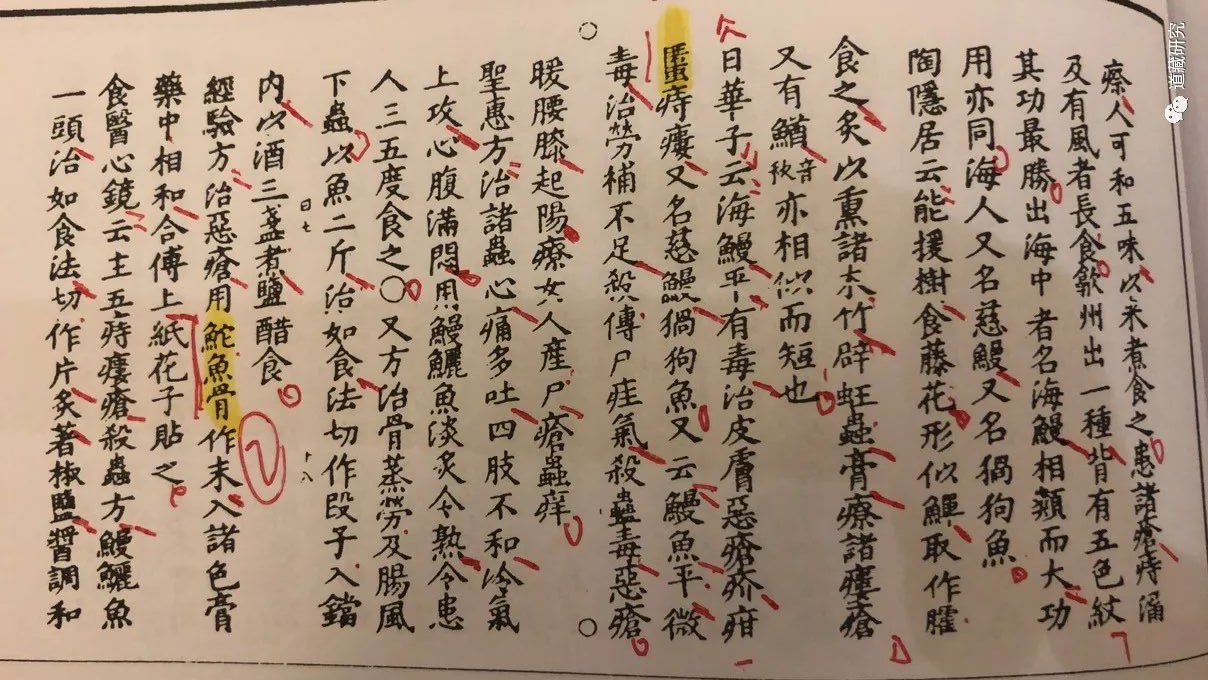
注:《日华子》这一段记录,虽不长,但信息量很大。尸注,通常是人死后传给至亲的一种传染病,又叫鬼注。是以前专篇介绍过,不再重复。
里面有个字,我不认识,打问号的地方,我点注的原文照片拍出来了(上图),标黄底的那个字,有认识这个字的朋友,请赐教。
这里需要说一下的是“暖腰膝,起阳”。这几个字记录了鳗鱼有壮阳功效。这在一般的医书中相对少见。所以多说几句。
对北方人来讲,吃海产品相对少些。很多人对鳗鱼的印象比较深的,是日本料理的“鳗鱼饭”或“鳗鱼寿司”,两小段鳗鱼,配一砂锅米饭,还感觉很好吃。有特色。但知道鳗鱼能壮阳的人,比例不高。
有一次,我和陈院长一起到省鳗鱼协会领导办公室泡茶,看到了关于鳗鱼的宣传册,上面写有壮阳功效。当时我还没有读到本书的这一章,并不知道鳗鱼这一功效。于是很奇怪,就问:“他们这么宣传可有依据?”答曰:“看看背面”。于是看到一行说文解字:“鳗,鱼,日,四,又”,没看懂,问这么拆“鳗”字是何意?答曰:“鳗,意思是:吃了这个鱼啊,一日四次,又要”,闻言,差点笑岔气儿。于是大家都笑起来,每人拿一本来阅读。我说您这不能算是科学依据吧?有点牵强啊,宣传一个产品的功效,就算是不解释科学原理,但至少得有实用案例。于是刘副厅就讲了他所见到或听到的人用案例。聊了很久,他们问是否相信了鳗鱼的这一功效。我说:“还是那个说文解字,让人印象深刻”,于是大家又哈哈大笑。
话别,捞点鳗鱼走。道家人对什么都好奇,于是说给我快递到厦门,多寄几盒,我送人试用。后来,收到了一大包,去外包装,放在单位冰箱里冻着。代替茶叶,作为伴手礼。但没去跟踪询问效果如何。慢慢也就忘记了,有一天同事说鳗鱼很久了,快过期了。我才知道还有剩下。于是说:“时间久了,不要再送人了。看看,若没过期,你们分吃了吧”,他们说不吃。于是我带一包回去尝尝,味道相当不错,甜的。两顿,吃完一包,量太足,一包能顶日本料理的好多倍,药效还没感觉到,体重上升能感觉到,可见营养丰富,滋补效果可能要看个人体质。我一直有体会,自己的智商,怎么补都上不去。偏就是体重,喝口水就能感觉到大补特补,就是人们说的:“喝口水就会发胖”的人。所以一般不敢吃滋补品。另,也知自己的体质,不太适合海产品。有兴趣的朋友可试试。
《圣惠方》:治诸虫心痛,多吐,四肢不和,冷气上攻,心腹满闷。用鳗鲡鱼淡炙令熟,令患人三五度食之。又方:治骨蒸劳及肠风下虫。以鱼二斤,治如食法,切作段子入铛内,以酒三盏煮盛、醋食。
注:“淡灸令熟”,无论是食用还是药用,多用烤灸方法,这是鳗鱼的一个炮制特点。
《经验方》:治恶疮。用鮀鱼骨作末,入诸色膏药中相和合,傅上,纸花子贴之。
注:这里说的是鮀鱼骨研末治恶疮,不是鳗鱼。可能是作者错放了章节此段应调整到鮀鱼那个章节去。
《食医心镜》云:主五痔漏疮,杀虫方:鳗鲡鱼一头,治如食法,切作片,炙,着椒、盐、酱调和食之。
注:这是常见病的食疗方法了,痔疮比较普遍,所谓“十人九痔”。有条件的话,各自如古法试试吧,若管用,不需谢,有机会替我们民族道文化说句公道话就行。
《稽神录》云:有人多得劳疾,相因染死者数人。取病者於棺中钉之,弃於水,永绝传染之病,流之於江。金山有人异之,引岸开视,见一女尤活。因取置渔舍、多得鳗鲡鱼食之,病愈。遂为渔人妻。
注:这是一个悲剧开头,喜剧结尾的浪漫故事。本文引用的宋代志怪小说《稽神录》中的记载,改编为剧本一定很好看。虽是志怪小说,却有很多常识是来自社会生活的总结。而且这一故事后来被李时珍引用到《本草纲目》中。
古代的痨病是传染病,其实就是瘟疫在蔓延。古人对付瘟疫的方法之一,也是隔离。人们把染病的人放到棺木中,封口钉上,然后将棺材扔到水里去,因为病人被钉在里面,所以没办法游上岸,这样可以永绝传染源。棺材就顺江而下,里面的人也就只能听天由命,等死就是必然的结果,因为棺材在漂流过程中很可能会沉入水底。不沉,人也会饿死在里面。
有一口棺材,顺水漂流很远,到了一个叫金山的地方(现在的江苏,由此可推此为长江鳗鱼),被当地的一个渔夫发现了,当时金山大概还没有疫情,这位渔夫觉得很奇怪,棺材都是埋进地下的,怎么水面上会有口棺材?会不会里面有宝贝?于是“引岸开视”,把这口棺材牵引到江岸边,打开瞧瞧,一看,里面躺着一位美女,还活着,天哪,这是天赐的仙女吗?于是这位渔夫就把她带回到自己的渔舍里,“多得鳗鱼食之”,多弄些鳗鱼给她吃,吃啊吃啊,“病愈”,传染病居然好了。“遂为渔人妻”,然后这位姑娘就嫁给了这位渔夫。故事结束。
恐怖的开头,曲折的过程,神奇的鳗鱼,美好的结局。还有比这更美好的文化故事吗?以我看,这比董永和七仙女的故事、牛郎和织女故事还要务实和浪漫。一个被命运判了死刑的女人,被活着钉进棺材时,扔到江面上,那是什么感觉?她在里面怎么想的?上天对一个人最大的惩罚,就是赐予绝望感。而那些伟大的灵魂,都是给人以希望。给人希望,是人世间最美好的品德。功德大于天。
那个女孩子在棺材里,该有多绝望?无法想像。一位渔夫的猎奇心理让他意外地得到一位天赐的美人。想像一下,一个娶不到老婆的渔人,突然有一天,水面上漂来了林妹妹,是不是跟做梦一样?至于那个神奇的食物鳗鱼,至少应有两个功效,一是免疫、一是抗疫。渔人救了这位已感染的女子,近距离密切接触,但他没有被感染,说明他的免疫力很强,这应与吃鳗鱼有关吧?这位已确诊的女人一直吃鳗鱼,病好了,说明鳗鱼有治愈这个病的功效。是某种传染病毒的克星。
各地的海洋与渔业部门,或可联合医疗部门做做试验,看看鳗鱼是不是有抗传染性病毒的功效。我这么边打字边天马行空地胡思乱想,基于我对古人记录的好奇心。《道藏》里面的古方、经方、验方、案例,是全人类共同的财富,所有人都可以去试验。谁先试出来谁就成为英雄。一如屠呦呦,把《道藏》中葛仙翁的青蒿素的提取方法去试验,从而为人类战胜疟疾服务一样。
《道藏》的丰富和了不起,不是个人语言可描述的。里面记载很多学科的成就,至今我们还没有超越。
我电脑里搜罗了古人的很多好方子,都是读古籍时抄录的,其中一部分,发给了我哥,在他的诊所里试验,有些已证明非常有效。大量的,我还没有翻译完。等将来我有条件了就成立一个“古方试验室”,专门研究、破解古人的验方。
《衍义》曰:鳗鲡鱼,生剖晒乾,取少许,火上微炙,俟油出,涂白剥风,以指擦之,即时色转。凡如此五七次用,即愈,仍先於白处微微擦动。
注:这个方子值得试试!这一段,是上传本文的最要主原因。大意:把鳗鱼生剖晒干,取一点,在火上慢慢烧,等到烧出油时,涂一些在白剥风的斑上,用手指擦,让皮肤吸收,当时皮肤颜色即有变化。这样用五七次,白斑的地方就好了。擦的时候,要注意从白的地方微微地擦动。
另,古文中的五七次,可能不是指五次或七次,而是五七三十五次。比如说一个人的年龄,《霸王别姬》中有句经典台词:“小尼姑年方二八,被师傅削去了头发”,这里“年方二八”,就不是两岁或八岁,而是十六岁。
需要说明的是,本段中的白剥风是不是现在说的白癜风?我还在考证中。一些书中,还有说是白斑风、白剌风、花斑癣等等。我觉得白剥风不是白癜风,是基于在本书中别的卷次章节中,我看到过白癜风的说法,说明这是两种不同的病。作者也明确记录过一些白癜风的治疗药物,比如:蛇蜕、白花蛇、杜蒺藜、罗摩子、朱雄鸡冠血,等等,但是散乱在本草各分部(那位白癜风的朋友请注意,这些药是我专从全书中查到的,专门为您发出来,供参考。尽管我不知道您是谁。但会尽力)。
书中相关记载不少,但这一段是对炮制方法相对明确记录的,所以更有价值些。个人觉得,白斑风、白癜风、白剥风、白剌风等,或症状细分有别,或是发病原因不同,所以有了不同的称谓。加上个人体质原因,效用也应有区别。仅供参考。
另外,在《图经衍义本草》之外,也有关于鳗鱼的一些记载,比较权威的两条,我抄录下来,供参大家考吧:
鳗鲡鱼血:疮疹人眼生翳,以少许点之。(李时珍 《本草纲目》)
这里的翳,指的是眼球上生的障蔽视线的白膜,会影响视力。
鳗鲡鱼膏:治颈项及面上白驳,浸淫渐长,有似癣:鳗鲡鱼脂敷之,先试剥上,刮使燥痛,后以鱼脂敷之。(《姚僧垣集验方》)
注:这一方大体同上。只是强调了涂的时候要用力,“刮使燥痛”,要用力刮擦,刮到痛,轻轻涂在表面可能不行。
写这些疾病相关的内容,都没心思发道情了,甚至在翻译这此些内容的同时,也不想写旧体诗了。看来得转转话题了。
杨子 2021.6.6 于厦门
Eel Treats Vitiligo--Tujing Yanyi Bencao 32-9
32. Eel Treats Vitiligo--Tujing Yanyi Bencao 32-9
Originally published by Yang Zi, Daozang Research, 2021-06-06
This chapter was not in the original uploading plan, but in an earlier reply to a reader's comment I promised to upload a formula for treating vitiligo. So today I am uploading some of the knowledge concerning the eel in the Daozang (Daoist Canon), especially the folk remedies and proven formulas within it. To do something of use to everyone is a Daoist's wish in the first place. Known or unknown, nothing warms like one person helping another.
The original text of this piece is carried in chapter 9 of the thirty-second juan of the Tujing Yanyi Bencao; an expert, reading the numbers I annotate, can easily find the original text and its source. Once readers grow used to it and know a few of the numbers and codes, we shall have that much more unspoken understanding. That way the explanatory text can be shorter, saving time and energy.
One very important feature of the Tujing Yanyi Bencao is that it has pictures. What follows is this chapter of the original text of the Daozang (Daoist Canon), as punctuated and annotated by me. First, look at the eel the ancients drew:
The manli fish (the eel). In the name, man is pronounced man and li is pronounced li.
Its flavor is sweet and it is toxic. It governs the five hemorrhoids and fistula sores, and kills various worms.
Tu Jing says: The manli fish is not recorded in the Ben Jing as to the region it comes from, but today it is found everywhere. It resembles the huang eel but has a larger belly, greenish-yellow in color. It is said to be of the kind of the jiao dragon and the shen clam, skillful at attacking the winding banks and making them slump; people who live near rivers and lakes greatly fear it. Though this fish is toxic, it can tonify deficiency and exhaustion of the five zang. People long ill with wasting consumption may cook it with the five flavors and rice and eat it. Those who suffer from sores, hemorrhoids, fistulas, or wind should eat it regularly. Shezhou produces a kind with five-colored markings on its back whose potency is the strongest. Those that come out of the sea are called sea eels; they are similar but larger, and their function is the same. The sea folk also call them ci eels, or wogou fish.
Note: this passage puts it plainly: the eel is toxic, but it can tonify deficiency and exhaustion of the five zang. People often say, "Every medicine is three parts poison"--Chinese medicine uses precisely the toxicity of its medicines to treat illness, the so-called "fighting poison with poison." So there is nothing fearsome in a thing's being toxic; the key is how to turn its toxicity to the service of human health. In this book many everyday vegetables are also marked toxic--this one toxic, that one toxic--and we eat them daily all the same. At first it was a little worrying to read, but read enough and it all seems perfectly ordinary. When the ancients said "toxic," it sometimes meant nothing more than discomfort after eating, or an allergy. Even milk, drunk in excess, is toxic (usually it comes out as eczema). Anything eaten to excess does harm. Moderation and balance remain the dependable dietary plan. Heaven gives birth to the myriad things, mutually generating and mutually overcoming. To find the foods that generate with one's constitution and avoid those that overcome it is the handiest way of nourishing life.
Tao Yinju says: It can climb trees to feed on vine flowers; it resembles the huang eel, and may be taken and made into meat broth and eaten. Roasted, it is used to fumigate wood and bamboo and keeps the wood-boring worms away. Its ointment treats all fistula sores. There is also the qiu fish (qiu is pronounced qiu), which is likewise similar but shorter.
Note: Tao Hongjing says the eel can climb trees to swallow vine flowers, and he uses the word "yuan" (to climb by pulling oneself up), which is vivid: the long eel, following the trunk, pulls itself up and up--a real picture. With reading, if you only grow still and sink your heart into the words, you will melt into them and become a character in the book--lead or onlooker, it does not matter--the point is to "read your way in," to get inside the book. Then we discover there is no book that is not good reading, and no book that cannot be understood. Those who say they cannot understand a book have mostly failed to settle their hearts, or do not thirst all that much for the knowledge in it. Many books on finance, books on playing the stock market especially, are deadly dull; indeed many are written by people who failed at the market themselves, to make a living. Yet they sell remarkably well: most of the market's retail "leeks" study the like of "Secrets of Investing," "Secrets of Growth Stocks," and "Get Rich Quick" as if they were scripture. The reason is that they believe a code to wealth is hidden inside. If we believe a code to health lies hidden in the ancient books, then people who truly care about their health will find that the traditional Chinese medicine and materia medica books of the ancients are not at all hard to understand. Tao Hongjing's record of the eel is fairly short: roasted, it can be used to fumigate wood and bamboo, which shows it wards off insects. And that eel ointment can treat all kinds of fistula sores is its more commonly used effect. This point will come up many times in the citations that follow.
Rihuazi says: The sea eel is neutral and toxic. It treats malignant sores and scabies of the skin, gan-ni wasting sores, and hemorrhoids and fistulas. It is also called the ci eel and the wogou fish. It also says: the eel is neutral and slightly toxic. It treats exhaustion, supplements insufficiency, kills the corpse-transmitted zhu qi, kills worm toxins and malignant sores, warms the lower back and knees, raises the yang, and treats the worm-itch sores of women after childbirth.
Note: this passage of Rihuazi, though not long, is packed with information. Corpse zhu is usually an infectious disease passed after death to one's closest kin, also called ghost zhu. It was introduced in a dedicated earlier piece, so I will not repeat it.
There is a character in it I do not recognize. Where I typed a question mark, I photographed the original text I punctuated and annotated (image above). The character on the yellow highlight--if any friend knows it, please enlighten me.
What needs mentioning here is "warms the lower back and knees, raises the yang." These few characters record that the eel has yang-strengthening power. That is relatively rare in ordinary medical books, so let me say a few more words.
For northerners, seafood is relatively less common on the table. Many people's deepest impression of the eel comes from Japanese cuisine--"eel rice" or "eel sushi": two small pieces of eel with a clay pot of rice, and it still tastes very good. Distinctive. But the proportion who know that eel strengthens the yang is not high.
Once, Dean Chen and I went to the office of the head of the provincial eel association to drink tea, and I saw a promotional brochure about eels that listed among its effects the strengthening of the yang. I had not yet read this chapter of the book at the time and did not know of this effect of the eel. Puzzled, I asked: "Do they have any basis for advertising this?" The answer was: "Look at the back." There I saw a line of character dissection in the Shuowen Jiezi manner: "Eel: fish, sun, four, again." I did not understand, and asked what it meant to split the character eel this way. The answer: "Eel means: eat this fish, and it is four times a day, and you still want more." At that I nearly laughed myself sideways. Everyone burst out laughing, and each took a copy to read. I said: surely this cannot count as scientific evidence? It is a bit of a stretch. To promote a product's effect, even if you do not explain the scientific principle, you should at least have real cases. So Deputy Director-General Liu told of cases he had seen or heard of people using it. We talked a long while, and they asked whether I now believed in this effect of the eel. I said: "It is still that character dissection that leaves the deepest impression." And everyone roared with laughter again.
When we parted, they gave me some eel to take along. Daoists are curious about everything, so I asked them to courier some to Xiamen--send several boxes, I said, and I will give them to people to try. Later a big package arrived; I stripped the outer packaging and put it in the freezer at the office, in place of tea, as gifts to take to others. But I never followed up to ask how it worked. In time I forgot about it, until one day a colleague said the eel had been there a long time and was near its expiry date. Only then did I learn there was some left. So I said: "It has been too long; do not give it to anyone else. Check whether it is still good--if it has not expired, you all share it and eat it." They would not eat it. So I took a package home to try. The taste was quite good--sweet. Two meals, and the package was finished; the quantity was far too generous--one package is worth many times the Japanese-restaurant serving. The medicinal effect I never felt; the weight gain I could feel--clearly it is rich in nutrition, though the tonic effect may depend on one's constitution. I have long had the experience with my own body: my IQ refuses to rise no matter how I supplement it. But my weight--the moment I drink a mouthful of water I can feel a great tonic at work. I am one of those people say "get fat on a mouthful of water." So generally I dare not eat tonics. Besides, I know my constitution does not suit seafood well. Friends who are interested may try it.
Shenghui Fang: For heart pain from worms, constant vomiting, disharmony of the four limbs, cold qi rising to attack, and fullness and oppression of heart and abdomen. Lightly roast a manli fish until done, and have the patient eat it in three to five sittings. Another formula: for bone-steaming consumption and intestinal wind with worms passed below. Take two jin of the fish, prepare it as for eating, cut it into sections, put it in a pan, simmer with three cups of wine, and eat with vinegar.
Note: "Lightly roast until done"--whether for eating or for medicine, the roasting method is mostly used; this is one peculiarity of the eel's processing.
Jingyan Fang: For malignant sores. Grind the bones of the tuo fish to powder, blend it into ointments of various kinds, spread it on, and cover it with a paper-plaster flower.
Note: what this describes is tuo fish bones ground to powder for malignant sores--not the eel. The author probably misplaced the passage; it should have been moved to the chapter on the tuo fish.
Shiyi Xinjing says: For the five hemorrhoids and fistula sores, a worm-killing formula: take one manli fish, prepare it as for eating, slice it, roast it, and eat it seasoned with pepper, salt, and soy sauce.
Note: This is dietary therapy for a common ailment--hemorrhoids are widespread, as the saying goes, "nine of ten people have hemorrhoids." If you have the means, try it by the old method. If it works, no need to thank me--just speak a fair word for our nation's Daoist culture when the chance comes.
Jishen Lu says: Some people contracted consumption, and several died of it in a chain of infection. The sick were nailed inside coffins and abandoned to the water, to cut off the contagious disease forever, and floated down the river. At Jinshan someone marveled at a coffin, towed it to the bank and opened it to look, and found a young woman still alive. He took her back to his fishing hut and gave her plenty of manli eel to eat, and the sickness healed. Thereupon she became the fisherman's wife.
Note: This is a romantic story that begins in tragedy and ends in comedy. The record is quoted from the Song collection of strange tales Jishen Lu; adapted into a screenplay, it would surely make fine watching. Strange tales though they be, much of the common sense in them is distilled from social life. And the story was later cited by Li Shizhen into the Bencao Gangmu.
In ancient times consumption was an infectious disease--really an epidemic spreading. One of the ways the ancients dealt with epidemics was isolation. People put the infected into coffins, sealed and nailed them shut, then threw the coffin into the water; since the sick person was nailed inside, there was no way to swim ashore, and so the source of infection was cut off forever. The coffin drifted down the river, and the person inside could only trust to fate; waiting for death was the inevitable outcome, for in its drifting the coffin might well sink to the bottom. And if it did not sink, the person would starve to death inside.
One coffin drifted a long way downstream and reached a place called Jinshan (in today's Jiangsu--so from this we can infer these were Yangtze eels). It was spotted by a local fisherman. Jinshan probably had no epidemic at the time. The fisherman found it very strange: coffins are buried in the ground--how could there be a coffin floating on the water? Might there be treasure inside? So he "towed it to the bank and opened it to look," and there inside lay a beautiful woman, still alive. Good heavens--was this a fairy sent by heaven? So the fisherman took her back to his fishing hut and "gave her plenty of manli eel to eat." She ate and ate, and "the sickness healed"--the contagious disease actually cured. "Thereupon she became the fisherman's wife"--and the girl married the fisherman. End of story.
A horrifying beginning, a twisting middle, a marvelous eel, a beautiful ending. Could there be a more beautiful story in our culture? In my view it is more down-to-earth and more romantic than the story of Dong Yong and the Seventh Fairy, or of the Cowherd and the Weaver Girl. A woman sentenced to death by fate, nailed alive into a coffin and thrown out onto the river--what must that feel like? What was she thinking in there? The greatest punishment Heaven can inflict on a person is the gift of despair. And the great souls are those who give people hope. To give people hope is the finest virtue in this human world. Its merit outweighs heaven.
How desperate must that girl have been inside the coffin? It is beyond imagining. A fisherman's curiosity brought him, all unlooked-for, a beauty bestowed by Heaven. Imagine it: a fisherman who could not find a wife, and then one day a Lin Daiyu comes drifting across the water--is it not like a dream? As for that marvelous food, the eel, it should have at least two effects: one is immunity, the other fighting the epidemic. The fisherman rescued this infected woman and was in close contact with her, yet he was not infected, which shows his immunity was strong--surely related to eating eel? The woman, already stricken with the disease, ate eel all along and recovered, which shows the eel has the power to cure this illness. It is the nemesis of some contagious virus.
The ocean and fisheries bureaus of the various regions might join with the medical departments to run some trials and see whether the eel truly works against contagious viruses. As I type, my thoughts gallop off in all directions like this, out of my curiosity about the ancients' records. The old formulas, classical formulas, proven formulas, and case records inside the Daozang (Daoist Canon) are the common wealth of all humanity, and anyone may put them to the test. Whoever proves one first becomes a hero--just as Tu Youyou took the method of extracting artemisinin from the Immortal Ge in the Daozang (Daoist Canon) and tested it, and so served humanity's victory over malaria.
The richness and the greatness of the Daozang (Daoist Canon) are beyond any individual's powers of description. It records achievements in many disciplines that we have still not surpassed.
My computer holds a great many good formulas collected from the ancients, all copied out while reading old books. Part of them I sent to my elder brother to try in his clinic, and some have proven very effective. The greater part I have not finished translating. When conditions allow someday, I will set up a "Laboratory of Ancient Formulas" devoted to studying and unlocking the ancients' proven recipes.
Yanyi says: The manli fish--cut it open raw and dry it in the sun. Take a little, warm it over a low flame, and when the oil comes out, apply it to the white-peeling wind, rubbing it in with a finger; the color changes on the spot. Use it in this way five to seven times and it heals; but first rub gently at the white places.
Note: This formula is worth trying! This passage is the chief reason I uploaded this piece. The gist: cut the eel open raw and dry it in the sun; take a little, warm it slowly over fire; when the oil comes out, spread some on the patches of white-peeling wind, rub with a finger, and let the skin absorb it--the skin color changes right away. Use it five to seven times and the white patches heal. When rubbing, take care to rub gently, starting from the white places.
Also, "five to seven times" in the old texts may not mean five times or seven times, but five-times-seven--thirty-five times. Take a person's age: in "Farewell My Concubine" there is a classic line: "The little nun was just two-eights old when the master shaved away her hair." "Two-eights" there does not mean two or eight years old, but sixteen.
What must be made clear: is the white-peeling wind of this passage the same as what we now call vitiligo? I am still verifying. Some books also speak of white-spot wind, white-thorn wind, variegated tinea, and so on. My view that white-peeling wind is not vitiligo rests on this: in other chapters of this book I have seen vitiligo mentioned by name, which shows they are two different diseases. The author also explicitly recorded certain medicines for vitiligo--snake slough, the white-flower snake, du jili, luomo seeds, the blood of a vermilion rooster's comb, and so on--though scattered through the various divisions of the materia medica. (The friend with vitiligo, please note: I found these drugs specifically by searching the whole book, and I am posting them specially for you, for reference. Though I do not know who you are. But I will do my best.)
There are quite a few related records in the book, but this passage records the processing method relatively explicitly, which makes it more valuable. My own feeling is that white-spot wind, vitiligo, white-peeling wind, white-thorn wind, and the rest either differ in fine divisions of symptoms or arise from different causes, and so have different names. Add differences of individual constitution, and the effects should differ as well. For reference only.
Besides, outside the Tujing Yanyi Bencao there are also some records concerning the eel; I copy out the two more authoritative ones for everyone's reference:
Blood of the manli fish: for a clouding film growing in the eye from sore-rash, apply a few drops. (Li Shizhen, Bencao Gangmu)
The yi here means the white film that grows on the eyeball and blocks the sight; it impairs vision.
Ointment of the manli fish: for white patches on the neck and face that spread and creep and grow, resembling tinea: apply the fat of the manli fish. First test on a patch, scraping until it is dry and painful, then apply the fish fat. (Yao Sengyuan Jiyan Fang)
Note: This formula is much the same as the one above. It only stresses that the application must be forceful--"scrape until dry and painful": rub hard, scrape until it hurts. A light coat on the surface probably will not do.
Writing all this material about disease, I have no heart to post Daoqing chants; even while translating these contents I have no wish to write old-style poems. It seems I must turn to other topics.
Yang Zi, Xiamen, June 6, 2021