《心闲道德经》第一章:认知边界
1、《心闲道德经》第一章:认知边界

这些年来,本公众号的不少读者多次留言或私信,希望我唠叨唠叨《道德经》,可我一直没有行动。原因有二:
1)讲《道德经》的人太多了,古往今来,解释这本书的人,也太多了。这个世界根本不缺少一个凑热闹的人;
2)我对《道德经》敬畏之心,自小背诵《老子》,就是不知道意思。长大后,每一个年龄段去阅读,常读常新。渐渐发现,《道德经》是很难解释明白的,只有自己去体悟。我总觉得,“世人一讲道,老子就发笑”,所以一直没有满足大家的心愿。可是呢,现在做“道化心闲”这个品牌,受到了本公众号读者的通力支持,我内心非常感恩,想尽力满足读者的心愿。而我内心,一直难忘,《道德经》对我的长期滋养与加持。可以说,如果不是《道德经》的启发,就没有“道化心闲”这个品牌。所以,我决定用自己的表达方式,在《道藏研究》的公众号和视频号,开始上传我与本书的理解及相关经历。共81篇,致敬《道德经》的81章。公众号上传文字,视频号同步音乐版的道情(童声,干净,适合小孩子听背)。此说明。
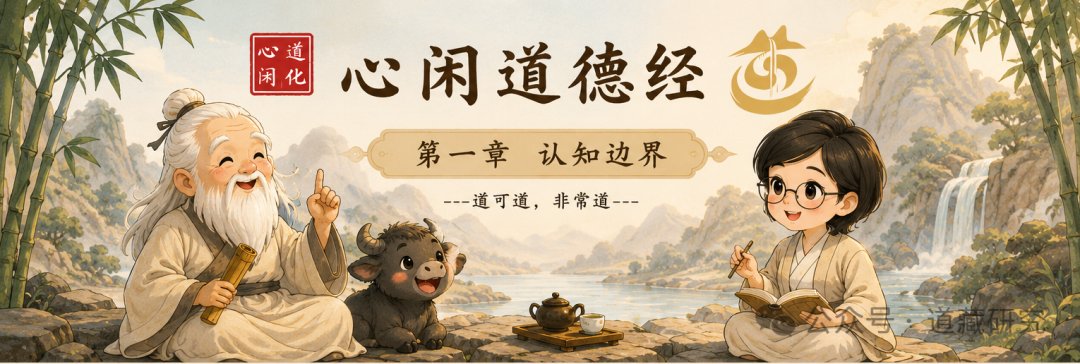
另,凡本公众号读者,在“道化心闲”官方旗舰店(京东、天猫)下单时,满足基础金额时,请记得出示视频号的关注截屏,可以多一份读者专享礼品,读者礼品是有标识的,标识比较高端,看到就知道了,送礼体面过人。

一、原文与释义
原文:
道可道,非常道。名可名,非常名。
无名天地之始;有名万物之母。
故常无,欲以观其妙;常有,欲以观其徼。
此两者,同出而异名,同谓之玄。
玄之又玄,众妙之门。
白话文:
可以用言词表达的“道”,并不是恒常不变的“道”;
可以用文字表述的名“名”,也不是真正恒常的名。
无,是形成天地开始;
有,是创生万物的根源。
因此,从“无”的角度,去观照世界的奥妙;
从“有”的角度,去观照世界的边界与形态。
“有”和“无”,其实同出一源,只是名称不同。
它们都可以称之为“玄”。
而“玄”之中,还有更深一层的“玄”,
那里,是一切奥妙的门径。

二、心闲理解
《道德经》第一章,很多人一上来就觉得“玄”。
“道可道,非常道;名可名,非常名。”
尤其第一次读的时候,常常会有一种感觉:每个字都认识,但连在一起,好像忽然忽然不认识了。
于是有人开始怀疑自己:“是不是我悟性不够?”
其实不用急。
老子这一章,讲的未必是什么高深莫测的“神秘学”,他真正厉害的地方,在于他很早就发现:
人的认知,其实是有边界的。
你能说出来的,往往只是你已经理解的那一部分。
一旦给一个东西命名,很多时候,也等于把它固定住了。而那些真正庞大、复杂、活着的东西,一旦被语言固定,反而容易失去原来的样子。
所以老子开篇第一句就说:“道可道,非常道。”
能够被完全讲清楚的“道”,往往已经不是那个真正活着流动的“道”了。这句话,其实很像生活。
比如一个人,本来只是一个活生生的人。可生活中,人们常常会不自觉地给事物下定义:
这是“成功人士”;
这是“普通人”;
这是“聪明人”;
这是“厉害的人”。
可人真的是几个词就能概括的吗?
很多时候,一个标签贴上去,人反而变窄了。
名字,本来是为了方便理解世界。可有时候,名字太多,定义太多,人也容易被定义困住。
所以老子接着说:“名可名,非常名。”
能被固定住的名字,也未必是真正永恒的名字。
这里,老子提出了一个特别重要的观察方式:

“有”和“无”。“无,名天地之始;有,名万物之母。”
“无”,不是没有;“有”,也不只是存在。
老子的意思更像是:
“无”,是那个还没有被固定、还没有被切割、还没有被命名的状态,是形成天地的本始。
“有”,则是世界开始显现、开始被看见、开始有形状的状态,是创生万物的根源。
所以:
有,让世界变得清晰;
无,让世界重新变得广阔。
真正的智慧,不是执着于“有”或者“无”,而是能够在两者之间自由转换。
就像一棵树。
春天还没长叶的时候,它有一种“无”的感觉;等到枝叶繁盛、开花结果,它又进入“有”的状态。
所以老子并不是在讲抽象哲学,而是在讲:
世界本来就是流动的。很多事情,不是一刀切的。
有时候,“有”很好。
有了名字,我们能交流;有了规则,生活会方便。
但如果什么都一定要定义清楚,人也容易越来越紧。
有些东西,留一点空间,反而更舒服。
这也是为什么,真正有智慧的人,往往不会急着给一切下结论。
因为他知道:世界很大,人的理解有限。
有时候,我们以为自己已经看清了,后来才发现,只是站在门口看了一眼。
世界上很多东西,越想完全说清,反而越容易失真。
有时候,真正重要的东西,恰恰无法被语言彻底表达。
所以老子最后说:“玄之又玄,众妙之门。”
这里的“玄”,不是故弄玄虚。
它更像是在说:世界有很多层。

你以为已经到了终点,结果推开门,后面还有一层;你以为已经解释清楚了,结果再往深处看,又发现语言开始不够用了。
所以真正的智慧,往往不是“我什么都知道”。
而是:知道自己还有很多不知道。
这反而是一种轻松。
因为一个人一旦不再执着于“必须解释一切”“必须定义一切”“必须控制一切”,让心回归自然,人就会慢慢放松下来。从而像历代道家所追求的那样,让道家的产品,让人更健康、更漂亮、更快乐、更长寿,以及,常清静。
这也是我做“道化心闲”这个品牌时的一种心态,想表达道家“心闲”的状态。
留一点空白,留一点余地,留一点“说不清”。
风才能吹进来。

三、心闲道情
《道德经第一章》认知边界
紫气东来入函谷,大道无形贵虚无;
一牛一人一卷书,心闲神安道不孤。
道可道兮非常道,名可名兮非常名;
无名天地之伊始,有名万物之化生。
常守其无观其妙,常执其有知其徼;
有无同源名相异,千变万化众妙门。
玄之又玄玄无尽,提笔开口失其真;
欲识老君真实意,不在言说只在心。
五千真言留后世,青牛西去入烟云;
世人千载论玄妙,不过空中一片尘。杨子 2026.5.11读后请记得两件事:1)去《道藏研究》视频号看看这首道情的音乐视频,会耳目一新的;2)若有下单,请记得跟客服看关注截屏,有“读者专享礼品”(贴有蓝色标识的)。我现在就去上传视频。视频号见。
Xinxian Daodejing, Chapter 1: The Boundaries of Cognition
1. Xinxian Daodejing, Chapter 1: The Boundaries of Cognition
Over the years, quite a few readers of this WeChat official account have left comments or sent private messages again and again, hoping I would ramble on a bit about the Daodejing. But I never got around to it. There are two reasons:
1) Too many people have lectured on the Daodejing. From ancient times down to today, too many people have explained this book. The world certainly does not need one more person merely joining the crowd;
2) I hold the Daodejing in awe. I recited the Laozi from childhood without knowing what it meant. After I grew up, reading it at every age, it always read new. Little by little I found that the Daodejing is very hard to explain clearly; one can only realize it for oneself. I have always felt that "the moment the world starts talking about the Dao, Laozi bursts out laughing," so I never fulfilled everyone's wish. But then again, now that I run the Daohua Xinxian brand, I have received the full support of this official account's readers. I am deeply grateful, and I want to do my best to meet the readers' wishes. And in my heart I have never forgotten the long years of nourishment and blessing the Daodejing has given me. One can say that without the inspiration of the Daodejing there would be no Daohua Xinxian brand. So I have decided, in my own way of expression, to begin uploading to the Daozang Yanjiu WeChat official account and video account my understanding of this book and the related experiences. Eighty-one pieces in all, in tribute to the eighty-one chapters of the Daodejing. The official account will carry the text, and the video account will carry, in sync, Daoqing chant music (children's voices, clean, good for little ones to listen to and memorize). So much by way of explanation.
Also: any reader of this official account who places an order at the Daohua Xinxian official flagship store (on JD or Tmall) that meets the basic amount, please remember to show a screenshot of your follow on the video account; you can get one extra reader-exclusive gift. The reader gift carries a mark, a rather high-end one — you will know it when you see it. A gift to give that does the giver proud.
I. Original Text and Explanation
Original text:
The Dao that can be spoken is not the constant Dao. The name that can be named is not the constant name. / The nameless is the beginning of Heaven and Earth; the named is the mother of the ten thousand things. / Therefore, in constant non-being one observes its mystery; in constant being one observes its boundaries. / These two emerge from the same source but differ in name; together they are called the dark. / Dark upon dark, the gateway to all wonders. / Vernacular version:
The "Dao" that can be put into words is not the constant, unchanging "Dao"; / the name that can be set down in writing is not the truly constant name. / "Non-being" is the beginning from which Heaven and Earth are formed; "being" is the root that gives birth to the ten thousand things. / Therefore, from the angle of "non-being" one observes the mystery of the world; / from the angle of "being" one observes the world's boundaries and forms. / "Being" and "non-being" in fact come from the same source, and only their names differ. / Both may be called "dark." / And within the "dark" there is a yet deeper layer of "dark" — / there lies the gateway to all mysteries.
II. Xinxian Understanding
With Chapter 1 of the Daodejing, many people find it "mysterious" the moment they pick it up.
"The Dao that can be spoken is not the constant Dao; the name that can be named is not the constant name."
Especially the first time you read it, there is often a feeling: you know every single character, but strung together they suddenly, suddenly stop looking familiar.
So some people begin to doubt themselves: "Is my capacity for insight not enough?"
Actually, there is no need to rush.
What Laozi is discussing in this chapter is not necessarily some unfathomable "esoteric doctrine." Where he is truly formidable is that he saw, very early on:
Human cognition actually has boundaries.
What you can put into words is often only the part you have already understood.
Once you name a thing, in many cases you have also fixed it in place. And those things that are truly vast, complex, and alive, once fixed by language, easily lose their original look.
That is why the very first line of Laozi says: "The Dao that can be spoken is not the constant Dao."
A "Dao" that can be fully talked out is often no longer that truly living, flowing "Dao." This line, in fact, is very much like life.
Take a person: originally just a living, breathing human being. Yet in life, people constantly, without noticing, hand down definitions about things:
This is a "successful person"; / this is an "ordinary person"; / this is a "clever person"; / this is an "impressive person".
But can a person really be summed up in a few words?
Very often, once a label is stuck on, the person actually becomes narrower.
Names were originally for making the world easier to understand. But sometimes, with too many names and too many definitions, people easily get trapped by the definitions.
So Laozi goes on to say: "The name that can be named is not the constant name."
A name that can be pinned down is not necessarily a truly eternal name.
Here Laozi puts forward a particularly important way of observing:
"Being" and "non-being." "Non-being names the beginning of Heaven and Earth; being names the mother of the ten thousand things."
"Non-being" is not nothing; "being" is not mere existence either.
What Laozi means is more like:
"Non-being" is that state not yet fixed, not yet cut apart, not yet named — the original beginning from which Heaven and Earth are formed.
"Being," then, is the state in which the world begins to appear, begins to be seen, begins to take shape — the root that gives birth to the ten thousand things.
So:
Being makes the world clear; / non-being makes the world vast again.
True wisdom is not clinging to "being" or to "non-being," but being able to turn freely between the two.
It is like a tree.
Before it puts out leaves in spring, it has a certain feel of "non-being"; when its branches grow lush and it flowers and fruits, it enters the state of "being."
So Laozi is not talking abstract philosophy; he is talking about:
The world is fluid to begin with. Many things cannot be cut with one clean stroke.
Sometimes "being" is good.
With names, we can communicate; with rules, life is more convenient.
But if everything absolutely must be defined clearly, people easily grow tighter and tighter.
With some things, leaving a little space is actually more comfortable.
This is also why people of true wisdom usually do not rush to pronounce conclusions about everything.
Because they know: the world is vast, and human understanding is limited.
Sometimes we think we have seen things clearly, only to discover later that we merely took one glance from the doorway.
For many things in this world, the more completely you try to say them, the more easily they get distorted.
Sometimes what truly matters is precisely what cannot be fully expressed in language.
So Laozi says at the end: "Dark upon dark, the gateway to all wonders."
The "dark" here is not deliberate mystification.
It is more like saying: the world has many layers.
You think you have reached the end, but push open the door and there is another layer behind it; you think you have explained it all clearly, but look a little deeper and you find language starting to run short again.
So true wisdom is usually not "I know it all."
It is: knowing that there is still much one does not know.
And that, if anything, is a kind of ease.
For once a person no longer clings to "must explain everything," "must define everything," "must control everything," and lets the heart return to what is natural, one slowly loosens up. And then, as the Daoists of the successive ages pursued, let Daoist products make people healthier, more beautiful, happier, longer-lived — and, ever clear and still.
This is also a frame of mind I hold while doing the Daohua Xinxian brand: I want to express the Daoist state of "xin xian" — the heart at ease.
Leave a little blank space, leave a little margin, leave a little of what "cannot quite be said."
Only then can the wind blow in.
III. Xinxian Daoqing Chants
Daodejing, Chapter 1: The Boundaries of Cognition
Purple qi comes from the east and enters Hangu Pass; the great Dao is formless and prizes the void. / One ox, one man, one scroll of writing; heart at ease, spirit at peace, the Dao is never alone. / The Dao that can be spoken is not the constant Dao; the name that can be named is not the constant name. / The nameless is the beginning of Heaven and Earth; the named gives birth to and transforms the ten thousand things. / Constantly keep to non-being to observe its mystery; constantly hold to being to know its boundaries. / Being and non-being share one source though their names differ; in the thousand changes and ten thousand transformations is the gate of all wonders. / Dark upon dark, the darkness never ends; take up the brush or open the mouth, and its truth is lost. / If you would know the true intent of the Lord Lao, it lies not in words but only in the heart. / Five thousand true words left to later ages; the green ox went west into mist and cloud. / For a thousand years the world has debated the mystery, yet it is only a speck of dust in the empty air. Yang Zi, May 11, 2026. After reading, please remember two things: 1) Go to the Daozang Yanjiu video account and watch the music video of this Daoqing chant; it will refresh your eyes and ears. 2) If you place an order, remember to show customer service your follow screenshot; there is a "reader-exclusive gift" (with a blue mark). I am off to upload the video right now. See you on the video account.