生男生女秘方---《御女损益篇第六》(1)
4、生男生女秘方---《御女损益篇第六》(1)
原创 杨子 道藏研究 2021-04-05

今天介绍陶弘景的《延性保命录》中的一段,节选自第六章《御女损益篇》。
本章主要是讲性养生的,就是如何通过采阴补阳的方法,达到延年益寿的目标。翻译进行到一半时,突然看到了古人研究的生男生女方法,突然想到,或许这对很多家庭有帮助。有些家庭需要男孩子,怀了女孩子就要打胎,又伤身体又造孽,但都是无奈之举。阅读中看到这样的文献记录,就索性先发抽出来单独发送。供参考。但愿我们民族的古籍和文化,能帮助我们活得更有质量。
看原文之前,先解释几个文中出现的专业术语,不然,有些古文阅读不习惯的人可能连译文也看不懂:
第一个专业名词:五常
五常:中国人对五常的定义和发挥简单到了淋漓尽致的地步。儒家、道家、道教、道医、中医、阴阳家、纵横家等各家学说都对五个概念进行演绎和诠释。但最后都殊途同归。归到哪里?归一,一就是道,统统回到大道的范畴上来。大体说来:
儒家说的五常指的是指仁、义、理、智、信五种品质,翻译成“五德”,可能更合适。
道家、医家、阴阳家、道教等所说的五常,常指金、木、水、火、土五种元素,中国人普遍地称之为“五行”,冯友兰先生给出的英文翻译是“five elements ”(五种元素)(冯友兰 《中国哲学简史》)

中国文化的核心密码,就是“阴阳+五行”,“阴阳五行”学说是放之四海皆准的理论,也就是我们文化中的“公理”。明白了“阴阳五行”学说,各家学派的理论,一点就通。中国古代常出“神童”和“天才”,都是因为这些人早早就通了“阴阳”的互动和转变,以及“五行“的相生相克原理。所以可以纵横捭阖,游刃于诸子百家学说。可为良相,可为良医;可为谋臣,亦可以谋身。如果不能理解透彻“阴阳”和“五行”,那几乎我们文化中所有的核心典籍都读不懂。“阴阳五行”是我们民族文化的通用密钥。
---
中国人追求天人合一,最朴素的心愿,就是追求永恒。因为这个民族相信违背天道就是作死的节奏,所谓逆天则亡。所以,古人在讲一切道理时,都离不开“天人合一”。人要遵循天道的五行之德,就连人身上的各个器官也遵循这一规律。比如,本文中的房中养生,《道藏》中互参的一些文献,就涉及到了这一理论(后面会举例)。看得人哑然失笑,觉得有些太玄乎了,但既然我们的文化基因如此,也就这么唠叨一通,把这个理论基础说一说。不然以后的文章可能很不好理解。
说实在的,读《道藏》,里面的有些东西,是没必要花费宝贵的生命去钻研的。个别内容实在荒唐。我更是看不惯一些打着道教旗号哄弄人的道士。当然,现在道教衰落到历史最低点,这样的人很少见了,因为没有土壤。某一种宗教(或学说)的骗子常出现在该宗教(或学说)的鼎盛时期。常见报道说有人利用某盛行的宗教骗财骗色,因为兴风作浪的前提是有人吹捧。我在话语上替道家说话,并不是“同情弱者”的心态,因为道家学说一点也不弱,用冯仑先生的话说:“老、庄学说,很凶的”,道讲弱,道示弱,但道文化一点也不弱。我之所以打算用一生的精力把《道藏》中的精华介绍给世人,是因为这个社会欠道文化一个公道。做人不爱锦上添花,做学术也一样。我烧的,是道文化的冷灶。并不是我多盼望成为道士,而是社会对道文化了解太少,误解太多,埋汰太多了,也太不公道了。不少电视剧,妖魔化我们的民族信仰。真是无知者无畏。作为这个民族的一员,本能地想替我们的民族文化说句公道话。

忽然感觉,我的文章有点象连续剧一样的,一集一集的,前后的文章,从内容看,似乎没有关系,其实是连贯起来的,有一个无形的线在其中。有朋友说读不懂,看到文言文就头大;有朋友说翻译的很明白,读起来流畅易懂。这与读者个人的国学基础有关系,也有熟悉我的文风与否有关系,更与对道文化的熟悉程度有关。一般而言,只要前后顺序看下来,都看得懂。我引用的古文都用蓝色字体特别标识,供基础好的同修参照,可以同步提高古文阅读水平。不习惯古文的,可以直接跳过蓝色字体,直奔白话文。关键的、钥匙性的专业术语或概念,我都会围绕核心专门唠叨,尽可能地把一个概念可能的外延都介绍清楚。
接着说我认为本段原文中,个别稀奇古怪又牵强的五常理念应用。刚才有提到让人忍不住发笑的理论,以下出自互参文献:
《玉房秘诀》云:黄帝曰:“何谓五常?”素女曰:“玉茎实有五常之道,深居隐处,执节自守,内怀至德,施行无己。夫玉茎意欲施与者,仁也;中有空者,义也;端有节者,礼也;意欲即起,不欲即止者,信也;临事低仰者,智也。……故能从五常,身乃寿也。”(《素女经》五常第六)
大意:黄帝问他的保健医生素女有关五常的事。真是各自都站在自己的专业角度诠释。素女是黄帝时期最伟大的性学专家,她的解释不离本行,她说男人的小弟弟都讲仁、义、理、智、信,看到这段,笑出声来。直觉,不是理论太牵强,就是男人的小弟太有文化。但《素女经》、《医心方》等等好多经典引用《玉房秘诀》这段话,而且还说要是行房事遵从五常之道的话,“身乃寿”,可以长寿。既是这样,咱也不好说这一理论牵强。因为更多的文献都佐证着这一理论很有靠谱,也很有文化。
这是古代的记录。这是一个有文化的民族。这一理论,唐朝时被日本人学了过去,而且践行得很好,直到现在。
宋朝后,理学家“存天理、灭人欲”的理论影响大了,中国人谈性色变,性文化相关的记录就少了。而日本人却把这些性文化理论践行到实际生活中了,特别是性的“礼”文化。曾看过一个记录片,讲日本人的性文化,男人在性启动时不免有野性,但关键时刻,忽然温柔、节制而又礼仪地说:“对不起,我要失礼了”。当时觉得那个人的家教原因。后来各种文献说明了,这些礼仪文化,原是从中国的传统。

曾听一位性学专家讲中国古代夫妻“相敬如宾”,在场的人都笑,说“相敬如宾”多么拘束和枯燥,怎么办事?那位专家说:“你们哪里懂,宾客之间的客气中,更是风流淫荡,妙不可言哪”。表面上越是正人君子,越是一肚子风月情怀。于是众人笑。文化中的细节,是需要细细理解和品味的。懂了便会默契,不懂便觉得麻烦,不可理解。
第二个专业名词:形法
形法:本文中的“形法”,是一种学术流派,诸子百家之一,《汉书》有详细记载:
形法者,大举九州之势以立城郭室舍形,人及六畜骨法之度数、器物之形容以求其生气贵贱吉凶。([东汉] 班固《汉书 艺文志》)
“形法”,原意是“堪舆、骨相”之术,用现代话讲,就是看风水、看骨骼面相的。所以,本文中,“形法”一词,我翻译成“外形及骨骼”。
第三个专业名词:王相日
每个月的二日、三日、五日、九日、二十日,是王相日。王相日生出的孩子贵不可言。
第四个专业名词:月宿
《千金翼方》中也称为“房宿”,二十八星宿之一。也有书中称“凡宿”或“斗宿”的,道家书中多有涉及。《道藏》难读,专业术语是一个重要原因。月宿日有规定,一年四季中,各不相同,春甲寅、乙卯,夏丙午、丁未,秋庚申、辛酉,冬壬子、癸亥。这几个日子夫妻行房非常好的,利于身体,也比较容易生男孩。
以下开始原文翻译(楷体字是原文,不习惯古文的可略过):
天老曰:人生俱含五常,形法复同,而有尊卑贵贱者,皆由父母合八星阴阳,阴阳不得其时,中也。不合宿,或得其时,人中上也。不合宿,不得其时,财为凡夫矣。合宿交会者,非生子富贵,亦利己身,大吉之兆。

注:天老说:人生都有五常之性,外形及骨骼都相同,然而,却有尊卑贵贱的个体差异,这都是由父母在创造生命时是否符合八星阴阳的原因。如果父母的性生活时间合了八星阴阳,但阴阳不得其时,即时辰选择不对,创造的生命是中等的。不合星宿,但也可能合上好时辰,这样生出的孩子是中上等的。不合星宿阴阳,又不得其时,这样生出的孩子哪怕是拥有财富,也会是凡夫俗子。合了星宿阴阳而交合生子的,就算不生出富贵孩子,对夫妻双方的身体健康也是有利的,大吉之兆。
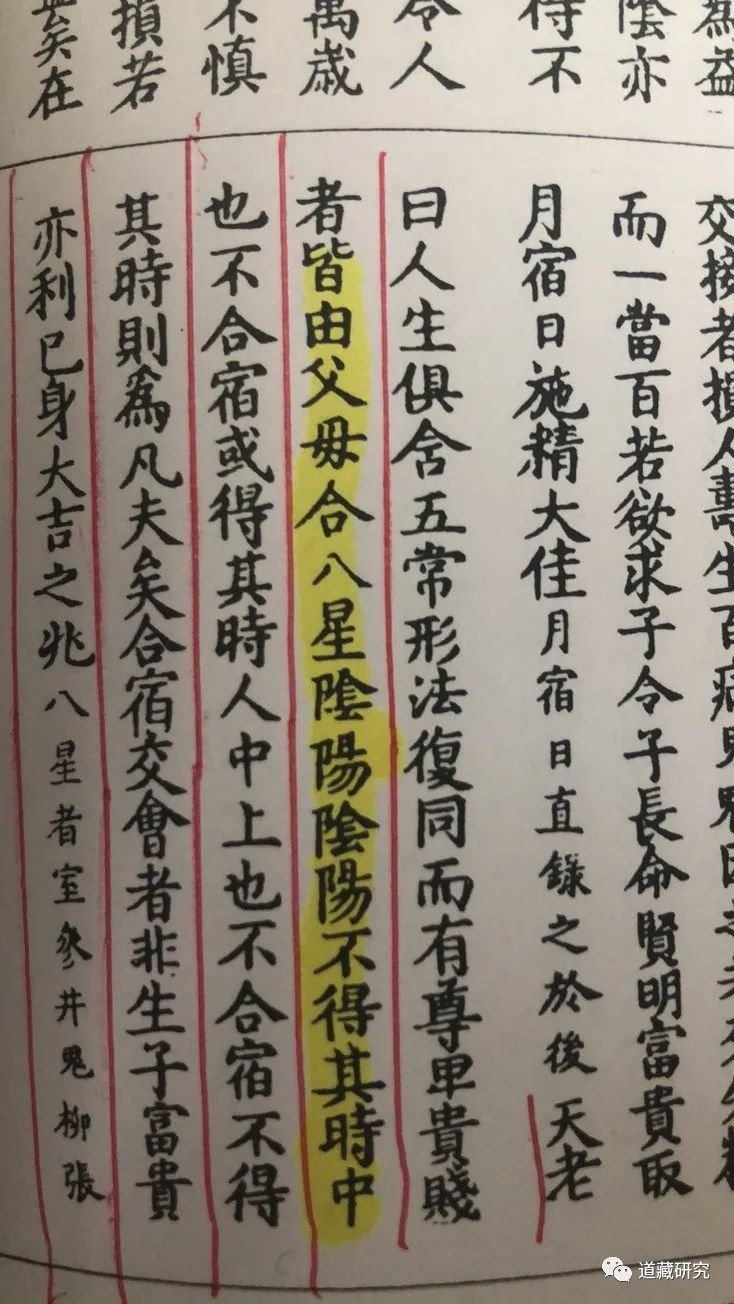
这一段的翻译,我反反复复斟酌,总觉得表述不是最妥当。所以贴出了上面这张原文图片。
或许,我用理学家的语言来解释这个原理,可能更容易明白一些。因为理学源自道学,理学就是诠释道学的。读明白以下这段,不用看原文及翻译,也就明白了大意。
程颐说:“性即是理”,朱熹继承他的观点,并提出了“气禀”之说。结合本文来说,就是一切都是因“道”而生,因“理”而行,因“性”而不同。父母的基因就是“理”,决定了一个生命的第一特征。比如,是生成人,还是小狗。花有花之理,叶有叶之理。花不会生成叶,叶不生成花。如果父母都是人,那就生成人。但是,是生男还是生女?主要由月宿日和经期决定;是聪明还是愚笨,是否富贵,是不是好命等,则与王相日有关。因为一个生命的诞生,不仅需要“道”、“理”,还会秉受不同的“气”,“气”决定了生命的高低贵贱和聪明愚笨。这就是朱熹所说的“气禀”。道家讲生命的起源,所讲的就是王相日、月宿日就是要人们在创造生命时选择最好日子和时辰,以让新生命秉受最好的天地灵气。
孙思邈在引用这段话时,进行了自己的理解,他在《养性禁忌第一》中说:
“人禀五常之形貌,而尊卑贵贱不等,皆由父母合会禀气寿也。得合八星,阴阳各得其时者,上也,即富贵之极;得合八星,阴阳不得其时者,中也,得中宫;不合八星,阴阳得其时者,下也,得下宫;不合此宿,不得其时者,则为凡人矣。合宿交会者,非惟生子富贵,亦利身大吉。(孙思邈《千金翼方》)
孙真人这么说就比较好理解了。他是在陶弘景的基础上进行的理解和诠释,表达更有逻辑,文字更通顺。大意是:
人禀受相同的五常形貌,但却有尊卑贵贱的区别,都是因为父母在交合时,新生命禀受了不同的气寿的原因。如果合了八星,又阴阳各得其时,这就是最佳的情况,生出的孩子富贵之极;得合八星,但阴阳不得其时,这是中等的情况;如果不合八星,但阴阳各得其时,这是下等的情况;如果不合星宿,阴阳又不得其时,出生来的就是凡夫俗子。合星宿交会生子者,不但孩子富贵,对父母的身体也是很有好处的。

药王孙思邈真人这一表达,让翻译的人,感觉到轻松多了。但我们不能因此而忘记了前人打下的基础。如果没有之前朝代的基础,大唐王朝再强盛,孙思邈再聪明,也不可能创造那么多的医学、医药学第一。
中国人算命,皆从“生辰八字”开始,也是有原因的。只是按生命的开始的另一个节点,即从娘胎的出生时辰。这是另一个话题了。不提。懂了生命创造的原理,那出生时的事,就容易理解了。读懂本文的,算命先生在你面前就不再神秘了。
八星者,室、参、井、鬼、柳、张、心、斗。月宿在此星可以合阴阳,求子。月二日、三日、五日、九日、二十日,此是王相生气日,交会各五倍,血气不伤,令人无病。
注:此段文中的八星是什么呢?八星者,指的是:“室、参、井、鬼、柳、张、心、斗”。月宿在此星就可以合阴阳,利于求子。农历每个月二日、三日、五日、九日、二十日,这几个日子是此“王相日”,此时性爱的养生功效会是平时的五倍,血气不伤,令人无病。
仍以王相日,半夜后,鸡鸣前,徐徐弄玉泉,饮玉浆戏之。
注:在王相日,半夜后,鸡鸣前,“徐徐弄玉泉,饮玉浆戏之”,玉泉、玉浆都指口中津液。指的应该是亲吻。药王孙思邈也曾认为过《仙经》中讲的性前戏对养生非常有效,于是他引用相关内容到自己的书中:
“令人长生不老,先兴女戏,饮玉浆。玉浆,口中津也。”(孙思邈《千金要方》卷二十七《房中补益第八》)
大意:性养生可令人长生不老的方法,先要兴作前戏,吞咽玉浆。玉浆,就是口中的津液。
若合用春甲寅、乙卯,夏丙午、丁未,秋庚申、辛酉,冬壬子、癸亥,与上件月宿日合者,尤益佳。若欲求子,待女人月经绝后一日、三日、五日择中王相日,以气生时,夜半之后乃施精,有子皆男,必有寿贤明。其王相日,谓春甲乙、夏丙丁、秋庚辛、冬壬癸。

注:如果性爱的时间刚好王相日与月宿日重合,养生效果是最好的。如果想要求子的话,还要讲究女人的生理周期。具体说,要选在女人月经结束后一日、三日、五日当中选择王相日,而且在气生之时,即夜半之后再施精,这时生的孩子都是男孩,而且一定会长寿且贤明。但一定要选择在王相日。
这是陶弘景的记录。我估计这是古人的大数据统计。因为古人除了阴阳五行的理论,只说合了天道、合了天时之类的吉利,再没有更多的科学细说。但古代道家、医家与道教的显著区别,就是道家、医家记录一般都有实验数据,或实践依据;而道教,就可能就是随意发挥的多些,实在说不通时,就是神仙就这么规定的。所以,世人所说的很多所谓糟粕多在道教中(儒教中也不少),而不是道家和医家。但是,话说过来,道教本身是宗教,宗教的特色就是神明的不可验证性。西方也是一样,那些信仰上帝的人,内心都相对的平和幸福,经常质疑上帝存在的人,活的相对不快乐。道教也是一样,那些虔诚的信徒都是简单的信仰,他们心有敬畏,活得有底线。那些不相信“三尺之内有神灵”的人,行为都不受约束,胡作非为,最后逃脱不了因果报应。
道家和医家,用现代所谓科学的观点来说,相对靠谱了。尽管他们没有用现代的科学名词解释,但道家和中医那套理论是完整的,结论也多是大数据统计的结果。而且,随着时间的推移,有些理论并没有被推翻,而是更加深入,说明这些理论是经得住了实践的验证。
这种王相日、月宿日,再加上女人月经后第一、三、五日的行房安排,生的孩子都是男孩,是经历住的时间的检验。因为陶弘景所在的时代是南北朝,而到了唐朝,药王孙思邈把这一理论进行了补充和升华,他的记录是:
若欲求子者,但待妇人月经绝后一日三日五日,择其王相日及月宿在贵宿日,以生气时夜半后,乃施泻。有子皆男,必寿而贤明高爵也。以月经绝后二日四日六日施泻,有子必女。过六日后,勿得施泻,既不得子,亦不成人。([唐]孙思邈 《房中补益》、《千金药方》)

注:孙思邈这段补充很重要。也就是说,他不但认可了女子经后一、三、五日,会生出男孩,而且还补充月经结束后二、四、六日行房,生的孩子必定是女孩。这其实也好记的,男主阳,所以是单数;女主阴,是双数。如果真的通了阴阳五行的原理,很多知识点不用死记,推理就行了。《易经》就是这样的。六十四卦,虽不算多,但如果一爻变化,情况就全变了,千变万化无穷卦。所以不能死记硬背,一定按顺序去推算,一环扣一环,规律的很,错不了。过了六日之后,再行房就不要再泄精了,这样不会怀孕,怀了也不容易成人。这是性养生文化的观点,性爱如果为了生孩子,就选好日子,按时辰排精。如果不是为了生孩子,就不要外泄,以保全生命精华。这可能就需要学习“还精补脑”的一些房中技能了。
经后六天内行房容易受孕,这一记录与现代医学的受孕期并不矛盾。但古代的道家又明确了生男、生女的具体日子,这是一大创举。女子月经后的单日与双日会怀上不同性别的孩子,可能与染色体的活动规律有关。只是当时没有这些名词和科学实验。道家只是根据大数据的统计。个人认为,或许因个性差异会有意外,但照此方法生孩子,生男生女的成功概率,大体不差。这种理论是经过道医两家好几百年的记录才逐步形成的。
除了女子经期的选择,道家各种文献中,还记录了要合王相日、月宿日。但日期,各不相同,具体来说:
王相日是指:春甲乙、夏丙丁、秋庚辛、冬壬癸。
月宿日就比较多一些,春甲寅、乙卯,夏丙午、丁未,秋庚申、辛酉,冬壬子、癸亥。
这些日子具体都是农历的哪些天,篇幅限制,不再列出来。有兴趣实践的,可查下万年历,重视一下几个条件的重合日子,再加上行房时辰正确,生男生女,几乎可控。
(本段翻译完)
特注:原文其他段落中多次提到,行房忌讳中,“醉饱”是其中最重要的。因为“醉饱”行事,极不利于养生,生出的孩子质量受影响。因为本文只翻译一段,所以,众多的其他注意事项,还不能包括进来。以后有机会慢慢上传。
愿你生出你想要的儿子或女儿,并且聪明健康,富贵俱足。
A Secret Formula for Having Boys or Girls --- "Yunü Sunyi Pian, No. 6" (1)
12. A Secret Formula for Having Boys or Girls --- "Yunü Sunyi Pian, No. 6" (1)
Originally published by Yang Zi, Daozang Research, 2021-04-05
Today I will introduce a passage from Tao Hongjing's Yanxing Baoming Lu, excerpted from Chapter Six, "Yunü Sunyi Pian".
This chapter is mainly about nourishing life through sex, that is, how to reach the goal of lengthening one's years by the method of drawing on yin to supplement yang. When the translation was half done, I suddenly came upon the ancients' methods for having boys or girls, and it occurred to me that this might be of help to many families. Some families need a boy, and if they conceive a girl they have an abortion, which hurts the body and creates bad karma, yet all of it is done out of helplessness. Seeing such a record in the literature while reading, I simply pulled it out first and sent it separately. For reference. I only hope our nation's old books and culture can help us live with more quality.
Before looking at the original text, let me first explain a few technical terms that appear in it; otherwise, some people unused to reading classical Chinese may not understand even the translation:
The first technical term: the five constants
The five constants: the Chinese made the definition and development of the five constants simple to the utmost degree. The Confucians, the Daoist school, Daoism, Daoist medicine, Chinese medicine, the yin-yang school, the school of vertical and horizontal alliances, and other schools of thought have all deduced and interpreted these five concepts. But in the end they all return by different roads to the same place. Return to where? Return to the one; the one is the Dao; all of them come back into the sphere of the great Dao. Roughly speaking:
What the Confucians call the five constants refers to the five qualities of benevolence, rightness, ritual propriety, wisdom, and good faith; to translate it as "the five virtues" might be more fitting.
What the Daoist school, the medical school, the yin-yang school, and Daoism call the five constants usually refers to the five elements of metal, wood, water, fire, and earth, which Chinese people commonly call "wuxing"; the English translation Mr. Feng Youlan gave is "five elements " (the five elements) (Feng Youlan, "A Short History of Chinese Philosophy").
The core code of Chinese culture is "yin-yang + the five elements"; the doctrine of yin-yang and the five elements is a theory that holds everywhere under heaven, the "axiom" of our culture. Once you understand the doctrine of yin-yang and the five elements, the theories of every school open at a touch. Ancient China often produced "child prodigies" and "geniuses", all because such people had early grasped the interaction and transformation of yin and yang and the mutual generation and overcoming of the five elements. So they could move freely between alliance and division, at ease among the hundred schools. They could become good ministers, good physicians; they could be counselors, and could also look after themselves. If one cannot thoroughly understand yin-yang and the five elements, then almost none of the core classics of our culture can be read. Yin-yang and the five elements are the universal key to our national culture.
---
The Chinese seek the unity of heaven and the human; their plainest wish is to seek eternity. For this nation believes that going against the heavenly Dao amounts to courting death — as they say, to oppose heaven is to perish. So when the ancients spoke of any principle, they could not leave "the unity of heaven and the human". A person must follow the five-element virtues of the heavenly Dao; even the various organs of the human body follow this law. For instance, the bedroom nourishing of life in this text and some cross-referenced documents in the Daozang (Daoist Canon) touch on this theory (I will give examples later). It makes a reader burst out laughing, feeling it is all rather too mysterious; but since our cultural genes are what they are, I will chatter on like this and lay out this theoretical foundation. Otherwise the articles to come may be very hard to understand.
To be honest, some things in the Daozang (Daoist Canon) are not worth spending precious life to probe; a few contents are simply absurd. Still less can I stand certain Daoists who hoodwink people under the banner of Daoism. Of course, now that Daoism has declined to its lowest point in history, such people are rarely seen, for there is no soil for them. The swindlers of a given religion (or teaching) tend to appear in that religion's (or teaching's) heyday. Reports often tell of people using some flourishing religion to cheat money and sex, because the premise for stirring up trouble is that there are people to puff you up. That I speak up for the Daoist school in words is not out of a "sympathy for the weak" mindset, for the Daoist school is not weak at all — in Mr. Feng Lun's words, "the teachings of Laozi and Zhuangzi are very fierce". The Dao speaks of weakness, the Dao shows weakness, but Daoist culture is not weak at all. The reason I mean to spend a lifetime's energy introducing the essence of the Daozang (Daoist Canon) to the world is that this society owes Daoist culture a measure of justice. In life I do not care to add flowers to brocade, and it is the same in scholarship. What I tend is the cold stove of Daoist culture. It is not that I especially long to become a Daoist, but that society understands Daoist culture too little, misreads it too much, besmirches it too much, and is too unjust to it. Not a few TV dramas demonize our national faith. Truly, the ignorant are fearless. As a member of this nation, I instinctively want to say a fair word for our national culture.
I suddenly feel my articles are a bit like a serial drama, episode after episode; the pieces before and after seem unrelated in content, yet in fact they are strung together, with an invisible thread running through. Some friends say they cannot understand and their heads ache at the sight of classical Chinese; some friends say the translation is very clear and reads smoothly and easily. This has to do with a reader's grounding in national learning, with whether they are familiar with my style, and even more with how familiar they are with Daoist culture. Generally, so long as one reads straight through in order, it is all understandable. I have marked all the classical Chinese I quote in blue type, for fellow cultivators with a good foundation to consult, so they can raise their classical reading level at the same time. Those unused to classical Chinese may simply skip the blue type and go straight to the vernacular. The key, key-like technical terms or concepts I always chatter about around the core, trying as far as possible to make clear every possible extension of a concept.
To go on with what I take to be a few odd, far-fetched applications of the five-constants idea in this passage. I just mentioned a theory that makes one unable to help laughing; the following comes from a cross-referenced document:
The Yufang Mijue says: The Yellow Emperor asked, "What are the five constants?" Sunü said, "The jade stalk truly has the way of the five constants: it dwells deep in a hidden place, holds to its rhythm and guards itself, harbors the highest de within, and gives without self. That the jade stalk intends to give is benevolence; that it is hollow within is rightness; that its tip has joints is ritual; that it rises when desired and stops when not desired is good faith; that it lowers and raises in facing the affair is wisdom. ... Therefore one who can follow the five constants will live long." (Su Nü Jing, Wuchang No. 6)
In brief: the Yellow Emperor asked his health physician Sunü about the five constants. Truly, each interprets from their own professional angle. Sunü was the greatest sexologist of the Yellow Emperor's age, and her explanation never leaves her own field: she says even a man's little fellow practices benevolence, rightness, ritual, wisdom, and good faith. Reading this, I laughed out loud. My instinct says either the theory is too far-fetched, or a man's little fellow is remarkably cultured. But the Su Nü Jing, the Yixin Fang, and many other classics all quote this passage from the Yufang Mijue, and moreover say that if in intercourse one follows the way of the five constants, "the body will then live long" — one may have a long life. That being so, I am in no position to call the theory far-fetched. For still more documents bear witness that this theory is very reliable, and very cultured.
This is an ancient record. This is a cultured nation. In the Tang dynasty the Japanese learned this theory and carried it into practice very well, right down to the present.
After the Song, the Neo-Confucians' theory of "preserving heavenly principle, extinguishing human desire" grew influential, the Chinese turned pale at the mention of sex, and records to do with sexual culture grew few. The Japanese, though, carried these sexual-culture theories into actual life, especially the "ritual" culture of sex. I once saw a documentary about Japanese sexual culture: a man, at the start of sex, cannot help being a little wild, but at the crucial moment he suddenly says, gently, restrained, and courteously, "Excuse me, I am about to be discourteous." At the time I thought it came from that person's upbringing. Later, various documents showed that these ritual manners originally came from Chinese tradition.
I once heard a sexologist speak of ancient Chinese husbands and wives "treating each other like guests"; everyone present laughed, saying how constrained and dull "treating each other like guests" was — how could anything get done? The expert said, "What do you know? In the courtesy between guest and host there is even more romance and wantonness, beyond all words." The more a proper gentleman on the surface, the more a bellyful of romantic feeling. At that everyone laughed. The details of a culture need to be understood and savored slowly. Understand them and there is tacit understanding; fail to understand and they seem troublesome and incomprehensible.
The second technical term: xingfa
Xingfa: the "xingfa" in this text is a school of learning, one of the hundred schools; the Han Shu records it in detail:
Xingfa is the art of setting out the configuration of the nine provinces to establish the forms of city walls, houses, and dwellings, and of the measurements of the bone structures of people and the six domestic animals and the appearances of objects, so as to seek their vital qi, noble or base, lucky or unlucky. ([Eastern Han] Ban Gu, Han Shu, "Yiwenzhi")
"Xingfa" originally meant the arts of kanyu and bone-reading; in modern terms, geomancy and reading bones and faces. So in this text I translate the word "xingfa" as "form and skeleton".
The third technical term: wangxiang days
The second, third, fifth, ninth, and twentieth days of each month are wangxiang days. A child born on a wangxiang day is too noble to describe.
The fourth technical term: yuexiu
The Qianjin Yifang also calls it "Fangxiu", one of the twenty-eight lunar mansions. Some books call it "Fanxiu" or "Douxiu"; Daoist books often touch on it. That the Daozang (Daoist Canon) is hard to read is largely because of technical terms. Yuesu days are fixed, and differ across the four seasons: in spring jia-yin and yi-mao; in summer bing-wu and ding-wei; in autumn geng-shen and xin-you; in winter ren-zi and gui-hai. On these days intercourse between husband and wife is very good, beneficial to the body, and also more likely to produce a boy.
Now begins the translation of the original text (the regular-script characters are the original; those unused to classical Chinese may skip them):
Tianlao said: All human beings contain the five constants, and their form and skeleton are also the same; yet there are differences of noble and base, honored and humble, and these all come from whether the parents joined the yin and yang of the eight stars. If yin and yang did not meet at the right time, the result is middle. If the mansion was not joined but a good time was met, the person is upper-middle. If the mansion was not joined and the time was not right, then even with wealth he will be an ordinary man. Those who join in intercourse on a joined-mansion day — even if they do not bear a noble and rich child — benefit their own bodies; it is a sign of great good fortune.
Note: Tianlao says all human life has the nature of the five constants, and form and skeleton are the same, yet there are individual differences of noble and base, honored and humble; these all come from whether the parents conformed to the yin and yang of the eight stars when creating a life. If the parents' intercourse conformed to the yin and yang of the eight stars but yin and yang did not meet their right time, that is, the hour was wrongly chosen, the life created is of the middle grade. If the star mansion was not joined but a good hour may have been met, the child born this way is of the upper-middle grade. If the star mansion and yin and yang were not joined and the hour was not right, then even possessing wealth, the child born will be an ordinary mortal. For those who joined the mansion and yin and yang and conceived a child, even if they do not bear a rich and noble child, it is beneficial to the health of both husband and wife — a sign of great good fortune.
I weighed the translation of this passage over and over, and still felt the wording was not quite right. So I have posted the image of the original text above. / Perhaps if I explain this principle in the language of the Learning of Principle, it may be easier to understand. For the Learning of Principle grew out of the Learning of the Dao; the Learning of Principle is an interpretation of the Learning of the Dao. Once you read the following passage clearly, you will grasp the general meaning without looking at the original text or the translation.
Cheng Yi said, "Nature is principle"; Zhu Xi inherited his view and put forward the theory of "qi endowment". Applied to this text, it means everything is born because of "the Dao", moves because of "principle", and differs because of "nature". The parents' genes are the "principle", which decides the first characteristic of a life — for example, whether a human is born or a puppy. A flower has the principle of a flower, a leaf the principle of a leaf; a flower will not grow into a leaf, nor a leaf into a flower. If both parents are human, then a human is born. But will it be a boy or a girl? That is decided mainly by the yuexiu day and the menstrual period; whether it is clever or stupid, rich or not, lucky or not, has to do with the wangxiang day. For the birth of a life needs not only "the Dao" and "principle", but also receives different "qi"; "qi" decides the high and low, noble and base, clever and stupid of a life. This is what Zhu Xi called "qi endowment". When the Daoist school speaks of the origin of life, what it speaks of — the wangxiang days and yuexiu days — is precisely asking people to choose the best day and hour when creating a life, so that the new life may receive the finest numinous qi of heaven and earth.
When Sun Simiao quoted this passage, he gave his own understanding; he says in "Yangxing Jinji, No. 1":
"A person receives the form and features of the five constants, yet noble and base, honored and humble are unequal; all comes from the qi and lifespan received when the parents joined. If the eight stars are joined and yin and yang each meet their right time, that is the highest, the utmost of wealth and honor; if the eight stars are joined but yin and yang miss their time, that is the middle, the middle palace; if the eight stars are not joined but yin and yang meet their time, that is the lower, the lower palace; if this mansion is not joined and the time is not right, then he will be an ordinary man. Those who join in intercourse on a joined mansion not only bear noble and rich children, but benefit the body with great good fortune. (Sun Simiao, Qianjin Yifang)
What Sun the Perfected says this way is much easier to understand. His is an understanding and interpretation built on Tao Hongjing's foundation, more logical in expression and smoother in wording. In brief:
People receive the same five-constant form and features, yet there are differences of noble and base, honored and humble; all comes from the different qi and lifespan the new life received when the parents joined. If the eight stars are joined and yin and yang each meet their right time, this is the best case, and the child born is utmost in wealth and honor; if the eight stars are joined but yin and yang miss their time, this is the middle case; if the eight stars are not joined but yin and yang each meet their time, this is the lower case; if the mansion is not joined and yin and yang miss their time, what is born is an ordinary mortal. For those who conceive a child by joining the star mansion, not only is the child noble and rich, it is also very good for the parents' bodies.
The King of Medicine Sun Simiao's way of putting it makes a translator's task much lighter. But we must not, because of this, forget the foundation laid by those before him. Without the groundwork of earlier dynasties, however strong the Tang and however clever Sun Simiao, he could not have created so many firsts in medicine and pharmacology.
Chinese fortune-telling always begins with the "eight characters of birth", and there is a reason for it. It simply takes another node of a life's beginning, the hour of birth from the mother's womb. That is another topic; I will not go into it. Once you understand the principle of how a life is created, the matter of the birth hour is easy to grasp. If you have read this text, a fortune-teller will no longer be a mystery before you.
The eight stars are Shi, Shen, Jing, Gui, Liu, Zhang, Xin, and Dou. When the yuexiu is in these stars, yin and yang may be joined to seek a child. The second, third, fifth, ninth, and twentieth days of the month are the wangxiang and shengqi days; intercourse on them is fivefold in each respect, blood and qi are not harmed, and a person is kept free of illness.
Note: what are the eight stars in this passage? The eight stars are "Shi, Shen, Jing, Gui, Liu, Zhang, Xin, and Dou". When the yuexiu is in these stars, yin and yang may be joined, which helps in seeking a child. The second, third, fifth, ninth, and twentieth days of each lunar month are these "wangxiang days"; at such times the nourishing-life effect of sex is five times the usual, blood and qi are not harmed, and a person is kept free of illness.
Still on a wangxiang day, after midnight and before the cock crows, slowly play with the jade spring and drink the jade nectar in sport.
Note: on a wangxiang day, after midnight and before the cock crows, "slowly play with the jade spring and drink the jade nectar in sport" — jade spring and jade nectar both refer to the saliva in the mouth. It should refer to kissing. The King of Medicine Sun Simiao also once held that the foreplay spoken of in the Xian Jing is very effective for nourishing life, so he quoted the relevant content into his own book:
"To make a person live long without aging, first stir up play with the woman and drink the jade nectar. The jade nectar is the fluid in the mouth." (Sun Simiao, Qianjin Yaofang, Volume 27, "Fangzhong Buyi, No. 8")
In brief: the method by which nourishing life through sex can make a person live long without aging is first to stir up foreplay and swallow the jade nectar. The jade nectar is the fluid in the mouth.
If one also joins the spring jia-yin and yi-mao, summer bing-wu and ding-wei, autumn geng-shen and xin-you, winter ren-zi and gui-hai with the above yuexiu days, the benefit is especially fine. If one wishes to seek a child, wait until the first, third, or fifth day after the woman's menstruation has ended, choose a wangxiang day among them, and at the time when qi is born, after midnight, then emit semen; the children will all be boys, and will surely be long-lived, worthy, and bright. The wangxiang days mean: in spring jia and yi; in summer bing and ding; in autumn geng and xin; in winter ren and gui.
Note: if the time of sex happens to be when a wangxiang day and a yuexiu day coincide, the nourishing-life effect is the best. If one wishes to seek a child, the woman's physiological cycle must also be considered. To be specific, choose a wangxiang day among the first, third, and fifth days after the woman's menstruation ends, and at the hour when qi is born, that is, after midnight, then emit semen; the children born then will all be boys, and will surely be long-lived and worthy and bright. But one must be sure to choose a wangxiang day.
This is Tao Hongjing's record. I suspect it is the ancients' big-data statistics. For apart from the theory of yin-yang and the five elements, the ancients spoke only of auspiciousness such as conforming to the heavenly Dao or to the season, with no further scientific detail. But the marked difference between the ancient Daoist school and medicine on one hand and Daoism on the other is that the records of the Daoist school and medicine generally have experimental data or practical grounds, whereas Daoism is more likely to elaborate at will, and when it really cannot make sense of something, it simply says the immortals decreed it so. That is why much of what the world calls dross is found mostly in Daoism (and no little of it in Confucianism too), not in the Daoist school and medicine. But then, Daoism is itself a religion, and the mark of a religion is precisely that its deities cannot be verified. The West is the same: those who believe in God are, in their hearts, relatively peaceful and happy, while those who constantly question God's existence live relatively unhappily. It is the same with Daoism: devout believers hold a simple faith, they have reverence in their hearts, and they live with a bottom line. Those who do not believe that "there are spirits within three feet" let their conduct go unchecked and do as they please, and in the end cannot escape karmic retribution.
By the modern so-called scientific view, the Daoist school and the medical school are relatively reliable. Though they did not explain things with modern scientific terms, the theories of the Daoist school and Chinese medicine form a complete system, and their conclusions are mostly the results of big-data statistics. Moreover, as time has passed, some theories have not been overturned but have gone deeper, which shows they have stood the test of practice.
This arrangement of wangxiang days, yuexiu days, plus intercourse on the first, third, and fifth days after a woman's period, by which the children born are all boys, has stood the test of time. For Tao Hongjing lived in the Northern and Southern Dynasties, and by the Tang the King of Medicine Sun Simiao supplemented and refined this theory; his record is:
If one wishes to seek a child, simply wait for the first, third, or fifth day after the woman's menstruation has ended, choose a wangxiang day and a yuexiu day that falls on a noble mansion, and at the hour of born qi, after midnight, then emit. The children will all be boys, and will surely be long-lived, worthy, bright, and highly ranked. If one emits on the second, fourth, or sixth day after menstruation ends, the children will surely be girls. After the sixth day, one must not emit; one will not get a child, and even if conceived it will not grow into a person. ([Tang] Sun Simiao, "Fangzhong Buyi", Qianjin Yaofang)
Note: Sun Simiao's supplement here is very important. That is to say, he not only accepted that the first, third, and fifth days after a woman's period produce boys, but added that intercourse on the second, fourth, and sixth days after menstruation ends will surely produce girls. This is actually easy to remember: the male rules yang, so it is the odd numbers; the female rules yin, the even numbers. If one has truly grasped the principles of yin-yang and the five elements, many facts need not be memorized by rote — one simply reasons them out. The Yi is like this. The sixty-four hexagrams are not many, yet if a single yao line changes, the whole situation changes, in endless, inexhaustible permutations. So one must not memorize by rote; one must deduce in order, link by link, for it is very regular and cannot go wrong. After the sixth day, in further intercourse one should not emit again; this way there will be no pregnancy, and even if there is, it will not easily grow into a person. This is the view of sexual nourishing-life culture: if sex is for begetting a child, choose good days and emit semen at the set hour; if it is not for begetting, do not emit outward, so as to preserve the essence of life. This may call for learning some bedchamber skills of "returning the essence to nourish the brain".
That intercourse within six days after a period easily leads to conception is a record that does not conflict with modern medicine's fertile period. But the ancient Daoist school further fixed the specific days for begetting boys or girls, and that is a great innovation. That odd days and even days after a woman's period conceive children of different sexes may have to do with the activity patterns of chromosomes. It is simply that those terms and scientific experiments did not exist then; the Daoist school went only by big-data statistics. Personally I think there may be exceptions owing to individual difference, but by and large the success rate of having a boy or a girl by this method is not far off. This theory took shape only gradually over several hundred years of records by the Daoist and medical schools.
Besides the timing in relation to the woman's menstrual cycle, various Daoist texts also record the need to join wangxiang days and yuexiu days. But the dates differ; in detail:
The wangxiang days are: in spring jia and yi; in summer bing and ding; in autumn geng and xin; in winter ren and gui.
The yuexiu days are rather more numerous: in spring jia-yin and yi-mao; in summer bing-wu and ding-wei; in autumn geng-shen and xin-you; in winter ren-zi and gui-hai.
Exactly which days of the lunar calendar these are I will not list here, for lack of space. Those interested in putting it into practice may check a perpetual calendar, pay attention to the days when the several conditions overlap, and with the hour of intercourse correct, the sex of the child is almost controllable.
(The translation of this passage is complete.)
Special note: other passages of the original text repeatedly mention that among the taboos of intercourse, "intoxication or an overfull stomach" is the most important. For acting under "intoxication or an overfull stomach" is most harmful to nourishing life, and the quality of the child born is affected. Since this piece translates only one passage, the many other precautions cannot be included yet. I will upload them slowly when there is a chance.
May you bear the son or daughter you want, clever and healthy, with wealth and honor complete.