一株南烛独如丹
一株南烛独如丹
原创 某教授 道藏研究 2021-04-03 18:10
上一篇文章,介绍的陶弘景的《导引按摩篇》中的前三段,其中说到了《千字文》的作者因用脑过度一夜白发的事,顺笔提了一下:
《道藏》中有黑发、乌发的不少验方,比如:用南烛叶,乌发效果很好,常吃南烛叶乌米饭,80多岁不会白发。
由于主要在说导引法,所以,南烛叶可以乌发养颜的事,没展开说。某读者有心人,立即成文,介绍了南烛叶的相关功用、乌米饭的做法。不仅是乌发、美容、延年益寿的功效,而且,可能中国历史上所有关于南烛叶的诗都整理出来了。以下全文附上。另,中央电视台有几个关于乌米饭的记录片或节目,有兴趣的同修可以去查找看看。
一株南烛独如丹
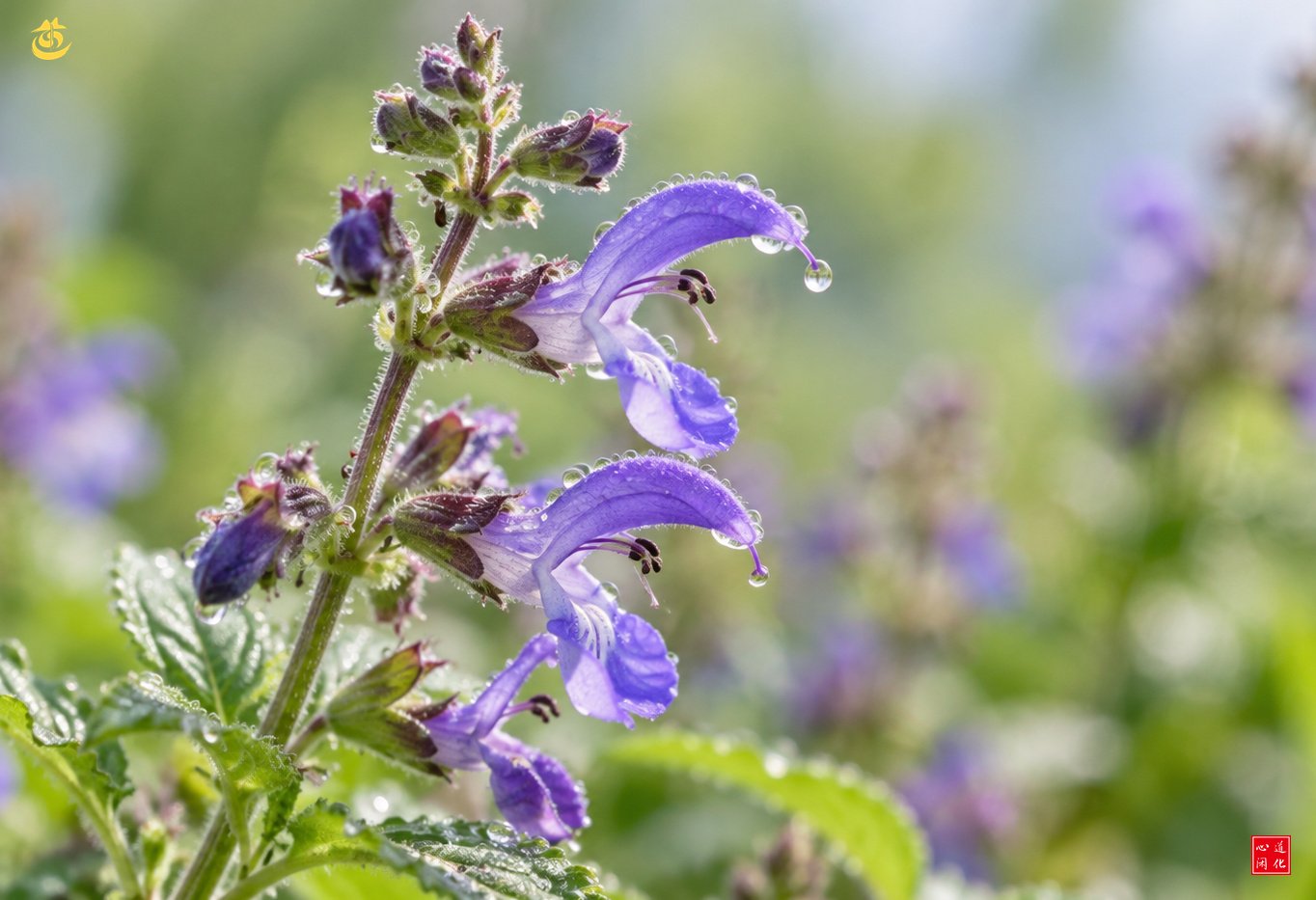
南烛,也称为南天烛、南烛草木、乌饭树,乌饭叶、男续、当染菽 、猴菽草,是杜鹃花科植物越橘属常绿灌木或小乔木,高可达9米;叶薄革质,花梗短,花冠白色,浆果熟时紫黑色,花果期6~10月。我国主要分布于华东、华中、华南和西南。扦插和播种繁殖。
南烛冬夏常青、陵冬不雕,而且可以酿酒、做饭,从古至今,饱受欢迎和歌颂。被后人推崇为“李白雄豪妙绝诗,同与徐凝传不朽”的唐朝诗人徐凝在其题名为《忆紫溪》的七绝中吟道:“长忆紫溪春欲尽,千岩交映水回斜。岩空水满溪自紫,水态更笼南烛花。”
李商隐则感叹说:旧著思玄赋,新编杂拟诗。江庭犹近别,山舍得幽期。嫩割周颙韭,肥烹鲍照葵。饱闻南烛酒,仍及拨醅时。
南宋陆放翁的《倚阑》以:“满庭晴日破朝寒,粥罢披裘小倚栏。残菊抱丛香欲尽,一株南烛独如丹”歌颂了南烛的“陵冬不雕”的风骨。
用南烛叶制作的米饭,民间称为乌饭。最早的做法见于陶弘景的《登真隐诀》。现代的做法是用水将新鲜采摘的乌饭树叶洗净,沥干,放入石槽,用木杵细细捣烂,直至叶子被捣碎成汁,释放出沁人心脾的香气,加入清水,反复挤压,滤出缥青色的汁水,这是乌米饭独特外观和味道的秘密所在,最后,将淘洗干净的糯米加入其中,浸泡一个晚上。吸收了乌饭树叶精华的糯米蒸熟后,就成了乌米饭,添加少许白糖,植物的芬芳与糯米的甘甜交相辉映。
道家把乌饭称为青精饭。宋代大诗人陆游在《小憩长生观饭已遂行》一诗中写道:“道士青精饭,先生乌角巾”,证明了青精饭确实是修道之人的必备之物。道家认为青是东方之色,与春天相应,滋长阳气,吃了能够“气与神通,命不复殒”。
《本草纲目》记载其久服具有“轻身明目,黑发驻颜”的功效。中国农业大学检测的乌饭树叶花青素含量是蓝莓的4.6倍。花青素的抗氧化能力是维生素C的50倍,久服对抗衰老会有帮助。
杜甫《赠李白》吐槽说:“岂无青精饭,使我颜色好。苦乏大药资,山林迹如归。”意思是难道不想经常吃青精饭,让我容貌漂亮、长寿延年?可我没有钱购买,只好自己到山里采集。
皮日休《南阳广文欲于荆襄卜居因而有赠》:“青精饭熟云侵灶,白(礻劫)裘成雪溅窗”。张贲《以青(饣迅)饭分送袭美鲁望因成一绝》:“谁屑琼瑶食青(饣迅),旧传名品出华阳。应宜仙子胡麻拌,因送刘郎与阮郎。”
(饣迅)者,迅也,意谓青精饭是一种不须再烹调、快速可食的食物。这和青精饭的加工方法、耐贮存等特点密切相关。山居食用青精饭,一般是先用南烛枝叶捣汁浸上好的粳米蒸熟后,晒干收藏,食用时,用热水煮一煮即可。这一食法和现代的方便面可以说是有异曲同工之妙。这些颂扬青精饭的诗句使其在唐朝就已经名声大噪。
青精饭或者说乌饭本是古代的一种食疗健身食品,具有养颜的功效。唐代陆龟蒙诗云:“旧闻香积金仙食,今见青精玉斧餐。
自笑镜中无骨录,可能飞上紫雪端。”
在北宋,谢薖《青精饭》咏道:“霍山王邓两真隐,驾鹤乘云飞九天。当时服饵定何物,同饭青精三十年。”
苏轼在《次韵程正辅游碧落洞》一诗中写道:“黄公献紫芝,赤松馈青精”。胡宿在《杂兴》中指出:“安得青精饭,为驻颜如丹。”
张镃在《次韵陈秀才》殷殷嘱咐说:“青精饭好终延老,紫石潭空总付渠。”汪莘《赠祁门不老山高法师》说“饭啖青精颜色好”。
南宋著名学者,著作了福州地方志的梁克家在《淳熙三山志》中记载:邓伯元、褚伯玉、王玄甫等人在(闽东)霍童山上,“授青精饭食、白霞丹景之法,见五脏,夜中能书”。
在明代,何转在《怀陈宾五·其三》中感激说:“感君青精饭,使我好颜色。”朱孟德在《西夏寒食遣兴》中感叹道:“饭煮青精颜固好,杯传蓝尾习能同。”陈重器在《屋楼山》中评论说“饭我青精颜色好”,吕㦂在《寄刘克刚太守》中感叹“愁无却老青精饭”。清代黄化鲤 《咏地瓜 其二》说“青精好饭无他让”,屈大均则有“社日家家南烛饭,青精遗法在苏罗”的诗句流传下来。这些文章诗句全面证明青精饭是养颜延年的食物。
除了做乌米饭,南烛还可以用于制作乌凤爪、乌猪手、乌米粽、乌饭茶等,清香可口,别有一番滋味。以前,一般只能在每年的四五月份摘乌米饭嫩叶的时候吃到乌米饭,过后很难吃到。如今,为了大家长期食用乌米饭,达到延年益寿的效果,研制出了乌米饭干制品,真空包装的乌米,这种便于贮存和携带方便的乌米,越来越受人们欢迎,已成为风靡江南的黑色旅游食品。
南烛入药已经形成了“南烛煎”、黑须仙丹、滋营养液膏、南烛草煎丸和陈氏乌须丸等方剂。
A Lone Nanzhu Tree, Red as Cinnabar
46. A Lone Nanzhu Tree, Red as Cinnabar
Originally published by a certain professor, Daozang Research, 2021-04-03 18:10
In the last piece I introduced the first three passages of Tao Hongjing's "Daoyin Anmo Pian," which told how the author of the Qianzi Wen went white-haired in a single night from overworking his brain, and I mentioned in passing:
The Daozang (Daoist Canon) holds quite a number of tested prescriptions for making the hair black. For example: nanzhu leaves work very well for blackening the hair; eat nanzhu-leaf wufan regularly and you will not go gray even past eighty.
Since the main topic was the daoyin method, I did not go into the matter of nanzhu leaves blackening the hair and nourishing the complexion. One attentive reader, a person of heart, took it up at once in an essay introducing the relevant functions of nanzhu leaves and how to make wufan. And not only the effects of blackening the hair, beautifying, and extending life--the essay may well have gathered in every poem about nanzhu leaves in all of Chinese history. The full text is appended below. Also, CCTV has several documentaries or programs about wufan; fellow practitioners with an interest may go and look them up.
A Lone Nanzhu Tree, Red as Cinnabar
Nanzhu, also known as Nantianzhu, Nanzhu Caomu, the wufan tree, wufan leaf, Nanxu, Dangran Shu, and Houshu Cao, is an evergreen shrub or small tree of the heath family, genus Vaccinium, growing up to nine meters tall; the leaves are thin and leathery, the flower stalks short, the corolla white, the berries purple-black when ripe, with flowers and fruit from June to October. In China it is distributed mainly in the east, the center, the south, and the southwest. Propagation is by cuttings and by seed.
Nanzhu stays green through winter and summer and does not wither even in the depths of the year; it can also be used to brew wine and cook rice, so from ancient times to now it has been warmly loved and sung. The Tang poet Xu Ning, esteemed by later ages with the line "Li Bai's bold, marvelous, matchless poems, passed down immortal together with Xu Ning," chanted in his seven-character quatrain titled "Recalling Purple Brook": "Long I remember Purple Brook as spring was about to end, a thousand cliffs mirrored each other as the waters wound aslant; the cliffs empty, the water brimming, the brook turned purple of itself, and the water's mien shrouded the nanzhu flowers."
Li Shangyin for his part sighed: "Long ago I wrote the rhapsody pondering the mystery, of late I compile assorted imitative verses; the river court still near parting, the mountain lodge gains its secluded tryst; tenderly I cut Zhou Yong's chives, richly I cook Bao Zhao's mallows; long have I heard of nanzhu wine, just in time for skimming the rising brew."
In his "Leaning on the Railing," Lu Fangweng of the Southern Song celebrated nanzhu's unbending spirit that "does not wither in winter" with the lines: "The clear sun over the full courtyard breaks the morning chill; porridge done, I drape my furs and lean a while on the railing; the last chrysanthemums hug their clusters, their fragrance all but spent; a single nanzhu tree alone is red as cinnabar."
The rice made with nanzhu leaves is called wufan among the folk. The earliest method is seen in Tao Hongjing's Dengzhen Yinjue. The modern way: wash the freshly picked wufan leaves, drain them, put them in a stone trough, and pound them fine with a wooden pestle until the leaves are crushed into juice and give off a fragrance that refreshes the heart; add clear water, press again and again, and filter out the pale green liquid--this is the secret of wufan's unique look and flavor. Last, add well-washed glutinous rice and soak it overnight. Steamed, the rice that has drunk in the essence of the wufan leaves becomes wufan; add a little white sugar, and the fragrance of the plant and the sweetness of the rice set each other off.
The Daoists call wufan qingjing fan, "green-essence rice." The great Song poet Lu You wrote in his poem "A Brief Rest at the Changsheng Abbey, Meal Done, Then Setting Out": "The Daoist's green-essence rice, the master's black-cornered kerchief," which proves that green-essence rice was truly a necessity for those who cultivate the Dao. The Daoists hold that green is the color of the east, corresponding to spring and nurturing the growth of yang qi; eaten, it enables one's "qi to communicate with spirit, and life no longer perishes."
The Bencao Gangmu records that taken over a long time it has the effect of "lightening the body, brightening the eyes, blackening the hair, and keeping the complexion young." Testing by China Agricultural University found the anthocyanin content of wufan leaves to be 4.6 times that of the blueberry. Anthocyanins have fifty times the antioxidant power of vitamin C, so long use helps against aging.
Du Fu grumbled in "Presented to Li Bai": "Is there no green-essence rice, to make my complexion good? But I lack the means for the great medicine, and the mountains and forests are as my homecoming." The meaning: how could he not want to eat green-essence rice all the time, to make his looks fine and extend his years? But he had no money to buy it, so he had to go gather it in the mountains himself.
Pi Rixiu's "The Guangwen of Nanyang Wishing to Settle Between Jing and Xiang, and So I Make This Gift": "The green-essence rice cooked, clouds creep over the stove; the white rough-fur cloak finished, snow splashes against the window." Zhang Ben's "A Quatrain Written on Sharing Out the Green-Essence Xun Rice to Send to Ximei and Luwang": "Who would think jade fit food, and eat the green-essence xun instead? Of old this famous grade was said to come from Huayang; it suits the immortal maid to mix it with sesame, and so it is sent to Liu-lang and to Ruan-lang."
Xun means swift: it signifies that qingjing fan is a food that needs no further cooking and can be eaten quickly. This is closely tied to how qingjing fan is processed and how well it keeps. For eating qingjing fan in the mountains, the usual way is first to pound nanzhu branches and leaves into juice, steep fine nonglutinous rice in it, steam it, then dry it in the sun and store it; to eat, one need only simmer it in hot water. This way of eating is, one might say, of one marvelous effect with the modern instant noodle. These lines of praise made qingjing fan's name thunder as early as the Tang.
Green-essence rice, or wufan, was in ancient times a therapeutic food for keeping fit, with the power to nourish the complexion. The Tang poet Lu Guimeng wrote: "Long have I heard of the golden immortal's food at the Fragrant Heap; today I see the green-essence meal of the jade axe.
I laugh that in the mirror there is no bone-record; can I perhaps fly up to the tip of the purple snow?"
In the Northern Song, Xie Ke chanted in "Green-Essence Rice": "Wang and Deng, the two true recluses of Mount Huo, rode cranes and clouds and flew to the ninth heaven; what was it they took for their elixir then? For thirty years they shared the rice of green essence."
Su Shi wrote in "Matching the Rhymes of Cheng Zhengfu on Touring the Biluo Cave": "Huang the Elder presents purple zhi; Chisongzi presents green-essence rice." Hu Su pointed out in "Miscellaneous Themes": "How shall I get green-essence rice, to keep my complexion red as cinnabar?"
Zhang Zi urged earnestly in "Matching the Rhymes of the Scholar Chen": "With green-essence rice so good, old age can truly be kept off; let the empty Purple Stone Pool go to him." And Wang Xin wrote in "Presented to Master Gao of the Unaging Mountain of Qimen" that "one eats green-essence rice and the complexion is good."
The famous Southern Song scholar Liang Kejia, who compiled the local gazetteer of Fuzhou, records in the Chunxi Sanshan Zhi that Deng Boyuan, Chu Boyu, Wang Xuanfu, and others, on Mount Huotong in eastern Fujian, "were taught the method of eating green-essence rice and the method of the white-mist cinnabar scenes, saw the five zang, and could write in the dark of night."
In the Ming, He Zhuan said gratefully in "Thinking of Chen Binwu, No. 3": "I am grateful for your green-essence rice; it has made my complexion good." Zhu Mengde sighed in "Expressing Feelings on the Cold Food Festival in Xixia": "Rice cooked with green essence, the complexion surely thrives; the blue-tail cup passing round, the custom all can share." Chen Zhongqi remarked in "Wulou Mountain" that "fed on green essence, the complexion is good," and Lü Cong sighed in "Sent to Prefect Liu Kegang" that "my sorrow is having no green-essence rice to hold off age." In the Qing, Huang Huali said in "On the Sweet Potato, No. 2" that "of fine green-essence rice there is none other to yield to it," and Qu Dajun has the lines handed down: "On the she-day, every house has nanzhu rice; the old way of green essence lives on in Suluo." These essays and poems prove from every side that green-essence rice is a food that nourishes the complexion and extends the years.
Besides making wufan, nanzhu can also be used for black chicken feet, black pork trotters, black rice dumplings, wufan tea, and the like, all fragrant and tasty, with a flavor of their own. In the past one could generally eat wufan only in April and May, when the tender leaves were picked; after that it was hard to come by. Now, so that everyone can eat wufan over the long term and gain the effect of extending the years, dried wufan and vacuum-packed black rice have been developed, and this black rice, easy to store and to carry, grows ever more popular and has become the fashionable dark-colored local food specialty popular with tourists of Jiangnan.
Taken into medicine, nanzhu has already yielded such formulas as the "Nanzhu Decoction," the Black-Whisker Immortal Elixir, the Nourishing Liquid Paste, the Nanzhu Decoction Pill, and Chen's Black-Whisker Pills.