生姜救命案例---《图经衍义本草》2
3、生姜救命案例---《图经衍义本草》2
原创 杨子 道藏研究 2021-06-03
续上文,接着说《图经衍义本草》关于生姜的偏方、验方。
《唐本》注云:姜,久服通神明,主风邪,主痰气。生者尤良。《经》云:久服通神明,即可常啖也。
注:古人真是的!南北朝时,陶弘景说多吃生姜会“少志少智”,不可久服。上篇文章中因为这一说法,我分析了半天自己变迟钝的原因。到了唐朝,却是“久服通神明”,可以常吃了。唉,我经常说“古之人不我欺也”,现在忽然感觉“古之人逗我玩也”。古人不欺骗我们,但常用一些相反的观点来迷惑我们。这也只能后人自解了。不过这也不难理解,不同的时代,不同地区的生姜,不同体质的试用人群,结果不同,很正常。所以,按自己的情况试用吧。
这样的医药书还好理解,但如果是史书,出现这样的情况,就会比较麻烦。比如《史记》中,关于秦始皇的出生,司马迁在不同的文章中,给出了两个说法。一说是秦异人的儿子,一说是吕不韦的儿子。搞得一个千古帝王的身世到现在论证不清楚,学者们争论了一千多年。百家讲坛的名师,河南大学的王立群教授,说司马迁是“调皮”还是什么,我记不清了,大致是说司马迁用这个模糊的概念与后人开了玩笑。害得他到处请教妇产科医生,根据赢政的出生时间,苦苦推算他的生父。读古籍之苦、读古籍之乐,尽在其中。
陈藏器云:生姜,本功外汗,解毒药,自余破血,调中,去冷,除痰,开胃。用热即去皮,要冷留皮。
注:体寒的人食用生姜,要去皮。皮可不扔,皮有大用,可使白发变黑。
《日华子》云:乾姜,消痰,下气,治转筋,吐泻,腹脏冷,反胃乾呕,瘀血,扑损,止鼻洪,解冷热毒,开胃,消宿食。
禹锡云:按《药性论》云:乾姜,臣,味苦、辛。治腰肾中疼冷,冷气,破血去风,通四肢关节,开五脏六腑,去风毒冷痹,夜多小便。乾者治嗽,主温中,用秦艽。主霍乱不止,腹痛,消胀满,冷痢,治血闭。病人虚而冷,宜加用之。
注:臣,指的是在配伍中是“臣药”角色。中药配伍讲究“君、臣、佐、使”,常看医书的人都明白,常看本公众号的人也明白)
又云:生姜,使。主痰水气满,下气。生与乾并治嗽,疗时疾,止呕逆,不下食。生和半夏,主心下急痛。若中热不能食,捣汁和蜜食之。又汁和杏仁作煎,下一切结气实,心胸拥隔,冷热气。
注:这个方子中,生姜又成了使药,药引子作用。这是中医的灵活,更是科学。
《食疗》云:生姜,温。去痰下气,除壮热,治转筋,心满,去胸中臭气,通神明。又、胃气虚,风热,不能食。姜汁拌鸡子壳,生地黄汁少许,蜜一匙头,和水三合,顿服立差。
注:鸡子壳,指的是鸡蛋壳。立差,意为立即就见效。
《外台秘要》:治霍乱,注痢不止,转筋入腹欲死。生姜三两捣破,以酒一升,煮三四沸顿服。又方:久患咳噫,连咳四五之声者。取生姜汁半合,蜜一匙头,煎令热,温服。如此三服,立效。
注:这里说的第一种病可能不多见了,人类基本已战胜了霍乱。但二个方子,应有现实意义,久咳不治的人很多,我亲见的就有一堆堆,有些人会连续咳好几下,很可怜。这里的方法也很简单,姜汁加蜂蜜,煮热,温服。服三次,立即见效。加了蜂蜜,可以缓解生姜的辛味,不难喝,多好啊!!方便的话请转出去,多多行善事,福报子孙。古人说不要作恶,不然一定会有报应,而且是“远在儿孙近在身”,这是恶报。其实善报也是一样的“远在儿孙近在身”。善恶皆有报,佛家的因果法则、道家的道法自然,都是这个世界上永恒的法则。我们笃信不疑,践行不止。
《千金方》:治乾哕嗽,若手足厥冷。宜食生姜,此是呕家药。又治心下痞坚不能食,胸中呕哕。生姜八两细切,以水三升,煮取一升,半夏五合洗去滑,以水五升,煮取一升,二味合煮取一升半,稍稍服之。又方:治产后秽污下不尽,腹满。生姜二斤,以水煮取汁服,即出。
注:“嘔家”,现简写为“呕家”,指呕吐的人。相同的用法包括病家等。
《经验方》:善治狐臭用生姜汁涂腋下,绝根本。
注:了不得!了不得!据说狐臭很顽固,是治不好的,现代人采取手术,但听说还是不能除根,古人试验的结果是可以绝根本。赶紧分享出去吧。好心总会有福报的。读大学时,我们有一位同学,女生,长得超漂亮,但很不幸,狐臭,她就用比较多的香水,夏天很难受,不适应的同学受不了,上课远远地坐着,不敢靠近。但同学们都很有修养,都努力地掩饰情绪,非常友好。唯恐伤害她的尊严。这就是教养。若是我当初知道这个方子就好了,可以帮同学忙。此生总恨读书迟!
《杨氏产乳方》:胎后血上冲心。生姜五两切,以水八升,煮三升,分三服。
[唐]崔魏公云:铉夜暴亡,有梁新闻之,乃诊之曰:食毒。仆曰:常好食竹鸡,竹鸡多食半夏苗。必是半夏毒,命生姜捩汁,折齿而灌之,即活。
注:这个故事神奇又有趣。唐朝时,有人夜里突然死了,有位叫梁新的人听说了,过去诊治,确诊为食物中毒。仆人说死者特别喜欢吃竹鸡,而竹鸡又多食半夏苗。因此推测必是半夏中毒了。于是用生姜拧出汁,掰开牙齿灌下去,立即又活过来了。
这真是神奇!神奇!神之奇又奇!
这个记录突然让我想起了唐朝大文豪韩愈间接服用硫磺壮阳的故事。因为两个案例的用药原理相似。
据记载:“昌黎公逾晚年颇亲脂粉,故可服食;用硫磺末搅粥饭,啖鸡男,不使交,千日,烹庖,名‘火灵库’,公间日进一只焉”,“始亦见功,终致绝命”。([宋]陶谷《清异录》)
大意:韩愈晚年“颇亲脂粉”,就是颇好女色,又感觉到力不从心,所以采用服食的方法壮阳。他把硫磺研成末喂公鸡,而且不让这些公鸡和母鸡交配,一千日之后,再炖鸡肉吃,取名叫“火灵库”,他觉得公鸡先吸取了硫磺的毒性,而他从服食鸡肉中间接获得硫磺的壮阳功效。“始亦见功,终致绝命”,这种方法开始是有效的,但他吃太多了,“间日进一只”,隔一天吃一只公鸡,最后吃死了。过犹不及!过犹不及!别怪道家服食方法不管用,自己不知道节制造成的。
为了不轻易说古人“坏话”,我考证了一下宋朝这位陶谷的文品及《清异录》记录的可靠性。结论是:可信。
于是,一首打油诗,记录下这个方子:
《硫磺鸡》
唐有退之昌黎翁,文章风流百代宗;
常亲脂粉失元气,一战再战不成功。
求得仙方欲壮阳,借向金禽服硫磺;
始见功效欢乐极,隔日一只命终亡。
(注:金禽,鸡的别称)
其实,韩愈就算是一只鸡不吃,或根本不亲脂粉,最后也一样命亡。人生,各有爱好和诉求。随心,即是道场。生命,开心为上。
突然想到,我们现在食用的鸡肉,很多资料都说肉食鸡是用各种药物喂大的,也有人说那些药经过鸡吸收后,人再吃鸡肉就没事。看到以上食用竹鸡导致的半夏中毒,及韩愈食用硫磺鸡而中毒,让人对肉食鸡不放心起来。还是买溜达鸡比较放心吧。当然,最放心的就是可以见到饲养方式的散养鸡。但这种方式已很少了。
又,本段中,我有一点小感慨。因为一个“诊”字,我在《道藏》原文中看到的是“言+尔”,以为是电脑转错了,就打字查找,五笔打不出。查“诊”的繁体,也查不到。不得已,用了搜索工具书,结果如下图:
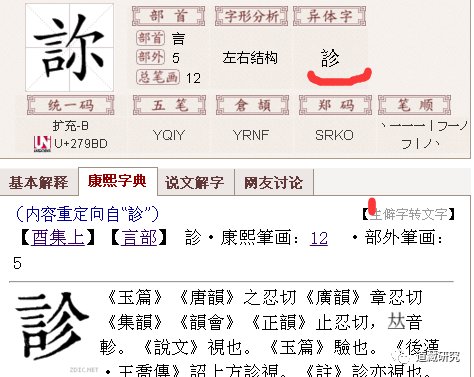
虽然查到了,这让我感觉到电脑对中国文字的不利一面。我们的古文字,可能就是这样一个、两个、三个,慢慢消失掉的吧。虽然我也知道,不合进步趋势的东西势必要淘汰,可就是感觉到似乎有些不对头。如果古字消失到一定的数量,后世可能真的看不懂我们的古籍了。现代白话文才推行一百年,挽救古字、古文还得及,但愿有人具备相关优势,可以为此努力。我非推行复古,只是觉得后世之人若只看得懂白话文,那才是真正的文化危机,我们的文明只能当成古董束之高阁。尽管后世人与我无关了。但我爱这个民族的文化。所以唠叨此段。
《衍义》曰:生姜,治暴逆气,嚼三、两皂子大,下咽定,屡服屡定。初得寒热痰嗽,烧一块,含齿之终日间,嗽自愈。
暴赤眼无疮者,以古铜钱刮净姜上取汁,於钱唇点目,热泪出。今日点,来日愈。但小儿甚惧,不须疑,已试良验。
注:得了严重的红眼病,并且没有疮伤的,用生姜汁点眼睛,可治愈。想像一下很可怕,但古人试过了,就是流泪而已,不用怕,很有效。当日点,第二天就见效。甚至小孩子也可以用这种方法,还说不用怀疑。这是古人为医学事业做出的辛苦尝试。验方最宝贵!看到了不与大家分享,难说善念心十足。
下篇预告:白癜风的验方,一味海产品的药用及食用功效。此方原不在上传规划,但上篇文章留言中有读者说他得相关疾病,很烦恼,问起有没有相关古方。我答复有,会整理上传,所以把那个方子倒腾出来,尽快整理上传。今天有客人来,我需要去办公室泡茶,明天至下周,安排出差。拟下周末吧。
照例,两首道情:
《抚琴》
古鼎焚香香弥远,新人泡茶茶久香。
快意书籍榻前放,信手诗词赋几行。
千金红钱隔屏撒,高楼抚琴自听响
诵偈阅经天地心,静观花落俗念亡。
YZ.2019.9.21
《为道为君》
八月举步泗水滨,作别都市远红尘;
林中隐鹭飞始见,云后惊雷响方闻。
清界湖边漫吟诗,玉树风摆石榴裙;
人间瑶池多瑞气,中有仙家修道真。
掬水捧月珠在手,摘花插发满头春;
山雨飘飘花洗妆,清风阵阵月熏魂。
壮士横刀行天下,揽我佳人夜销魂;
耳边海风波涛起,天籁之音隔窗闻。
起身揽衣推窗望,繁星满天好日辰;
缘何千里苦相念,半为修道半为君。
Life-Saving Cases of Fresh Ginger--Tujing Yanyi Bencao (2)
31. Life-Saving Cases of Fresh Ginger--Tujing Yanyi Bencao (2)
Originally published by Yang Zi, Daozang Research, 2021-06-03
Continuing from the last piece, I go on with the folk remedies and proven formulas for fresh ginger in the Tujing Yanyi Bencao.
The Tang Ben notes: Ginger, taken long, opens communication with the spirits, governs wind pathogens, and governs phlegm qi. The fresh root is especially good. The Jing says: taken long it opens communication with the spirits, so it may be eaten regularly.
Note: Honestly, these ancients! In the Northern and Southern Dynasties, Tao Hongjing said eating too much fresh ginger makes one "weak of purpose and dull of mind," and that it must not be taken long. In the previous piece, on the strength of that saying, I spent half the article analyzing why I had grown slow-witted. Come the Tang, however, it is "taken long, it opens communication with the spirits," and it may be eaten regularly. Ah--I have often said that "the ancients did not deceive me"; now I suddenly feel that "the ancients were toying with me." The ancients do not lie to us, but they often bewilder us with opposing views. That is for later generations to work out for themselves. Nor is it hard to understand, really: different eras, ginger from different regions, trial groups of different constitutions--different results. Quite normal. So try it according to your own case.
A medical book like this is easy enough to take; but when it happens in a history, it is more troublesome. In the Shiji, for instance, on the birth of the First Emperor of Qin, Sima Qian gives two different accounts in different chapters: one that he was the son of Yiren of Qin, one that he was the son of Lü Buwei. The result is that the parentage of an emperor for the ages remains unproven to this day, and scholars have argued over it for more than a thousand years. A famous lecturer on "Lecture Room," Professor Wang Liqun of Henan University, said Sima Qian was being "mischievous"--or something of the sort, I forget exactly--the gist being that Sima Qian used this blurred notion to play a joke on posterity. It sent the professor all over the place consulting obstetricians, painstakingly reckoning from Ying Zheng's birth date who his true father was. The bitterness and the joy of reading ancient books are all in this.
Chen Cangqi says: Fresh ginger--beyond its basic functions, sweating and antidoting drug poisons; besides these it breaks blood stasis, regulates the middle, removes cold, dispels phlegm, and opens the appetite. When you want its heat, peel it; when you want cold, keep the peel.
Note: Those with cold constitutions should peel fresh ginger before eating it. But the peel need not be thrown away--the peel has great uses: it can turn white hair black.
Rihuazi says: Dried ginger dispels phlegm, brings qi downward, treats cramps, vomiting and diarrhea, cold in the abdominal organs, regurgitation and dry retching, static blood, and traumatic injury; stops nosebleed floods, resolves cold and heat toxins, opens the appetite, and digests lingering food.
Yuxi says: According to the Yaoxing Lun: dried ginger is a minister; its flavor is bitter and acrid. It treats aching cold in the lower back and kidneys and cold qi; it breaks blood stasis and dispels wind, frees the joints of the four limbs, opens the five zang and six fu, and removes wind-toxin cold painful-obstruction and frequent night urination. The dried form treats cough, warms the middle, and is used with qinjiao. It governs unremitting cholera and abdominal pain, dispels distension and fullness and cold dysentery, and treats blood blockage. For patients weak and cold, it is fitting to add it to prescriptions.
Note: "Minister" means it plays the role of the "minister drug" in a combination. Chinese drug combination goes by "sovereign, minister, assistant, courier"; anyone who often reads medical books understands this, and so do the regular readers of this WeChat official account)
It also says: Fresh ginger is a courier. It governs phlegm-water qi and fullness, and brings qi downward. Both the fresh and the dried treat cough, remedy seasonal illness, and stop retching and refusal of food. Taken fresh together with pinellia, it governs acute pain below the heart. If one has internal heat and cannot eat, pound out the juice, mix it with honey, and eat it. Also, juice mixed with apricot kernels and reduced into a syrup brings down all bound qi and excess, congestion and blockage of heart and chest, and cold and heat qi.
Note: In this formula fresh ginger becomes the courier drug, playing the part of the guiding courier. This is the flexibility of Chinese medicine--and it is science.
Shiliao says: Fresh ginger is warming. It dispels phlegm and brings qi downward, relieves high fever, treats cramps and fullness of the heart, removes foul qi from the chest, and opens communication with the spirits. Also, for deficiency of stomach qi, wind-heat, and inability to eat: mix ginger juice with eggshell, a little fresh rehmannia juice, one spoonful of honey, and three ge of water; take in a single dose and recovery is immediate.
Note: Jizike means the shell of a hen's egg. Licha means it takes effect immediately.
Waitai Miyao: For cholera with unremitting pouring diarrhea and cramps spreading into the abdomen to the point of near death. Pound and crush three liang of fresh ginger, add one sheng of wine, bring it to the boil three or four times, and take in a single dose. Another formula: for chronic cough-hiccup, where one coughs four or five sounds in a row. Take half a ge of fresh ginger juice and one spoonful of honey, warm them over heat, and drink warm. Three such doses, and it takes effect at once.
Note: The first illness named here has perhaps become rare--humanity has by and large conquered cholera. But the second formula should have real relevance today. Many people have lingering coughs that never get treated; I have personally seen heaps of them--some people cough several times in a row, poor things. The method here is simple too: ginger juice plus honey, warmed over heat, drunk warm. Three doses, and it takes effect at once. The honey softens the acridity of the ginger; it is not hard to drink--how fine!! If it is convenient, please pass this along: do more good deeds, and blessings will reward your children and grandchildren. The ancients said, do no evil, or retribution will surely come--and it comes "far off in your sons and grandsons, or near at hand in your own body." That is evil's reward. But good's reward works just the same: "far off in your sons and grandsons, near at hand in your own body." Good and evil both bring their returns: the Buddhist law of cause and effect, the Daoist law of the Dao following nature--both are eternal laws of this world. We believe without doubt and practice without cease.
Qianjin Fang: For dry retching with cough, and cold reaching the hands and feet. Fresh ginger is fitting food; it is the drug for those given to vomiting. It also treats glomus and hardness below the heart with inability to eat, and retching in the chest. Cut eight liang of fresh ginger fine, boil in three sheng of water and draw off one sheng; take five ge of pinellia, wash off the slickness, boil in five sheng of water and draw off one sheng; combine the two and boil down to one and a half sheng, and sip it little by little. Another formula: for postpartum lochia that fails to come away completely, with fullness of the abdomen. Take two jin of fresh ginger, boil in water, draw off the juice, drink it, and it comes away at once.
Note: "Oujia"--written here with the full-form character for ou, now written in the simplified form--means people given to vomiting. Similar usages include bingjia (the sick) and the like.
Jingyan Fang: Excellent for body odor--rub fresh ginger juice into the armpits; it eradicates the trouble at the root.
Note: Remarkable! Remarkable! They say body odor is stubborn and incurable; modern people resort to surgery, but even then, I hear, it cannot be rooted out--while the ancients' trials showed it can be eradicated at the root. Share this quickly, won't you? A kind heart always earns its blessing. In my university days we had a classmate, a girl, surpassingly beautiful, but--most unluckily--she had body odor. She used a good deal of perfume; summers were hard for her. The classmates who could not stand it sat far off in class and dared not come near. But everyone was well-bred: all worked to hide their feelings and stayed very friendly, for fear of wounding her dignity. That is what upbringing means. If only I had known this formula then--I could have helped her. All my life I have regretted reading too late!
Yangshi Chanru Fang: For blood rushing up to the heart after childbirth. Cut five liang of fresh ginger, boil in eight sheng of water down to three sheng, and take in three doses.
Duke Cui Wei of the Tang relates: Xuan died suddenly in the night. A man named Liang Xin heard of it, examined him, and said: food poisoning. The servant said: he was ever fond of eating bamboo partridge, and bamboo partridge often feeds on pinellia sprouts. It must be pinellia poisoning. He ordered fresh ginger wrung out for its juice; they pried his jaws open and poured it in, and he came back to life at once.
Note: This story is marvelous and delightful. In the Tang, someone died suddenly in the night; a man named Liang Xin heard of it, went over to examine him, and diagnosed food poisoning. The servant said the dead man was especially fond of eating bamboo partridge, and bamboo partridge often feeds on pinellia sprouts. From this it was inferred that it must be pinellia poisoning. So they wrung the juice out of fresh ginger, pried open his teeth and poured it in, and he immediately came back to life.
This is truly marvelous! Marvelous! A marvel of marvels, the gods' own wonder!
This record suddenly reminded me of the story of the great Tang man of letters Han Yu taking sulfur indirectly to strengthen his yang. Because the principle of the medication in the two cases is similar.
The record says: "In his late years His Honor Changli grew quite fond of women, and so he took to the practice of medicinal dietary ingestion: he stirred sulfur powder into rice porridge and fed it to roosters, letting none of them mate; after a thousand days they were slaughtered and cooked, and the dish was named 'Huo Ling Ku' (Treasury of Fire Spirits); His Honor ate one every other day," and "at first it showed results, but in the end it cost him his life." (Tao Gu of the Song, Qingyi Lu)
The gist: in his late years Han Yu was "quite devoted to rouge and powder"--that is, rather fond of women--and felt his strength failing him, so he adopted the method of dietary ingestion to strengthen his yang. He ground sulfur into powder and fed it to roosters, letting none of them mate with hens; after a thousand days the roosters were slaughtered and cooked, and the dish was named "Huo Ling Ku" (Treasury of Fire Spirits). He supposed the roosters had first absorbed the sulfur's toxicity, and that by eating their flesh he would obtain the sulfur's yang-strengthening power indirectly. "At first it showed results, but in the end it cost him his life." The method worked at the beginning, but he ate far too much--"one every other day," a rooster every second day--until he ate himself to death. Too much is as bad as too little! Too much is as bad as too little! Do not blame the Daoist methods of dietary ingestion for failing; it was his own lack of moderation that did it.
Not wanting to speak ill of the ancients lightly, I did some checking into the literary character of this Tao Gu of the Song and the reliability of what the Qingyi Lu records. My conclusion: credible.
So, a bit of doggerel verse to record this formula:
"The Sulfur Chicken"
In the Tang there was the old man Changli, Tuizhi; his essays and flair made him the master of a hundred generations;
Ever close to rouge and powder, he lost his original qi; battle after battle, never a victory.
He sought an immortal formula to strengthen his yang, borrowing the golden fowl to take his sulfur;
At first it worked, and his joy was boundless; then one rooster every other day, and his life was done.
(Note: the golden fowl is another name for the chicken.)
In truth, even if Han Yu had not eaten a single one of those chickens, or never gone near rouge and powder at all, he would still have died in the end. In life, each has their own loves and their own wants. To follow the heart--that itself is the place of practice. In this life, joy comes first.
A sudden thought: much of what is written says the broiler chickens we now eat are raised on all manner of drugs, though some say that once the chicken has absorbed those drugs, eating its meat does us no harm. But having seen the pinellia poisoning from eating bamboo partridge above, and Han Yu's poisoning from eating sulfur-fed chickens, one grows uneasy about broilers. Better to buy "strolling" free-range chickens. Of course the most reassuring of all are free-range chickens whose way of being raised you can see with your own eyes. But that way has grown rare.
One more thing: this passage gave me a small reflection. Because of the single character zhen ("to diagnose"), what I saw in the original text of the Daozang (Daoist Canon) was "yan + er"; I thought the computer had mis-converted it, so I tried typing it--Wubi could not produce it. I looked up the full form of zhen, and could not find that either. As a last resort I turned to a reference search tool, and the result is shown in the image below:
Though I did find it, the search made me feel the unfavorable side of computers for the written language of China. Our ancient characters may be disappearing just like this--one, two, three at a time. I know well enough that whatever runs against the tide of progress is bound to be eliminated, yet still it feels somehow not right. If the ancient characters vanish past a certain number, later ages may truly be unable to read our old books. The modern vernacular has been promoted for only a hundred years; there is still time to save the old characters and old prose--may there be someone with the right advantages willing to labor at it. I am not urging a return to antiquity; I only feel that if the people of later ages can read nothing but the vernacular, that will be a real crisis of culture, and our civilization will have to be shelved away like an antique. Though the people of later ages are nothing to me. But I love the culture of this people. Hence this stretch of grumbling.
Yanyi says: Fresh ginger treats sudden rebellious qi. Chew a piece two or three soapbeans in size; once it is swallowed the condition settles, and repeated doses settle it repeatedly. At the first onset of chills-and-fever phlegm cough, burn a piece and hold it in the teeth the whole day, and the cough heals of itself.
For acute red eyes without sores: take an old bronze coin and scrape peeled, clean ginger to draw out its juice, and drip it into the eye from the coin's lip; hot tears will flow. Drip today, and tomorrow it is healed. Children are much afraid of it, but do not doubt--it has been tried with excellent results.
Note: for severe pink eye without sores, dripping fresh ginger juice into the eye can cure it. It sounds frightening to imagine, but the ancients tried it: it is only tears flowing--no need to fear, and it works well. Drip today, and the next day it is better. Even small children can use this method--so it says, no need to doubt. This was the painstaking trial the ancients made for the cause of medicine. Proven formulas are the most precious thing! To have seen this and not share it with everyone--hard to claim a heart full of good intent.
A preview of the next piece: a proven formula for vitiligo--the medicinal and dietary uses of one sea product. This formula was not in the original uploading plan, but in the comments on the last piece a reader said he suffers from the ailment in question and is troubled by it, and asked whether there is a related ancient formula. I replied that there is, and that I would organize and upload it, so I dug that formula out, to arrange and upload it as soon as possible. Today I have guests coming and need to go to the office to brew tea; tomorrow through next week I am away on business. Let us say next weekend. As usual, two Daoqing chants:
"Playing the Qin"
In the ancient tripod incense burns, its fragrance carrying far; a new hand brews tea, and the tea's fragrance lasts long.
Books after my heart lie open before the couch; at random I set down a few lines of verse.
A thousand coins of red money scatter past the screen; in the high tower I play the qin and listen to the sound myself
Chanting gathas, reading scriptures, the heart of heaven and earth; quietly watching the flowers fall, worldly thoughts die away.
YZ.2019.9.21
"For the Dao, and for You"
In the eighth month I set out on the banks of the Si River, bidding the city farewell, far from the red dust;
The hidden egret in the woods is seen only when it flies; the startling thunder behind the clouds is heard only when it sounds.
By the clear lake I chant poems at ease; in the wind the jade tree sways like a pomegranate skirt;
The Jasper Pool on earth is full of auspicious air; within it the immortals truly cultivate the Dao.
Scooping water, I hold the moon like a pearl in my hand; plucking flowers, I pin spring all over my hair;
The mountain rain drifts down as flowers wash their makeup; gust after gust of clear breeze, and the moon perfumes the soul.
A brave man crosses the world with sword in hand; I draw my beloved close, and the night carries me away;
In my ears the sea wind and rising waves; the sounds of heaven heard through the window.
Rising, gathering my robe, I push open the window and gaze: a sky full of stars on this fine day;
Why do I long so bitterly across a thousand li? Half for the Dao I cultivate, and half for you.