人最智慧的器官----舌头
4、人最智慧的器官----舌头
杨子 道藏研究 2016-08-29
夏日无聊时,当为是非季。
可能太无聊了,人们找不到谈资。于是八卦某影星的婚变,所有媒体体齐上阵,热闹非凡。大部分的报道,都是为赚取眼球的,甚至是到了一种荒唐的地步。
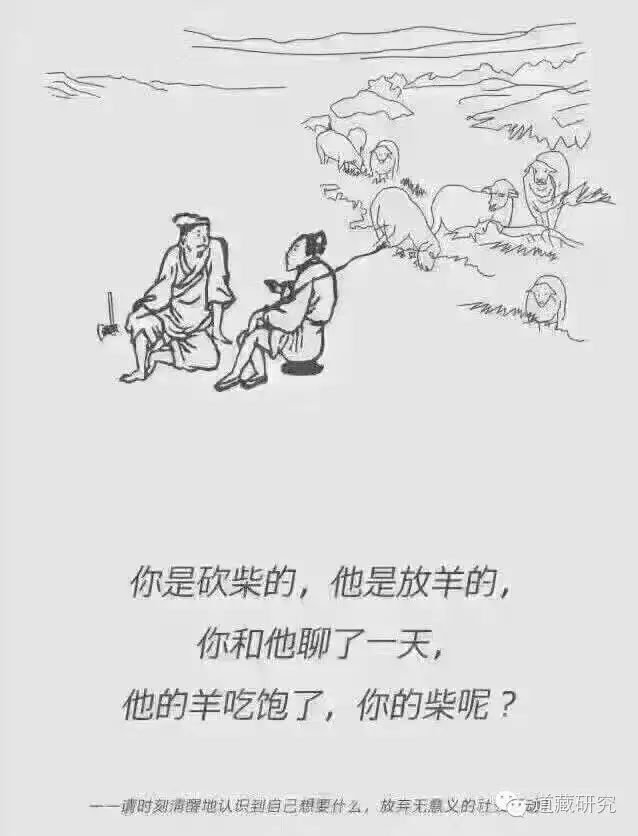
八卦是非,是人类的一种特色风习,也是人社会性的一种表现。心理学研究表明,越是内心空虚无聊的人,越容易八卦是非。很多人可能没有明白,现代媒体很重要的工作不是揭露真相,而是八卦是非,吸引眼球是媒体的终极目的。如果你把自己的宝贵时光放在与媒体互动和沟通上,与上图打柴的人,有什么区别呢?人家八卦是非,是本职工作,而且从中受益,成就了本身。而我们从中又能增长多少知识,提升多少修为呢?改善了多少生命质量呢?逝去的时间,谁有本事找得回来?

然而,身上最难管束的器官,当属舌头。“是非只为多开口,烦恼皆因强出头”,前一段,写了一篇文章《过午不食》,其中有句话:事少,忧少;情少,伤少;话少,祸少;食少,病少。
人生这四个减灾去难的方法,有两个与舌头相关。舌头是我们身上最智慧的器官,也是罪过最大的器官。
百病皆从口入,过食为健康大忌。这谁都知道。在餐桌上,明明知道肚子已饱了,而且体内根本不需要那么多营养,但嘴巴还是停不下来,为什么呢?就是因为舌头对美味的无限需求。尝完美味,舌头洗漱完毕,和身体大部分器官一样,开始休息,而肠胃却无法休息,彻夜工作,而且不管工作量多少,天亮前必须完成,因为早餐又要来了。长此以往,肠胃不得病就是怪事了。
说人是非,也是舌头的另一功能。尽管我们都知道,“来说是非者,即是是非人”,但还是忍不住会去听,会去参与,这是人的本性。记得小时候家里西屋书房里挂了一副书法作品,叫“唐太宗见许敬宗”,有一天,大哥在扫地时(家里最爱做卫生的就是大哥,整天扫个不停),不知怎么个原由,他举着扫把,忽然给我和二哥串讲起那副作品,那场景,我至今记得(文意显然,不再翻译):
唐太宗问许敬宗曰:“朕观群臣之中唯卿最贤,人有议卿非者,何哉?”敬宗对曰:“春雨如膏,农夫喜其润泽,行人恶其泥泞;秋月如镜,佳人喜其玩赏,盗贼恶其光辉,天地之大尤憾而况臣乎?臣无肥羊美酒以调和众口是非,且是非不可听,听之不可说。君听臣受戮,父听子遭诛,夫妇听之离,朋友听之绝,亲戚听之疏,乡邻听之别。人生七尺躯,谨防三寸舌,舌上有龙泉,杀人不见血。谁人面前不说人?谁人背后无人说?”太宗曰:“卿言甚善,朕当识之!”

那是我最早接受关于“是非”的教育,知道了舌头的可怕,每每想到“夫妇听之离,朋友听之绝,亲戚听之疏,乡邻听之别”就无限感慨;想到“舌上生龙泉,杀人不见血”,就不寒而栗。然而,谁人背后无人说,谁人人前不说人
作为社会人,谁又能逃脱了这是非的怪圈呢?“树大风憾树,名高名伤人”,人红是非多,这似乎也是一种是非学定律。所以古人说:
木秀于林,风必摧之;堆出于岸,流必湍之;行高于人,众必非之”(李康《运命论》)
然而上学后,却又读到了不少人因为舌头而腾达成功的人,比如毛遂,“毛先生以三寸之舌,强于百万之师。胜不敢复相士。”遂以为上客。(司马迁《史记·平原君虞列传》)
著名的外交家张仪在被一顿胖揍后,问太太他的舌头还在不在,当听说舌头还在时,就很安慰很满足,因为那是他的“吃饭工具”,只要舌头在,就可以到处游说,飞黄腾达。
张仪被楚相“掠笞数百”,其妻曰:“嘻!子毋读书游说,安得此辱乎?”张仪谓其妻曰:“视吾舌尚在否?”其妻笑曰:“舌在也。”仪曰:“足矣。” (司马迁《史记·张仪列传》)
张良为刘邦称帝立下了汗马功劳,决定成功身退,自称“以三寸舌为帝者师,封万户,位列侯,此布衣之极”,于是深感不安,要辞官回家。
以上例子,基本上都是儒家的。
说说佛家。

佛教中关于舌头最经典的故事,当属鸠摩罗什舌舍利的故事了。

东晋鸠摩罗什是现在新疆人,姚秦国师,伟大的佛经翻译家、传经高僧。公元409年,大师圆寂前与众僧道别时曾说:“凡所出经论三百余卷,唯《十诵》一部未及删烦了,存其本旨必无差失。愿凡所宣译,传流后世,咸共弘通。今于众前发诚实誓,若所传无谬者,当使焚身之后,舌不燋烂。”意思是假如他所译的经典没有错误,在他焚身之后,这个舌头就不会烧坏,不会烂掉。果然,在他圆寂时,火灭身碎后,惟有舌头完好无损。三寸不烂之舌,证显鸠摩罗什之誓。后来,他的舌舍利被移到甘肃武威鸠摩罗什寺供奉至今。
憨山大师《醒世歌》是我随车音乐中播放较多的佛歌,其中有两句苦口婆心的劝善语:
休将自己心田昧,莫把他人过失扬,
惹祸只因闲口舌,招愆多为狠心肠.
其实,不仅佛教,基督教中也有类似的教育:
你们不要论断人,免得你们被论断。因为你们怎样论断人,也必怎样被论断;你们用什么量器量给人,也必用什么量器量给你们。(《圣经》之《马太福音》7:1-2)
但凡涉及舌的智慧,道家当属第一。因为这里有“柔弱胜刚强”最经典的领悟。
在北大校园,有一个老子吐舌的雕像,传说是孔子向老子求教时,老子给孔子看自己的舌头和牙齿还在不在,以此来诠释“柔弱胜刚强“的道理和智慧。略考证下,这个故事其实是发生在老子和他的老师商容之间的,因为孔子名气大,也因为孔子确实也向老子求教过,所以这个故事就给误传了。真实情况如下:

“商容,不知何许人也,有疾。老子曰:‘先生无遗教以告弟子乎?’’---容张口曰:‘吾舌存乎?’曰:‘存。’曰:‘吾齿存乎?’曰:‘亡。’‘知之乎?’老子曰:‘非谓其刚亡而弱存乎?’容曰:‘嘻!天下事尽矣。’”(皇甫谧《高士传》)
高人商容,生病了,老子去看望他,问道:“先生没有什么遗教告诉弟子的吗?”商容张开口,说:“我的舌头还在吗?”老子说:“还在。”“我的牙齿还在吗?”“没有了。”你可懂其中道理?”老子说:“不是说刚强的容易消亡而柔弱的容易生存吗?商容说:“哈哈!天下的道理都在这里了!”
在这个典故的页边空白处,我写了一首小诗来诠释自己的理解:
咏舌(一)
齿嚼百物苦,舌品千味香;
坚齿早损落,柔舌寿命长。
此间可有道?柔弱胜刚强。

舌头与牙齿是近邻居,也是搭档。年老了,牙齿磨光了,舌头还完好。确实是柔弱胜刚强的典型表现。牙齿的工作是切割和咀嚼,而舌头则是搅拌和品味。而且在决策层面上,大脑更多的听从舌头的意见,很少顾忌牙齿的感受。我们身上的所有器官,都没有舌头这样的好待遇和好结局。
一首打油诗,表达下对柔舌的佩服:
咏舌(二)
尝遍人间美味,说尽他人是非
人老身倦发白,齿落眼花耳背
遍观周身器官,唯舌无有损毁
高师不在天涯,柔舌生存智慧
倘若真能做到:格局法天,承诺法山,包容似海,智慧如舌。该是怎样的一种人生修为呢?至少,少话一句话,多读一卷书。迷茫浮躁中,愿皈依智慧。
The Wisest Organ in the Human Body--The Tongue
32. The Wisest Organ in the Human Body--The Tongue
By Yang Zi, Daozang Yanjiu, 2016-08-29
When summer days grow dull, it is surely the season of gossip.
Perhaps out of sheer boredom, with nothing else to talk about, people turned to gossiping about a film star's broken marriage, and every media outlet joined the charge, a marvelous bustle. Most of the stories were there to hook the eye, some of it carried to a truly ridiculous extreme.
Gossiping and scandal-making are one of humanity's distinctive customs, and one expression of our social nature. Psychological research shows that the emptier and more bored people are within, the readier they are to gossip. Many people perhaps have never noticed that an important part of the modern media's work is not uncovering the truth but gossiping and scandal-making; hooking the eye is the media's ultimate aim. If you spend your precious hours in interacting and communing with the media, how do you differ from the firewood-gatherer in the picture above? For them, the gossiping is the day's proper work, and they profit by it, making themselves by it. But how much more knowledge do we gain from it, how much do we add to our cultivation? How much do we better the quality of our lives? And the time already gone, who has the power to fetch it back?
Yet the hardest organ in the body to discipline must be the tongue. "Trouble comes only of talking too much; vexation all of pushing one's neck out." A while back I wrote an essay, "Not Eating After Noon," in which there was a line: fewer matters, fewer worries; fewer entanglements, fewer wounds; fewer words, fewer misfortunes; less food, less sickness.
Of these four ways of cutting harm and averting trouble in life, two are bound up with the tongue. The tongue is the wisest organ in us, and also the organ with the greatest sins to its name.
A hundred diseases enter by the mouth, and overeating is the great taboo of health; everyone knows that. At the table, knowing full well the belly is full, and that the body has no need at all of so much nourishment, the mouth still will not stop. Why? Because of the tongue's boundless demand for delicious flavors. When the tasting is done and the tongue has rinsed itself clean, it goes off to rest like most of the body's organs, while the stomach and gut get no rest: they work through the night, and whatever the workload, it must be finished before daybreak, because breakfast is coming again. Go on that way long enough, and it would be a wonder if the stomach and gut did not sicken.
Passing judgment on others is another function of the tongue. Though we all know that "the one who comes retailing gossip is himself the gossip," we still cannot help listening and joining in; such is human nature. I remember that when I was small, hanging in the west-room study of our house was a piece of calligraphy titled "Emperor Taizong Meets Xu Jingzong." One day, while my eldest brother was sweeping (he was the one in our family who loved housework best, sweeping all day without stop), for some reason or other, broom held high, he suddenly began retelling that piece to me and my second brother. That scene I remember to this day (the meaning being plain, it is not translated again here):
Emperor Taizong asked Xu Jingzong: "Looking over all my ministers, you alone are the worthiest, and yet there are those who speak against you. Why?" Xu Jingzong replied: "Spring rain is like rich oil: the farmer delights in its moisture, the traveler hates its mud; the autumn moon is like a mirror: the beauty delights to gaze at it, the thief hates its light. Heaven and earth, vast as they are, still incur complaint; how much more then your servant? I have no fat sheep and good wine to smooth the many mouths of gossip, and what is more, gossip must not be listened to; even if heard, it must not be repeated. When a ruler listens, ministers are put to death; when a father listens, sons are executed; when husband and wife listen, they part; when friends listen, they break; when kin listen, they grow estranged; when neighbors listen, they are set apart. A man's life is a frame of seven feet; guard well against the tongue of three inches. On the tongue sits the Longquan sword: it kills without drawing blood. Who does not speak of others when in company? Who is not spoken of behind his back?" Taizong said: "Well said indeed. I shall remember it."
That was my earliest schooling in "gossip." I learned how frightful the tongue can be. Whenever I think of "when husband and wife listen, they part; when friends listen, they break; when kin listen, they grow estranged; when neighbors listen, they are set apart," my heart overflows; when I think of "on the tongue grows the Longquan, killing without drawing blood," I shiver. And yet: who is not talked of behind his back, and who does not talk of others when in company
As social beings, who can escape this strange loop of gossip? "A big tree, and the great wind shakes it; a lofty name, and it wounds its bearer." The more famous a person, the more gossip surrounds them; this too seems to be a law of the science of gossip. So the ancients said:
A tree that stands out in the forest, the wind will surely break; a mound that rises from the bank, the current will surely churn it; a man whose conduct stands above the crowd, the many will surely find fault" (Li Kang, Yuming Lun)
Yet once I was in school, I also read of not a few people who rose to fortune and success by way of the tongue, Mao Sui for one: "Master Mao, with a three-inch tongue, has proved mightier than an army of a million men; Sheng no longer dares to judge men again." And so he was made a guest of the highest honor. (Sima Qian, Shiji, "Pingyuan Jun Yu Liezhuan")
The famous diplomat Zhang Yi, after taking a sound thrashing, asked his wife whether his tongue was still there; and hearing that it was, he was greatly comforted and content, for it was his "bread-winning tool": so long as the tongue remained, he could go anywhere persuading and lobbying, and rise high and far.
Zhang Yi was "flogged several hundred strokes" by the chief minister of Chu. His wife said: "Ah! If you had not gone in for books and lobbying, how would you have come to this disgrace?" Zhang Yi asked his wife: "Look, is my tongue still there?" His wife laughed: "The tongue is there." Yi said: "That is enough." (Sima Qian, Shiji, "Zhang Yi Liezhuan")
Zhang Liang performed feats of the first order in helping Liu Bang to the throne, and resolved to retire at the height of success, calling himself "one who with a three-inch tongue became tutor to an emperor, was enfeoffed with ten thousand households, and stood among the marquises, the utmost a man in common cloth can attain." Deeply uneasy at this, he wished to resign his office and go home.
The examples above are, on the whole, Confucian ones.
Now let us speak of the Buddhists.
The most classic Buddhist story about the tongue must be the story of Kumarajiva's tongue relic.
Kumarajiva of the Eastern Jin was a native of what is now Xinjiang, state preceptor to the Yao Qin, a great translator of Buddhist sutras and a high monk who transmitted the scripture. In AD 409, when the master took leave of the assembled monks before his passing, he said: "Of the sutras and treatises I have brought out, over three hundred scrolls, only the Shisong has not yet been trimmed of its redundancies; keep to its original sense, and there will surely be no error. May all that I have preached and translated be handed down to later generations, and may all together spread it abroad. Now, before this assembly, I make a vow in honesty: if what I have transmitted is without error, then after this body is burned, my tongue shall not be scorched or rotted." The meaning: were the scriptures he had translated without error, then after his body was burned, this tongue would not burn up or rot away. And so it proved: when he passed away and the fire went out and the body crumbled, the tongue alone was whole and unharmed. The three-inch unrotted tongue bore witness to Kumarajiva's vow. Later his tongue relic was carried to the Kumarajiva Temple in Wuwei, Gansu, and enshrined there to this day.
Master Hanshan's "Song to Awaken the World" is a Buddhist song I often play among the music in my car; two lines of it plead for goodness with tireless patience:
Do not dim the field of your own heart; do not broadcast the faults of others,
Disaster is courted by an idle tongue; misfortune invited by a cruel heart.
In fact, not only Buddhism; Christianity too has its like teaching:
"Do not judge others, lest you yourselves be judged. For with the judgment you give, you shall be judged; and with the measure you mete out, it shall be measured back to you" (the Bible, the Gospel of Matthew, 7:1-2)
But in whatever touches on the wisdom of the tongue, the Daoist school must rank first, for here is the most classic insight into "the soft and weak overcoming the hard and strong."
On the campus of Peking University there is a statue of Laozi with his tongue thrust out. Legend has it that when Confucius came to consult him, Laozi showed Confucius whether his own tongue and teeth were still there, by way of expounding the principle and wisdom of "the soft and weak overcoming the hard and strong." A little research shows that the story in fact took place between Laozi and his teacher Shang Rong; because Confucius was the more famous, and because Confucius truly did once consult Laozi, the story came to be passed down in error. The true account is this:
"Shang Rong, a man of no known origin, fell ill. Laozi said: 'Master, have you no last teaching to give your disciple?''---Rong opened his mouth and said: 'Is my tongue still there?' He was answered: 'It is.' 'Are my teeth still there?' He was answered: 'They are gone.' 'Do you understand?' Laozi said: 'Is it not that the hard perishes while the soft endures?' Rong said: 'Ah! Then all the affairs of the world are settled.'" (Huangfu Mi, Gaoshi Zhuan)
The lofty master Shang Rong fell ill, and Laozi went to see him, asking: "Master, is there no last teaching you would give your disciple?" Shang Rong opened his mouth and said: "Is my tongue still there?" Laozi said: "It is." "Are my teeth still there?" "They are gone." "Do you understand the principle in this?" Laozi said: "Is it not that the hard and strong easily perish, while the soft and weak easily endure?" Shang Rong said: "Ha! All the principles under heaven are in this!"
In the margin beside this classic tale, I wrote a little verse to set out my own understanding:
"On the Tongue" (I)
The teeth chew a hundred things, all bitter travail; the tongue tastes a thousand flavors, all sweet fragrance;
The hard teeth are early worn away and fall; the soft tongue's life is long.
Is there a Dao herein? The soft and weak overcome the hard and strong.
The tongue and the teeth are near neighbors, and partners too. In old age the teeth are worn away, while the tongue is still whole; truly a classic showing of the soft and weak overcoming the hard and strong. The teeth's work is cutting and chewing; the tongue's is stirring and tasting. And at the level of decision, the brain listens more to the tongue's opinion and seldom heeds the teeth's feelings. Of all the organs in our body, not one has the tongue's good treatment and good end.
A doggerel verse, to show my admiration for the soft tongue:
"On the Tongue" (II)
It has tasted every delicacy the world affords, and said out all the rights and wrongs of others,
The man is old and weary, his hair white; teeth fallen, eyes dim, ears dull,
Survey all the organs of the body: only the tongue has come to no harm,
The great master dwells not at the sky's edge; the soft tongue is the wisdom of survival.
If one could truly attain it, a bearing modeled on heaven, promises modeled on mountains, tolerance as vast as the sea, and wisdom like the tongue, what a degree of life-cultivation that would be! At the least: one sentence less of talk, one scroll more of reading. Amid the daze and the restlessness, I take refuge in wisdom.