《仙传外科秘方》选摘一
6、《仙传外科秘方》选摘一
原创 杨子 道藏研究 2021-10-03
曾发过一篇“偏头疼方子”的宋朝宫廷秘方,那是皇帝告诉王安石的,王安石告诉了苏东坡,苏东坡记录在他的养生笔记中,后被收录到《苏沈良方》中,得以广泛流传。我转发后,有试过的,说很有效,还有人说三十年的偏头疼好了。看来古人的方子,是很有价值的。大概是前段时间又有网友翻到了那篇文章,后台给我发“信息”,问前额疼痛不可忍,可有方子?由于不是“留言”,“信息”保存时间很短,所以查不到具体内容了。大部分的“信息”我看不到。因为我一般只有更新时才登录公众号,“信息”都是系统自动清空。
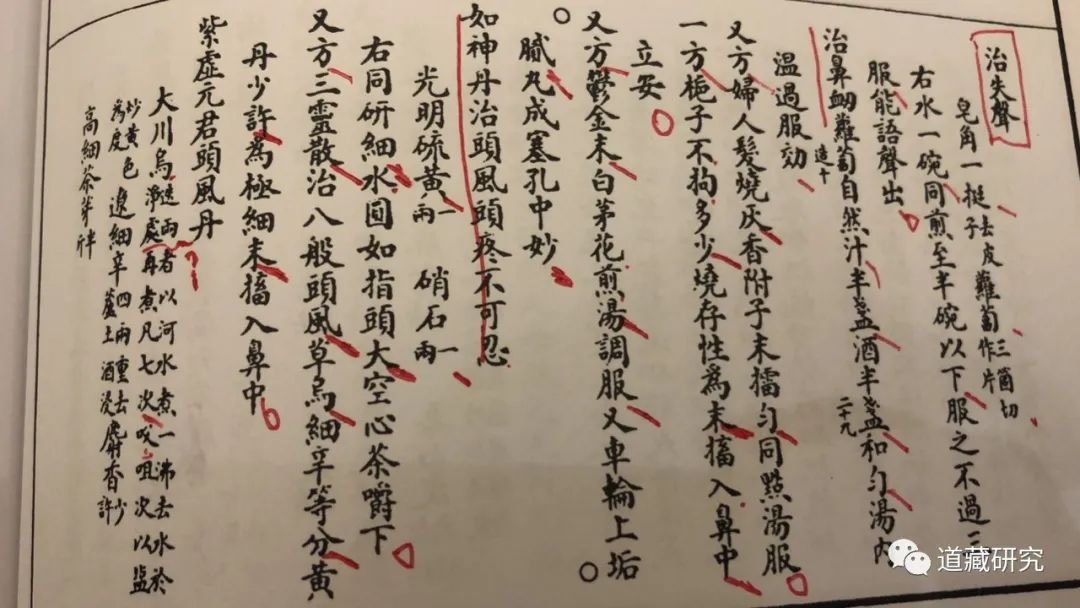
前几天,窗前闲卧,翻看《仙传外科秘方》(又名《仙传外科集验方》),偶然看到有治头痛、头风的方子,还有一些杂症验方,于是就想到了那个信息。所以就分享出来。管不管用我不知道,原文转载古人的记录而已。插图为我点注原文:
先简介下这本书,整理《道藏》中的经典书籍才是核心:
经名:《仙传外科集验方》。又名《仙传外料秘方》。本书由外科集验方和增添别本经验诸方两部分内容组成。共十一卷。底本出处:《正统道藏》太平部。元朝禾川(江西吉安)杨清叟所编述,然后他传给了吴宁极;吴宁极传给他的儿子吴有章,吴有章又传授给西平善观李先生(注:此处人名,百度百科的作者简介信息中的“李生生”,是错误的,原文是“李先生”);李先生又传授给了浚仪(河南开封)赵宜真,赵宜真发愿要将此书广为济世。
此书,从元朝传到了明朝,才被刊印。纵有朝代更迭,文化和知识的传承一直在民间持续,这让人很感动。不从政有不从政的用处,就是可以没有政权本位感地专注保护和传承真正有价值的文化,那些只为一个朝代本位讲话的,在朝代更迭时,命运变化太大,有些人可能命都保不住,不要说传承文化了。甚至哪怕王权不改姓,同一政权内部的帝位更迭也会造成很多人的命运天地之别,正所谓:“一朝天子一朝臣”。儿子继位,弃用甚至收拾老子的重臣,也是常见的事。那些民间学者,最大的优势就是可以不受政治影响地毕生努力于一件有意义的事。所以文脉延续靠的是代代不绝的民族精神。本书的传承,就是典型的例子。从元到明,又经过多人不懈地将孤本草稿相传相授,不断被抄录重编,最后才辑录成《赵宜真集》。参校本:明刻本、北京图书馆藏清抄本(简称抄本)、弭刻本《秘传外秤方》。

据“庐陵友兰父吴有壬”在本书序言中说,“浚仪原阳赵炼师,以通儒名,家学於老氏,道行高洁,超迈辈流,处心切於济人。以平昔所获奇异方书,汇聚成帙,中经兵火散失,唯外科方仅存”,作者赵宜真,儒道双通,道行高洁,品行出众,怀有切切济世之心。以他个人的力量收集奇方异书,汇聚成册。后来因战乱,都佚失了,只存下这十一卷外科验方。宝贵的医方都散失了,是很大的憾事;但还能存下这些外科验方,也是极幸运的。后世之人,在感恩之余,就好好学习研究吧。莫负了作者一生之辛苦。赵宜真在序言中举例说明了“夫杂病有方,伤寒有法,二者兼尽其道,乃为良医”的道理,让人信服,让人感动。
这本书怎么被刊印而得以流传的呢?
“戊午秋,挟其书游金精,寓雩都之紫阳观,盖二十年前尝以道法授其观之高士箫凤冈。今而重过,又能愈其徒刘顺川积年不治之疮疾,凤冈即欲版行,以广其扶危救急之意。”
一年秋天,赵宜真带着他的书稿到金精,也就是江西的宁都县的紫阳观游览。原来,这个道观的道长箫天倪(凤冈)是他的徒弟。二十年前,他曾以道法教授过这位道士。这次经过此道观,师徒二人重逢。正值箫凤冈的师弟刘致柔(顺川)得了顽疾,数年间遍身疮疖,百药不治。于是赵宜真就用这书中的外科验方---还魂汤,将他治好了。于是箫天倪就说要将老师这本书刊印发行,“以广其扶危救急之意”,这样就可以把他老师扶危救急的本意发扬光大。因为一时没找到刻版的工匠,“而原阳仙化,遗命其徒终其志,将受秘方总编为一卷”。该书还没来得及出版,赵宜真就死了,留遗嘱给他的徒弟要把这本书刊印广布,以“拯危急,利仓卒”,广行方便。(读这段感动得想落泪,想想我们在这个功利的社会时的自私和短视,真是无地容)“使凡为人子者皆得此书,可不陷於不孝。使凡为医者皆得此书,可不堕於不仁,则仁人孝子之心具在此”。古代中国人都最讲究“仁孝”的修为。为人之子,得了这本书,可以为长辈保健养生,是为孝;行医的人得了这本书,就可以治病救人,是为“仁”,中国文化中讲“医者仁心”,即是此意。

本书有两篇序文,赵宜真原阳子自序,及吴有壬作序。以上部分,是我综合了两序的大意。
另,此书感动我的是内容还有在附录中的一篇小文---《力到行方便文》。文中,作者的内心生良善和素养,以及纯朴自然的情怀,让人温暖、感动。读古,总不免思今,想想我们今天所做的每件事,都是为了挣钱,为了大的房子,为了好的车子,为了更高的生活水平,为了得到社会的尊重……这些奋斗动机,无一样不是自私、为我,虽无可厚非,但比起古人的思想境界来,总不免惭愧。摘录几句与君分享、共勉:
《力到行方便文》
人在世间,方便第一,力到便行,蹉过可惜。
(注:与人方便,便是神仙)
一平粜米是第一大方便。
(注:粜(tiào),会意兼形声。从出,从糶,糶亦声。本义指卖出谷物、粮食。组词平粜,就是平价出售谷物。本文大意是:让人有饭吃,解决温饱问题,是第一大方便。)
一济人疾病,大是方便,若能精虔修合许真君如意丹施人,可济万病,治疫尤速。次则诸般可施之药皆好,又能印施良方亦佳。
(注:给人冶病是排名第二的方便。若不能看病的,能施以良药或印施良方,也是大善事)
一夏月施汤水,冬月施老病衣服,存恤鳏寡孤独,收养遗弃孩儿,死而无棺者施之木,急难困乏者随宜救济。
(注:夏天给人汤水解暑,冬天给老弱病残的人保暖衣服,照顾社会上的鳏寡孤独,收养弃儿,救人于危难困穷等等,力所能的帮助别人,也是善举)
一济度幽冥,费小功大。……(本段太长,原文略)。
(注:帮助逝者超度亡灵,让生者得以精神慰藉等等。这样的善事,虽然费钱少但功德大。道门之人如葛洪葛仙公等等,都是各善事施及阴阳两界的大慈善家。作者提到了一种我们现代人容易忽略的慈善---精神慰藉和知识传播。我们现在的观念,一提到慈善,就是捐款捐物资,多属物质方面的布施。在古人的概念中,精神上给予慰藉也是大慈善。道教中如此,佛教中也是。佛教就有一种观念,法布施是最大的功德。佛教有时称呼有德行的人为“善知识”。道教中也是一样,道教把那些给人们讲善念、传播知识的人,称为真人,比如孙真人(孙思邈)。当然,真人还有另外一个概念,是道门中修行达到了一定的程度的高人)
一物命痛苦,与人本同,苟可不杀,便宜止免,昆虫乌兽,一视同仁,教典持斋,及放生三官,考较三元,斋皆为不杀物命。
(注:不杀生。道教信奉“天地与我并生,万物与我为一”,语出《庄子·齐物论》,认为万物生命平等,能不杀生也是善行方便)
一修桥补路,开井通渠,兴利除害,劝善解惑,息争止战,皆方便也。
(注:修桥补路、开井通渠、解人纷争等等,都是力行方便)
如前方便事,富贵者行之,及人既广,受报必丰,福寿增崇,家有余庆。学道者行之,方为功行两全,自然遇师得度,威道有缘。
(注:上述方便诸事,富贵人能行,福寿双报,家有余庆。学道的人力行,功行两全,自然会的名师度化,名列仙班。)
这些都是看起来普普通通的劝善文字,并无什么高深之理,朴实无华。但是,当夜深人静,一个人静读深思之时,总是让倍觉人性的升华,眼前浮现一个温情的社会画面。所谓“道门十二愿,愿愿皆慈悲”,“慈悲”是一种精神境界。我去道学院上课,下课时就直接结束了。学生们告诉我说要经过一个仪式才结束。我问下课就下课,还有什么仪式?于是他们请我喊一声“下课”。我就喊“下课”,全体同学立即齐立、鞠躬,高声道:“老师慈悲!”我立即回复:“慈悲!慈悲!”原来,道门还有这么多讲究,中国文化,处处礼节庄重。

《仙传外科集验方》主要辑录的是外科验方,内容很多,从事外科的人,或是有外科、皮肤疑难症的人,可去详细阅读原文。原文很详细,还有很多图,有些是毒疮长什么样子,有些是画出了长的部位,很详细。(如上图)本文,我只摘录其最后一章的中的“诸杂症”中的一小部分,有些是验方,有些是急救方法,蓝字为原文呈现,部分点注,不再翻译:
治诸杂证品
救自缢死
自旦至暮,虽已冷可活。心下微温者,虽一日已上可活。急抱起死者,使绳宽解,去绳,切不可割断绳也。却与之微微捻正喉咙,放倒卧,用被盖,急用竹管吹其两耳,一人急牵其发,不放手,就用脚踏其两肩。一人摩其胸及屈伸其手足,摩捋之。如活即以粥饮与之,此法救人无不活者。
(注:现在住房都天花板了,很少有梁木了,上吊的人少了,本不想摘录了,但看到“此法救人无不活者”,这么厉害的方法,还是转出来吧。本意是启发懂行的人思考这种方法能“起死回升”的原理,这才是要义)
救水溺死
先以刀斡开溺者口,横放箸一只,令其牙衔之,使可出水。或覆瓮或立甑,以溺者腹肚覆其上,令头垂出水。如无瓮饭,横腹圆木上亦可。水出后,令健夫屈死人两足着肩上,以背相贴倒驼之而行,令出其水尽,仍先打取壁土一堵置地上,以死者仰卧其上,更以壁土覆之,止露口眼,自然水气翕入土中,其人或苏,仍急用竹管各於口、耳、鼻、脐、粪门内更迭吹之,令上下气相通。又用半夏末少许搐其鼻,如略活,用清粥饮灌之。
又孙真人救溺死法,急解去死人衣带,艾灸脐中即活。
(注:这个一定要转的,因为经常看到有人溺水的报道。这两种方法讲的都是人溺死之后怎么救活。文中的孙真人,指的是药王孙思邈,他这个方法倒是简单的。只要艾灸肚脐就能治活。我突然想起小时候的一个不远的邻居,八岁的小男孩,掉水里淹死了,他的奶奶哭得死活来,一边大哭,一边拼命地用手扣他的喉咙,想让他把水吐出来。后来折腾了很久,有人牵了一头牛来,把那孩子倒挂在牛背上,大概是要把水倒出来。最后,那孩子还是死了。唉,那时我还不识字,要是当时读了这个“孙真人救溺死法”就好了,估计就可以救他一命了。)
救冬月堕水冻死

凡四肢冷,口不能言,只有微气者,不可便以火炙,用布袋盛热灰,放在心头,冷即换热者,待眼开,却用温酒或米饮灌之。
(注:冻死的不能烤火施救,是关键)
救伏暑死
不可使冷,冷之即死。宜用温汤,常摩洗其心腹间。如路途急切,用路上热土置腹脐间,令人更尿其脐中,即活。
(注:热死的不能以冷施救,是关键。)
救卒中风不省人事,多因痰壅
用白矾二钱重,生研末,生姜自然汁调,斡开口灌下,其涎或吐或化下便醒。
(注:中风不省人事,还是常见的)
救卒中恶不省者
用韭菜研汁,灌入鼻中。
救睡卧中不省死
用韭菜汁滴鼻中,冬月用韭和根,捣汁灌之。
(注:韭菜汁这么厉害,居然能救命,印象深刻)
凡压死、缢死、溺死、魇死、产后晕绝此名五绝
右可用半夏一味为末,如豆大,吹纳鼻中,须臾即活。
(注:半夏本有毒,姜可解。所以现在中医一般用的是“姜半夏”。但这味毒药能这么简单轻松救这“五绝”,如此厉害,咱们给它赐名“活命半夏”吧)
解食河豚鱼毒,仓卒无药,急以清油多灌之,吐出毒物即愈。
(注:这个好,吃河豚是有风险的,餐桌边上摆上清油,以备安全)
解毒散,不以是何毒药服之,虫皆吐出,神效。
右以白矾、石菖蒲,等分为末,新汲水调下二钱,两服见效。神授太乙散,治伤寒阴阳二证,不问阴阳两感,表裹未分皆效。
川升麻 白芍药 紫苏叶 乾葛 陈皮 川芎 青皮 甘草 香附子 白芷
右等分为散,每服三钱,水一盏半,生姜三片,煎八分,连进二服。如头痛,加连须须葱白三茎;气痞中满,加枳壳。产妇婴儿老人皆可服,神效。
(注:转这些,皆因看到了“神效”二字)
治反胃
治反胃,反胃之疾,十有九死,非药不效,良因辄强以食,或饮以羹汤,是速其吐,今得其说,不强以食,绝其羹汤,先投来复丹暑药,知其非伏暑证;遂投养正灵砂之类,饥则以饭炒香;乾啖之,一点汤水亦不与,三日后竟不复吐,饮食如初,治方用。
右以甘蔗捣汁七升,生姜捣汁一升,打和分作三服。

一方,枣子一个,去核,裹全班猫一个,用文武火煨毕,去猫用枣,空心服之,白汤送下。
又取驴溺汁,每日服一盏妙。
(注:班猫:这里可能是斑蝥这种昆虫。驴尿居然可以治反胃。忽然想到了印度人喝牛尿,以及中国古代那咱只有帝王才有条件享用的壮阳产品“秋石”。驴尿、牛尿、童子尿,原来都是解毒药。好像是尿都有解毒作用吧,美剧《老友记》中有这样的场景。后来看了相关文献,果然有此说法。几年前,我还没来福建。我们到厦门调研,参观一个海洋工程。北京没有海,厦门岛一周全是海,我因好奇跑到沙滩上走,接待我们的一位领导好客礼貌,于是下去陪着走。没想到他被水母蜇了,疼痛难忍。于是我告诉他那个缓解疼痛的方法。他当时疼痛得汗珠子流个不停,不加思索地信了。但沙滩上没有厕所,连棵可遮挡的植物都没有,于是要赶紧找。我飞快地跑在前面,他艰辛地跟着,痛苦极了。花了很长时间,后来终于找到了。等到我们走到大马路上与大部队汇合,我们双方单位的领导都用怪异地眼光看着他,半开玩笑地说:“你带美女跑哪儿去了?”那位院长伤痛不堪,只是苦笑。我赶紧解释:被水母蜇了。真心过意不去,抱歉到现在,都是我跑到沙滩上去,才害得人家受一场罪)
治消渴,神效散。
白芍药 甘草炙

右等分,为粗散,每服三钱重,水一盏半,煎至八分,去滓服,不拘时,日三服,疾止则已。
治消渴,神效圆。
蜜陀僧二两 黄连去须,一两
右为细末,蒸饼糊为丸,梧桐子大,浓煎茧皮盐汤,或酒,或茄根汤吞下。一日五丸,日增五丸至三十丸止,不可多,渴止勿服。昔旅店有客患此病,夜求水不得,酌釜中汤饮之而愈,旦往视之,乃躁茧汤也。
又方,用雄牛穿鼻木烧灰存性,为末,酒调服,或锉碎煎汤服之,数服见效。
(注:消渴症即糖尿病,目前现代医学不能根治。这些古人用的方子居然用“神效散、神效丸”来形容,说明有效。另,我还在《老老恒言》中看到一则“赤小豆粥”可治糖尿病的记录。因为自从听说了一位朋友受糖尿病的困扰,每次在读古籍时,看到“消渴症”立即敏感,收集了很多相关方法,因为每个人体质不同,也不敢乱推荐。上世纪,本不信中医的胡适,他的消渴症就是长期喝黄芪给治好的)
治白浊、小便浊频甚者。
右用陈冬瓜仁,炒为末,空心米饮调下五钱许,多服见效。
治水肿,黑豆煮去皮,焙乾为末,米饮调服,每服二钱重。
(注:这个有道理。中医理论,黑色入肾经,水肿多是肾脏系统有问题了,所以用黑豆有效)

治肠风痔漏等疾,白芷一味,以米浴浸一宿,取出切片,用火煅地令热,扫去灰,将纸放在地上,以白芷铺上,翕乾为末,每日酒调下。
一方,皂角去子及皮,蜜炙为末,米糊丸,米饮吞下。
一方,苍耳叶或子,焙乾为末,蜜调服。
涂洗药,朴消井花水调洗,如要涂,用蜜和鸡苏丸并朴消调搽上。
一方,铜青、蜜陀僧各一钱,麝少许,为末,津液和调搽之。
痔疮突出,坐立不便,效速如神,韭菜净洗,以沸汤煎泡於瓦木器内熏之,通手沃洗,最佳也。
一方,西瓜皮煮熟闻香气,以上法熏洗。
又法,生姜切薄片,放在痔上痛甚处,以熟艾作炷於姜上,灸三壮,黄水即出自消。若肛门上有两三个痔,三五日后如前法逐一灸之,屡试甚效。
治脱肛,乌龙尾即梁上尘同鼠粪和之,烧烟於桶内,令坐其上熏之,数遍即不脱矣。
注:这一通文字,虽都是偏方,也都静静地阅读,无甚稀奇感。因为这是太常见的病,古往今来,方子多实在太多了。所以没指望看到便捷方法。但读到“隔姜炙痔”的文字时,差点把人笑死。尽管作者记录“屡试甚效”,可这根本没操作的可能性啊,谁的屁股朝天呢?姜片怎么放上去?在墙上倒立?不过其原理倒是说得过去的,灸出水,痔即消,这个理论上讲得通。所以,转出来。另一种可能,就是现在用的坐灸器,象是一个盆似的,艾灸和生姜放在里面,人坐在上面。这倒是可行的,但古代就有这样的设备了吗?那也真够先进的。
于是,我在想一个问题,是不是所有的外科毒疮,都可以用灸疗呢?从道理上讲,反正是毒瘤,也别指望好皮肤了,能把毒消了不再继续扩散就行。隔姜灸可以起到“起水泡”的作用,通过这种方式,可以把皮下的内毒都拔出皮肉来,没水份了,然后表层脱落,就痊愈。
之所以这么思考,是因为我试过灸脚,证明方法可行。到了南方,湿气重。我的一只脚开始皮下奇痒,偶尔会有小水泡,更多时候啥也没有,根本不知道哪里在痒,好像一个“痒”在全脚皮下跑来跑去,一点办法没有。脚心痒时,恨不得拿刀剁了这只脚。表面看,整只脚白白净净的,竟也找不到一点问题,甚至连一个红点都没有。但痒起来实在太痛苦了。于是我就对脚踝下方的“水泉穴”和脚心的“涌泉穴”,两个地方,开始灸,用的磁悬炙。我看到过一个老中医讲的记录片,说炙疗啊,一定要把皮肤灸烂,病才好,正所谓“若要身体安,三里常不干”,又叫“化脓炙”,通常用的是麦粒炙,就是把艾绒搓成麦粒大小的形状,放在足三里穴位,直接点燃。足三里那边化脓,皮肤起了水泡,病就好了。如果经常灸足三里,那就全身安泰,百病不生。我想了想这种方法的原理,就是通过炙出水来排毒。
于是我就开始在脚上找地方排毒了。我不知道古人为什么给这两穴位取名“水泉穴”和“涌泉穴”,但对老祖宗的智慧是五体投地的,就猜测我体内的湿气在这两个地方藏着,在作怪,才会痒。于是开始了这对两个穴位的“力灸”,我用的是磁悬炙,并不觉得疼痛,只是觉得有点热。两壮下去,果然“水泉穴”灸出水泡。破了,水出。皮肤留了个疤痕,很久才慢慢恢复。但从此再也没有复发。除了根。原不想讲这个案例,难为情。但若是能帮到别人,分享下无妨。

由此我想,是不是所有的皮肤毒疮、真菌等问题,都可以用这个方法?就是把水抽出来,让病毒觉得“此非久留之地”而自绝,或随水而出时,或是在灸疗过程中高温烫死了。人体内的很多病毒都习惯了37度,所以发烧也是人体自我保护的一种表现。当身体发热时,可以杀死很多病毒。那这艾灸,温度就更高了,皮肤表面及皮下的真菌什么的,谁受得了?

病症,总是在出现,多思考对自我保健很重要。其实,很多宣布不治的病,都是有办法的,只是人类还没有找到。患者自己多动脑子,可能是最方便的。比如“意念疗法”,我就相信。我觉得人的意志和意念,在治疗中的作用,可能被大大低估了。很多病,原本不致命,或没有那么快致命,但如果医生讲话谨慎或保守些,再加上病人心态脆弱,意志不够坚强,可能就加速恶化。人体的所有组织和细胞是受自己的大脑控制,它们都听大脑的。大脑如果不让他们放弃,各器官和组织都随时可以积极组织抵抗,甚至反击。这是免疫力,更是本能。但我们现在的医疗,可能过于依赖药物,也就是靠“外力”来帮助打败病毒,外援到了,自卫队就懒着不动,越不动越懒,越懒越不动。这就是免疫力越来越弱的表现。意志若不消沉,意念就会坚定,这就是“士气”。长官不投降,士兵是不会先说投降的,只要意志不放弃,就一直存在转局的可能。战争如此,商业如此,人的生命,更如此。生命,是这个世界上最脆弱的,但也是最坚强的。只有决不放弃的心,才是赢到最后的保障。那些被确诊了癌症的人,有些很快就过世了。其实并不全是因为疾病到了那个程度,或许是过度医疗,同样的治疗方案和药量,有的人体质弱,身体承受不了;更多的,可能是心理素质原因,精神压力太大,压力大其实就是恐惧,恐惧就已向病毒示了弱,就有放弃的念头,俗称“吓死的”。而还有一些人,经过漫长的治疗,慢慢地转好了。所以同等病情的癌症患者一般两种情况:走得快,以及,康复的慢。走得快的,多是意志弱的,确切说,是吓死的;而后一种,就是乐观坚强的,与病毒进行长期的对抗。药物虽起作用,但更主要的,还是内生的力量。

我原来在讲什么话题?忘了。算了。这就是:走得太远,忘记了为什么出发。哈哈。
这大概就是阅读可以抗衰老的原因吧。一直读,一直七想八想,各种奇奇怪怪的想法,大脑一直在运动,脑子越用越灵活,于是不老。这也是我“只孤独,不寂寞”的原因吧。脑袋瓜里各种稀奇古怪的信息,玩不尽的排列组合,热热闹闹的,哪里有时间生烦恼呢?我把转发介绍古籍当成养生中来做了。这样不累,又有趣。
人参交龙散,治诸嗽不愈者。
人参 阿胶炒 款冬花 粟壳米炒
右等分,每服三钱,乌梅一个煎,半夜服。
(注:久咳不愈的人太多了。转。)
化痰圆
明矾枯,一钱 南星半生半熟 半夏泡
右为末,姜汁煮糊丸,小梧子大,每二三十丸,食后姜汤下。
旧本一捻金
知母一两 贝母一两 巴豆一十粒,去油
右研细,和前药令匀,每服一字,用姜三片,两面蘸药,卧床上细嚼咽下便睡,即定,次日必利。小儿止用一半
(注:老痰不化,我还见到过煮“海浮石”治好的,就是海边那种带孔的石头,长得像肺。中央台“健康频道”有个记录片,就是讲这个顽症的)
治失声。
皂角一挺,去皮子萝卜三个,切作片
右水一碗,同煎至半碗以下,服之不过三服,能语声出。

治鼻衄,萝卜自然汁半盏,酒半盏,和匀,汤内温过服效。
又方,妇人发烧灰,香附子末擂匀,同点汤服。
一方,栀子不拘多少,烧存性为末,搐入鼻中,立安。
又方,郁金末,白茅花煎汤调服。
(注:鼻衄,指鼻子出血。)
如神丹,治头风头疼不可忍。
光明硫黄一两 硝石一两
右同研细,水圆如指头大,空心茶嚼下。
又方,三灵散,治八般头风,草乌、细辛等分,黄丹少许,为极细末,搐入鼻中。
紫虚元君头风丹
大川乌迭??,两者以河水煮一沸,去水,於净处再煮,凡七次,吸咀??,次以盐炒黄色为度 辽细辛四两重,去芦土,酒浸 麝香少许 高细茶芽半斤
(注:此虚元君,指的是魏华存。本段诸多不认识的,我眼睛太累了,用放大镜也看不到了,本段白话文不靠谱。有兴趣的请自己从下面的原图中辨认吧)
右为末,每服三钱,食后临卧茶清调下,少时更以热汤催汗出,或鼻出涕为度。
(注:就是一位读者发信息说头疼不可忍,切切求助,为这个信息才发的此文,害我谨慎摘录、反复编辑了三天哈。以后,请不要向我寻医问药了,我不是医生,太难为我了。只是按自己的进度在阅读《道藏》,看到什么好玩的,就发出来娱乐解闷儿,人生嘛,开心为要。人们一问我,立即感觉负担很重,于是变成有目的阅读,就觉得累了。这是心里话。大家去咨询医生才合适,我不懂医)
治紫癜风,硫黄一两,醋煮一日、海螵蛸三个,同研为末,浴后以生姜蘸药,熟擦患处,须谨风少时,数度断根。
又方,知母磨醋擦。
(注:以前发过鳗鱼治白癜风的记录,这次又看到紫癜风。看到里面有醋,觉得靠谱。转)
耳聋久不闻声。
紧磁石一豆大 麝香一字 驼鹤油竹筒收
右用新绵裹了,塞於所患耳内,口中衔少生铁,觉耳内风雨声即愈,须作三五次方可。

(注:这个方子似乎有道理。古人说“鸣为聋之渐”,耳鸣是耳聋的开始。我耳鸣时,经朋友介绍,用过中成药“耳聋左慈丸”,我看了组方,君药就是“磁石”。不过那是服用。这个应该是物理疗法,更方便些。既然作者记录“三五次方可”,那就坚持三五次呗,总比耳朵聋了好啊。另,我在古籍中也看到过“巴豆治耳鸣”,将巴豆用棉花裹了,晚上睡觉时塞进耳朵。我想了下原理,可能是巴豆的硬度可以按摩刺激耳中的穴位。觉得靠谱。一次去福州出差,睡眠不好,耳鸣严重,驾驶员小胡跑遍福州城的大小药店,买不到巴豆。后来在中药材市场买到,试了一次,比较硬,我本来睡眠不算好,所以改用了我二哥寄来的两味中药(其中一味好像是乌头,有毒的),烧成灰的,我就装在小布袋里,放耳边。但同时又服了西药,好了。我个人认为,是西药起的作用。实事求是地讲,放耳边,起作用的可能性不太大。我替中医和道医讲公道话,但一点也不排斥西医。一如我替传统国学讲话,但一点也不排斥现代科学技术。我坚守中国的道文化,但一点也不排斥西方的文化。就犹如,我穿旗袍,但外面还套一件西式风衣一样。中西文化本没有矛盾,更没有对抗;如果有,那是没格局的人心在作祟。

我耳鸣好的另一个原因是,练习了导引催眠法,睡眠质量提高也很重要。有一天,厦大的黄教授来泡茶,我们聊《道藏》目录学,无意间提到耳鸣的话题,他说自己的学生有耳鸣一直治不好,我就拿出巴豆,让他挑大小不等的去给学生用,后来也忘记了去问是否管用,这里记录出来。)
蜘蛛疮,用羊乳敷其上,或用清油搽之,即安。
颠狗咬,韭菜根捣汁多服。又桃白皮煎服,或灸伤处三五壮。又真胆矾为末,贴疮上立愈。
(注:我在别的书上看到过疯狗咬了,得了狂犬病,就用狗脑子涂在伤口上,就好了。是哪本书,一时不记得了,忽然意识到我是不是真的不再年轻了,读书“过目不忘”已成为儿时的记忆了。但能确定的是看到过,反正都在《道藏》中,我还专门写过文章,不知散在哪篇之中,有很多草稿没有发出来。我写东西太散,没中心又没逻辑,随手打字,所以不好查找)
蜈蚣咬,嚼茱萸擦之。又鸡粪涂。又生姜汁调蚌粉搽。又以刀斫桑树皮取汁涂,立愈好。又疼痛不可忍,用艾火灸伤处三五壮。又以清油灯草点灯,以灯烟熏之亦止,不问其他毒虫伤,亦可用此熏,极验。
黄蜂蜇,以热酒洗之立效。或用清油搽上。

凡汤火伤,急向火炙,虽痛强忍一食顷,即不痛。又不可以冷水冷物榻之,热气不出,必烂人肉,切宜保之。
(注:这个是反常识的,得转一下。我们现在的理论是开水烫伤了,立即用冷水冲。这里作者说,要“凡汤火伤,急向火炙”,我也不认可。糊涂中。)
治寒足跟冻烂,五月五日午时,用姜葱艾揩一时许,更不再发矣。

(注:这个好,有些人年年足跟冻烂,就端午节治一下呗,不费什么劲。姜、葱、艾叶都是常见的,可不再发,多好。不过,我觉得应该补充一下,按上述治擦完以后,到了冬天,每天晚上,用热水泡脚,然后擦凡士林(纯),再穿上袜子睡觉,不但不会再犯足病,而且还会有一双雪白的玉足)
治牙痛,青蒿一握,水一碗,煎至半碗,待温漱之,疼即止。
(注:常牙痛的可试试!!)
神授香苏散,治四时瘟疫!!
香附子炒去毛 紫苏叶各四两 陈皮一两 甘草炙一两
右到为粗末,每服三盏,水一盏,煎至七分,去滓热服,不拘时,日三服。
(注:因为疫情原因,这两年全世界折腾得不成样子。这是古人记录的治瘟疫的方子。古人不讲这病毒那病毒,统统叫“瘟疫”,原来“非典”是只有冬天爆发,夏天就消失了。这次的新冠,可不管春夏秋冬,一年四季都发,全世界到处发,应该属于“四时瘟疫”了吧,当然“四时瘟疫”也可以有另一种理解,不再解释。)
Selections from Xianzhuan Waike Mifang (1)
39. Selections from Xianzhuan Waike Mifang (1)
Originally published by Yang Zi, Daozang Research, 2021-10-03
I once posted a "migraine formula," a Song court secret recipe: the emperor told it to Wang Anshi, Wang Anshi told Su Dongpo, and Su Dongpo recorded it in his notes on nourishing life; later collected into Sushen Liangfang, it spread wide. After I forwarded it, some who tried it said it worked very well; one even said a thirty-year migraine was cured. The ancients' formulas, it seems, are of real worth. Presumably a short while ago another reader dug up that piece and sent me a "message" through the back end, asking: forehead pain beyond bearing--is there a formula? Because it was not a "comment" but a "message," which is kept only a very short time, I can no longer retrieve the exact wording. Most "messages" I never see: I generally log in to the official account only when posting, and the "messages" are auto-emptied by the system.
A few days ago, idly lying by the window, I was leafing through the Xianzhuan Waike Mifang (also called Xianzhuan Waike Jiyan Fang) and happened on formulas for headache and head-wind, and some proven recipes for miscellaneous ailments, and so thought of that message. So I share them here. Whether they work I do not know; I merely pass on the ancients' records as the original has them. The illustrations are my notes and pointings on the original text:
First, a brief introduction to this book. Collating the classic books of the Daozang (Daoist Canon) is my proper core work:
Title of the work: Xianzhuan Waike Jiyan Fang, also called Xianzhuan Waike Mifang. The book consists of two parts, the Collected and Tested External Formulas and the Supplemented Experience Formulas from Other Copies, eleven juan in all. Source of the base text: the Zhengtong Daozang, Taiping division. Compiled and set down in the Yuan by Yang Qingsou of Hechuan (Ji'an, Jiangxi), who passed it to Wu Ningji; Wu Ningji passed it to his son Wu Youzhang; Wu Youzhang passed it on to Mr. Li of Xiping, Shanguan (note: for this name, the "Li Shengsheng" in Baidu Baike's biographical note is an error; the original reads "Mr. Li"); Mr. Li passed it on to Zhao Yizhen of Junyi (Kaifeng, Henan), and Zhao Yizhen vowed to spread the book wide for the aid of the world.
This book passed from the Yuan into the Ming before it was printed. Dynasties changed, yet the transmission of culture and knowledge went on unbroken among the people--which is deeply moving. Not taking office has its use: one can, without any sense of loyalty to a regime, concentrate on protecting and handing on culture of real value. Those who speak only for one dynasty's interest, when the dynasty changes, see their fates swing wildly; some may not even keep their lives, let alone carry on culture. Even where the royal surname does not change, the succession of thrones within one and the same regime will cast many fates between heaven and earth--hence the saying, "one Son of Heaven, one court of ministers." A son succeeding and discarding, even purging, his father's great ministers is a common thing too. The private scholar's greatest advantage is precisely that he can devote a lifetime to one meaningful work, untouched by politics. So the continuity of our letters rests on a national spirit unbroken generation after generation. The transmission of this book is a classic case: from Yuan to Ming, through person after person tirelessly handing on the sole manuscript of a lost work, copying and re-editing, until at last it was gathered into the Zhao Yizhen Ji. Collating editions: a Ming printing; a Qing manuscript held by the Beijing Library (abbreviated the manuscript); and a Mi printing, Michuan Waicheng Fang.
According to "Wu Youren, Youlanfu of Luling" in this book's preface, "the Refined Master Zhao Yuanyang of Junyi was famed as a scholar of wide reach; his family learning was of Laozi's school; his conduct of the Dao was lofty and pure, above his fellows, and his heart was set on aiding others. He gathered the strange and remarkable books of formulas he had obtained over the years into a volume; through the fires of war they were scattered and lost, and only the external formulas survived." The author Zhao Yizhen commanded both the Confucian and the Daoist; his conduct of the Dao was lofty and pure, his character outstanding, and he bore an urgent heart to aid the world. By his own strength he collected strange formulas and remarkable books and gathered them into a volume. Later, through the chaos of war, they were all lost, and only these eleven juan of external formulas survived. That the precious medical formulas were scattered is a great pity; but that these external formulas survived is great good fortune. We of later generations, beyond our gratitude, should simply study them well. Do not fail the author's lifetime of toil. In his preface Zhao Yizhen illustrated the principle that "for miscellaneous illness there are formulas; for cold damage, methods; only one who exhausts the way of both is a good physician"--persuasive, and moving.
How, then, was this book printed and so handed down?
"In the autumn of wuwu, he took his book and traveled to Jinjing, lodging at the Ziyang Temple of Yudu; some twenty years earlier he had taught the Daoist method to the temple's high adept Xiao Fenggang. Passing again now, he was further able to cure his disciple Liu Shunchuan's sore-illness of many years beyond treatment, whereupon Fenggang wished at once to cut blocks and publish it, to widen his intent of supporting the endangered and rescuing the urgent."
One autumn, Zhao Yizhen took his manuscript to Jinjing--that is, the Ziyang Temple in Ningdu County, Jiangxi--to travel and look about. It turned out that the temple's abbot, Xiao Tianni (Fenggang), was his disciple: twenty years before, he had taught this Daoist priest the Daoist method. Passing the temple this time, master and disciple met again. It chanced that Xiao Fenggang's fellow-disciple Liu Zhirou (Shunchuan) had contracted a stubborn illness: sores and boils all over the body for years, no medicine curing them. So Zhao Yizhen used a surgical formula from this book--the Huanhun Tang (Soul-Returning Decoction)--and cured him. Thereupon Xiao Tianni said he wished to have his teacher's book cut and issued, "to widen his intent of supporting the endangered and rescuing the urgent," so spreading abroad his teacher's original purpose. Because no carving craftsmen could be found at the time, "the Immortal of Yuanyang passed on to heaven, leaving it enjoined upon his disciples to finish his intent, gathering the secret formulas as a whole into one volume." The book had not yet been published when Zhao Yizhen died; he left a testament charging his disciples to print and spread the book, to "rescue the desperate and serve the sudden," and do good widely. (Reading this passage moved me nearly to tears: think of our selfishness and short sight in this utility-minded society of ours--I could not hold up my head.) "Let every son of man obtain this book, and he need not sink into unfiliality. Let every physician obtain this book, and he need not sink into want of benevolence; then the hearts of the benevolent and the filial are all contained here." The ancient Chinese set the greatest store by cultivation of "benevolence and filiality." A son of man who gains this book can keep his elders in health--that is filial; a physician who gains it can cure illness and save people--that is "benevolence." When Chinese culture says "the physician's heart is benevolent," this is what it means.
The book has two prefaces: Zhao Yizhen's own, under his name Yuanyangzi, and the one by Wu Youren. The part above is my synthesis of the gist of the two.
Also, what moved me in this book is a little piece appended at the end--Li Dao Xing Fangbian Wen. In it, the author's inner goodness and breeding, his plain and natural feeling, warm and move one. Reading the ancients always sets one thinking of today. Think of everything we do today: to make money, for a bigger house, a better car, a higher standard of living, to win society's respect... not one of these motives is not selfish, not for self; blameless enough, but beside the ancients' reach of mind one cannot help feeling ashamed. I copy out a few lines to share with you, for our mutual encouragement:
Li Dao Xing Fangbian Wen
To live in this world, convenience to others comes first; where your strength reaches, act; to let it slip past is a pity.
(Note: to make things convenient for others is itself to be an immortal.)
Selling grain at a fair price is the greatest convenience of all.
(Note: tiao, "to sell grain": an ideogram combined with a phonetic, built from "out" and from the graph for selling grain, which also supplies the sound. Its root meaning is to sell out grain and foodstuffs. The compound ping-tiao means selling grain at a level price. The gist of the line: to let people have food to eat, solving warmth and hunger, is the first great convenience.)
To aid people in illness is a great convenience. If one can devoutly and precisely compound the Ruyi Dan of Perfected Lord Xu and bestow it, it can aid the ten thousand illnesses, and is swiftest against epidemic. Next best, any medicines one can give away are good, and printing and bestowing good formulas is also fine.
(Note: treating people's illness ranks as the second convenience. Those who cannot practice medicine can bestow good medicines or print and spread good formulas--also a great good work.)
In summer, give out soup and water; in winter, give clothing to the old and ill; have care for the widowed, the childless, the orphaned, and the solitary; take in abandoned children; give wood to the dead who lack coffins; relieve according to means those in urgent straits and want.
(Note: giving soup and water in summer to relieve heat, giving warm clothing in winter to the old, weak, ill, and crippled, caring for society's widowed, orphaned, childless, and solitary, taking in foundlings, saving people from peril and poverty, and so on--helping others within one's strength is also a good work.)
To aid and deliver the dark world of the dead: small cost, great merit. ...... (This passage is long; [omitted in the source].)
(Note: helping the dead cross over, giving the living spiritual comfort, and so on. Such good works cost little money but earn great merit. Men of the Dao, like Ge Hong, the Immortal Lord Ge, were great philanthropists whose good works reached both the worlds of light and dark. The author mentions a kind of charity we moderns easily overlook--spiritual consolation and the spread of knowledge. In our present notion, the moment charity is mentioned, it means donating money and goods, mostly material giving. In the ancients' concept, giving spiritual consolation was also great charity. So in Daoism; so too in Buddhism. Buddhism has a view that the gift of the Dharma is the greatest merit. Buddhism sometimes calls the virtuous "good friends of the Way." So too in Daoism: Daoism calls those who teach people good thoughts and spread knowledge the Perfected--for instance the True Man Sun (Sun Simiao). Of course "perfected" has another sense as well: a person of high attainment who has reached a certain depth in Daoist practice.)
The suffering of living creatures is at root the same as humankind's; if the killing can be spared, then spare and stop it. Insects, birds, and beasts: regard all alike as kin. The canonical teachings enjoin the fast, and the release of living things to the Three Officers; the examination of the Three Origins; the fasts all exist for the sake of not killing living things.
(Note: not killing. Daoism holds to "heaven and earth were born together with me, and the ten thousand things and I are one," from Zhuangzi, "Qiwu Lun," holding the life of all things equal; to refrain from killing is also a work of convenience and good.)
Repairing bridges and mending roads, digging wells and opening channels, furthering benefit and removing harm, encouraging good and clearing up confusion, settling quarrels and stopping fights--all these are convenience.
(Note: repairing bridges and mending roads, digging wells and opening channels, resolving people's quarrels, and so on--all are convenience put forth in action.)
The works of convenience above, done by the rich and honored, reach people widely and win rich recompense: fortune and long life increase and mount, and the household has surplus blessing. Done by students of the Dao, they are merit and conduct complete in both; naturally they meet their master and gain deliverance, and have a share in the Dao.
(Note: the works of convenience above, done by the rich and honored, are repaid in both fortune and long life, the household having surplus blessing. Done by students of the Dao, merit and conduct are complete, and they will naturally win a famous master's deliverance, their names enrolled among the ranks of immortals.)
These look like the most ordinary exhortations to goodness, with nothing profound in them, plain and unadorned. Yet when the night is still and one person reads them alone and thinks, they always make one feel the ennobling of human nature, and a warm picture of society rises before the eyes. As the saying goes, "the twelve vows of the Daoist gate: every vow is compassion." "Compassion" is a state of spirit. When I went to teach at the Daoist academy, I would simply end class and go. The students told me there was a rite before one could end. I asked: class over is class over--what rite? So they asked me to call out "class dismissed." I called "class dismissed," and the whole body of students rose at once, bowed, and said in loud voices: "Teacher, compassion!" I answered at once: "Compassion! Compassion!" So the Daoist gate has all these refinements; Chinese culture is everywhere grave and courteous.
The Xianzhuan Waike Jiyan Fang mainly gathers external formulas, and the content is plentiful. Those in external medicine, or with stubborn external or skin complaints, may read the original in detail. It is very detailed, with many pictures: some show what the poison sores look like, some mark where they grow--most detailed. (See the picture above.) In this piece I excerpt only a small part of the "miscellaneous ailments" in its last chapter; some are proven formulas, some are first-aid methods. The blue characters present the original text, partly noted by me, not translated again:
On the treatment of the various miscellaneous ailments
Rescuing one hanged
From dawn to dusk, though already cold, the person can be revived. If there is the least warmth below the heart, the person can be revived even after a day and more. Quickly lift the dead person up, loosen the rope, and remove it; on no account cut the rope. Then gently straighten the throat, lay the person down, and cover with a quilt. Hurry to blow into both ears through a bamboo tube; one person pulls the hair without letting go, and at the same time treads on both shoulders. One person rubs the chest and bends and stretches the hands and feet, rubbing and stroking them. If the person revives, give rice gruel. This method has never failed to save.
(Note: housing nowadays all has ceilings; beam-wood is rare, and fewer people hang themselves. I had meant not to excerpt this, but seeing "this method has never failed to save," a method this formidable, I still pass it on. The intent is to set people who know the field thinking about how such a method can "raise the dead back to life"--that is the point.)
Rescuing one drowned
First use a knife to pry open the drowned person's mouth, and lay a chopstick crosswise in it, letting the teeth grip it, so that the water can come out. Or upturn an urn or stand a steamer, lay the drowned person belly-down upon it with the head hanging down, letting the water run out. If there is no urn or steamer, laying the person belly-down across a round log will also do. After the water is out, have a strong man bend the dead person's two feet up onto his shoulders, back pressed to back, and carry the person off upside-down, so that all the water runs out. Then first take a slab of wall-earth and set it on the ground, lay the dead person face-up upon it, and cover the person with more wall-earth, leaving only mouth and eyes exposed; the water-vapor will naturally be drawn into the earth. If the person revives a little, at once blow in turn through bamboo tubes into mouth, ears, nose, navel, and anus, so that the qi above and below communicates. Rub a little pinellia powder into the nose. If the person stirs toward life, feed thin rice gruel.
Also the True Man Sun's method of reviving the drowned: quickly undo the dead person's clothing and belt, and moxa-moxibustion on the navel revives the person.
(Note: this one simply had to be passed on, for one keeps seeing reports of drownings. Both methods tell how to revive a person after drowning. The True Man Sun in the text is Sun Simiao, the King of Medicine; his method is simple: moxibustion at the navel alone can revive. It suddenly reminded me of a neighbor of my childhood, not far off: a boy of eight fell into the water and drowned; his grandmother wept as if to die, and while wailing loudly kept digging at his throat with her hands, trying to make him spit the water out. After a long struggle someone led a cow over and hung the child upside-down along its back, presumably to pour the water out. In the end the child still died. Ah, I could not yet read in those days; had I read this "True Man Sun's method for the drowned" then, I might have saved his life.)
Rescuing one who has fallen into water and frozen in the winter months
Whenever the four limbs are cold, the mouth cannot speak, and only a thread of breath remains, do not at once roast the person by fire. Fill a cloth bag with hot ashes and lay it on the heart; when it cools, change it for hot. When the eyes open, give warm wine or rice water to drink.
(Note: for the frozen, do not rescue by the fire--that is the key.)
Rescuing one struck down by summer heat
Do not chill the person; chill, and the person dies. Use warm water, and keep rubbing and washing the chest and belly. If it is urgent on the road, lay hot roadside earth on the belly at the navel, and have someone urinate onto the navel, and the person revives.
(Note: for the heat-struck, do not rescue with cold--that is the key.)
Rescuing one suddenly felled by wind, unconscious, mostly from phlegm obstruction
Take two qian of alum, grind it raw to powder, mix it with raw ginger juice, pry open the mouth and pour it down; the phlegm will be vomited out or dissolved, and the person wakes.
(Note: felled by wind and unconscious--still common enough.)
Rescuing one suddenly struck by a noxious influence, unconscious
Grind leeks to juice and pour it into the nose.
Rescuing one who loses consciousness in sleep
Drip leek juice into the nose; in the winter months use leeks with their roots, pound to juice, and pour it in.
(Note: leek juice this formidable, actually able to save a life--a deep impression.)
Crushed, hanged, drowned, nightmare-struck, or fainted after childbirth: these are called the five forms of collapse
For all of these, take pinellia alone as powder, in a bean-sized amount, blow it into the nose, and within a moment the person revives.
(Note: pinellia is itself poisonous, and ginger detoxifies it; hence Chinese medicine today generally uses "ginger pinellia." But that one poison can so simply and lightly save these "five forms of collapse"--so formidable a thing; let us grant it a name: "life-saving pinellia.")
For poisoning from eating fugu, with no medicine at hand in the emergency: pour in plenty of clear oil at once; when the poison is vomited out, the person recovers.
(Note: a good one. Eating fugu carries risk; set clear oil by the table for safety's sake.)
Jiedu San (Detoxifying Powder): whatever the poison taken, worms will all be vomited out--divinely effective.
Take white alum and stone calamus in equal parts as powder, mix with freshly drawn water, and give two qian down; two doses and it shows. Shenshou Taiyi San, for cold damage of both the yin and yang patterns: whether yin and yang strike together, or exterior and interior are as yet undivided, it works for all.
Chuanshengma, Baishaoyao, Zisuye, Gange, Chenpi, Chuanxiong, Qingpi, Gancao, Xiangfuzi, Baizhi
Take all in equal parts as powder; each dose three qian, with a cup and a half of water and three slices of fresh ginger, boiled down to eight-tenths of a cup; give two doses in a row. For headache, add three stalks of scallion white with the roots on; for qi-block and fullness of the middle, add zhike. Mothers in childbed, infants, and the old may all take it--divinely effective.
(Note: I pass these on because I saw the words "divinely effective.")
Treating reflux of the stomach
For treating reflux of the stomach: of this illness nine in ten die; not that the medicine fails, but because they force food upon the patient, or give broth and soup, hastening the vomiting. Now that I have this account, one forces no food, cuts off the broth and soup, first gives the Laifu Dan summer medicine, knowing it is not a hidden-summer pattern; then gives Yangzheng pills, Lingsha pills, and the like; when hungry, fries rice till fragrant and has the patient chew it dry, giving not a drop of soup or water. After three days the patient stopped vomiting altogether and ate and drank as at first--so the method was used.
Pound sugarcane to juice, seven sheng; pound fresh ginger to juice, one sheng; beat them together and divide into three doses.
Another formula: one date, pitted, wrapped round one whole banmao beetle; bake it done over gentle and strong heat, discard the beetle, use the date, and take it on an empty stomach, washed down with plain hot water.
Again, take donkey's urine, one cup a day--marvelous.
(Note: banmao: this is probably the blister beetle. Donkey urine can actually treat reflux. It suddenly called to mind the Indians drinking cow urine, and that ancient Chinese virility product only emperors had the means to enjoy, "autumn stone." Donkey urine, cow urine, boy's urine--so they are all antidotes. It seems urine of any kind detoxifies; there is a scene to that effect in the American series "Friends." Later I read the relevant literature, and sure enough the claim exists. Some years ago, before I came to Fujian, we went to Xiamen on a research trip and visited a marine engineering project. Beijing has no sea; Xiamen is ringed all about by it. Out of curiosity I ran down for a walk on the beach, and the official receiving us, hospitable and courteous, came down to walk with me. Unexpectedly he was stung by a jellyfish, in unbearable pain. So I told him the method for easing the sting. He was sweating streams with the pain and believed me without a second's thought. But there was no toilet on the beach, not so much as a plant to hide behind, so we had to hunt fast. I ran ahead at speed; he followed with difficulty, in agony. It took a very long time, but we found one at last. By the time we reached the main road and rejoined the main group, the leaders of both our units fixed him with strange looks and said half-jokingly: "Where did you run off to with the pretty lady?" The poor director, in agony, could only smile bitterly. I hastened to explain: stung by a jellyfish. I am truly sorry about it--sorry to this day. It was my running down to the beach that cost him that ordeal.)
Treating wasting-thirst (xiaoke); the Divine Effect Powder.
Baishaoyao; Gancao, honey-fried
Take in equal parts as a coarse powder; each dose three qian heavy, with a cup and a half of water, boiled down to eight-tenths of a cup; strain off the dregs and take, at no fixed hour, three doses a day; when the illness stops, stop.
Treating wasting-thirst; the Divine Effect Pills.
Mituoseng, two liang; Huanglian, root-beards removed, one liang
Take as fine powder, paste into pills with steamed-cake dough, the size of parasol-tree seeds; swallow down with thick-boiled cocoon-skin salt soup, or wine, or eggplant-root soup. Five pills a day, adding five a day up to thirty; no more. When the thirst stops, stop taking. Of old, a guest at an inn had this illness; at night he begged for water and could get none, so he ladled the hot water in the cauldron and drank it, and was cured; at dawn he went to look, and it was the cocoon-boiling water.
Another formula: burn the wood of the nose-ring of a bull to ash, preserving its nature, powder it, and take it mixed with wine, or cut it small and boil it as soup; several doses show the effect.
(Note: wasting-thirst is diabetes, which modern medicine cannot at present cure. That these ancient formulas are described as "divine-effect powder" and "divine-effect pills" means they worked. Also, I saw in the Laolao Hengyan a record that "red-bean congee" can treat diabetes. Ever since I heard of a friend's trouble with diabetes, whenever I read the old books and see "wasting-thirst" I am instantly alert, and have collected many related methods; but constitutions differ, and I dare not recommend blindly. In the last century Hu Shi, who did not believe in Chinese medicine, had his wasting-thirst cured by long drinking of huangqi.)
Treating whitish turbidity, with urine very turbid and frequent.
Take aged winter-melon seeds, roast and grind to powder, and give about five qian down with rice water on an empty stomach; many doses show the effect.
Treating edema: boil black beans, peel them, dry them and grind to powder, and give with rice water, two qian a dose.
(Note: this one has reason in it. In Chinese medical theory, the black color enters the kidney channel, and edema mostly means the kidney system is at fault, hence black beans are effective.)
Treating intestinal wind, hemorrhoids and fistula and the like: baizhi alone, soaked in rice water one night, taken out and sliced; heat the ground with fire, sweep away the ash, lay paper on the ground, spread the baizhi on it, dry it and grind to powder, and give each day mixed with wine.
Another formula: soap-pod, seeds and skin removed, honey-roasted and ground to powder, pasted into pills with rice paste, swallowed down with rice water.
Another: leaves or seeds of the cocklebur, dried and ground to powder, taken mixed with honey.
Wash-and-smear medicine: mix mirabilite with newly drawn well water for washing; to smear, mix honey with Jisu pills and mirabilite and apply it on.
Another: copper green and mituoseng, one qian each, musk a little, as powder, mixed with saliva and smeared on.
For hemorrhoids protruded, so that sitting and standing are both hard: swift effect as from a god. Wash leeks clean, scald them with boiling water in an earthenware or wooden vessel, and steam the part over them; wash when it is cool enough for the hand to touch--best of all.
Another: boil watermelon rind till the fragrance is smelled, and steam and wash by the method above.
Another method: cut fresh ginger into thin slices, lay them on the very painful spot on the hemorrhoid, make a cone of ripe moxa on the ginger and give three moxa burns; yellow water will come out of itself and the swelling subside. If there are two or three hemorrhoids at the anus, moxa them one by one by the former method after three to five days; tried again and again, very effective.
Treating rectal prolapse: wulongwei, that is, the dust from the beams, mixed with mouse droppings; burn it to smoke in a bucket, have the person sit over it and steam the part, and after several passes it will not prolapse.
Note: all this run of text, though it is all folk recipes, I have still read quietly, without much sense of the strange. For these are too common ills; from ancient times to now the formulas have simply been too many. So I did not hope to see a handy method. But at the words "moxibustion on ginger for hemorrhoids" I nearly died laughing. Though the author records "tried again and again, very effective," this has no possibility of being done at all: whose bottom points at the sky? How would you set the ginger slice on? Stand upside-down against the wall? The principle, though, does carry: moxa draws water, the hemorrhoid subsides; theoretically it holds. So I pass it on. Another possibility is the sitz-moxa devices now in use, basin-shaped, with moxa and ginger inside, the person sitting on top. That is feasible; but did such apparatus exist in antiquity? That would be truly advanced.
So I fell to pondering a question: can all external poison sores be treated by moxibustion? On principle: it is a poison tumor anyway, do not hope for good skin; so long as the poison is dispersed and spreads no further, that is enough. Moxibustion over ginger can "raise blisters," and by this means the hidden poison under the skin can be drawn out of the flesh; with the moisture gone, the surface layer peels off, and it is cured.
The reason I think this way is that I have tried moxibustion on my foot and proved the method workable. After coming south, the damp is heavy. One of my feet began to itch madly under the skin, with an occasional small blister, and more often nothing at all: one simply did not know where the itch was; an "itch" seemed to run about under the skin of the whole foot, and there was nothing to be done. When the sole itched, I could have taken a knife and chopped the foot off. Seen from the surface, the whole foot was white and clean, without a single spot to find, not so much as a red point. But when the itch came, the torment was extreme. So I began moxibustion at two places: the "Shuiquan point" below the ankle and the "Yongquan point" in the sole, using magnetic-suspension moxibustion. I had seen a documentary in which an old Chinese-medicine doctor said that in moxibustion the skin must be burned through before the illness is cured--as the saying goes, "for the body to stay at peace, Zusanli must never dry," also called "suppurating moxa," usually done with grain-of-wheat moxa: the moxa floss is rolled to the size of a wheat grain, set on the Zusanli point, and lit directly. When Zusanli suppurates and the skin raises blisters, the illness is cured. Moxa Zusanli often, and the whole body is at ease, no illness arising. I thought about the principle of the method: it is drawing out the poison by moxa-drawn water.
So I began hunting places on my foot for the detox. I do not know why the ancients named these two points "Shuiquan" and "Yongquan," but I bow to the wisdom of our forebears with all five limbs, and conjectured that the damp in my body lay hidden at these two places, making mischief, and so the itch. So I began the "heavy moxibustion" of these two points, magnetic-suspension moxa again; it did not hurt, only felt somewhat hot. Two cones down, and sure enough the "Shuiquan point" moxa'd up a blister. It broke, the water came out, the skin kept a scar, and only slowly recovered after a long time. But it has never recurred since. The root was removed. I had not meant to tell this case--embarrassing. But if it can help someone, there is no harm in sharing.
From this I thought: can all skin poison sores, fungus troubles, and the like be treated by this method? Draw the water out, and let the virus conclude that "this is no place to linger" and end itself, or come out with the water, or else be scalded to death in the heat of the moxibustion. Many viruses in the body are used to 37 degrees; hence fever is itself one expression of the body's self-protection. When the body heats, many viruses can be killed. And moxibustion is hotter still--what fungus on or under the skin could stand it?
Ailments keep turning up; thinking much matters to one's self-care. In fact, many of the illnesses declared incurable do have their remedies; humankind simply has not found them. The patient's own working brain may be the handiest thing of all. Take "intention therapy": I believe in it. I feel that the role of a person's will and intention in treatment has probably been greatly underestimated. Many illnesses are not of themselves fatal, or not so quickly fatal; but if the doctor speaks cautiously or conservatively, and the patient's state of mind is fragile, the will not firm, it may worsen the faster. Every tissue and cell of the body is governed by one's own brain; they all obey the brain. If the brain does not let them give up, every organ and tissue can at any time mount an active defense, even a counterattack. That is immunity, and more than immunity: it is instinct. But our present medicine may lean too hard on drugs--that is, on "outside force" to help beat the virus: the outside help arrives, and the home guard slouches and stirs not; the less it stirs the slouchier, the slouchier the less it stirs. That is the very face of weakening immunity. If the will does not sink, intention stays firm; that is "morale." So long as the commanding officer does not surrender, the soldiers will not speak of surrender first; so long as the will does not give up, the possibility of turning the battle always remains. So in war, so in business, and so, above all, in a human life. Life is the most fragile thing in this world, and the most steadfast. Only a heart that refuses to give up is the guarantee of winning to the last. Of those diagnosed with cancer, some passed away very soon. It is not entirely that the illness had reached that pitch: perhaps it was over-treatment--the same plan and dosage, and some constitutions are too weak to bear it; or more often the cause is psychological make-up, mental pressure too great. Great pressure is in fact fear; fear has already shown weakness to the virus, and the thought of giving up is there--commonly called "scared to death." And there are others who, through long treatment, slowly turned toward the better. So patients with the same cancer generally fall into two cases: the quick to go, and the slow to recover. The quick to go are mostly the weak of will--scared to death, to put it plainly; the latter are the optimistic and the strong, carrying on a long contest with the virus. The drugs do their part; but the chief thing is still the strength born inside.
What was I talking about? I forget. Never mind. This is it: gone so far, one forgets why one set out. Haha.
This is probably why reading can fight aging. Read on and on, and think every which way--every sort of strange idea, the brain in constant motion; the more the brain is used the nimbler it grows, and so one does not age. It is also probably why I am "alone, but not lonely." In the head, all kinds of odd information, permutations without end, a lively hubbub--where would one find time to breed vexation? I have come to treat forwarding and introducing the old books as a part of nourishing life itself. So it is not tiring, and it is fun.
Renshen Jiaolong San, for coughs of every kind that will not heal.
Renshen; Ejiao, fried; Kuandonghua; Suke (poppy husk), rice-fried
Take in equal parts; each dose three qian, boiled with one dark plum, taken at midnight.
(Note: people with a cough that will not heal are far too many. Pass it on.)
Huatan Wan (Phlegm-Transforming Pills)
Mingfan, calcined, one qian; Nanxing, half raw half cooked; Banxia, soaked
Take as powder, boil ginger juice into a paste and roll pills the size of small parasol-tree seeds; twenty or thirty pills, taken after food with ginger soup.
The old edition's Yi Nian Jin (One Pinch of Gold)
Zhimu one liang; Beimu one liang; Badou ten grains, oil removed
Grind fine, mix evenly with the former medicines; each dose one zi, with three slices of ginger dipped in the medicine on both sides; lie in bed, chew slowly and swallow, then sleep; it will settle, and the next day there will surely be purging. Children take only half.
(Note: for old phlegm that will not transform, I have also seen a cure by boiling "haifushi" (sea pumice), the porous stone from the seaside that looks like a lung. Central Television's health channel has a documentary on just this stubborn complaint.)
Treating loss of voice.
One stick of soap-pod, skin and seeds removed; three radishes, sliced
One bowl of water, boiled with these to less than half a bowl; take it. Within three doses, the voice can come out.
For nosebleed: half a cup of raw radish juice and half a cup of wine, mixed and warmed in hot water--effective when taken.
Another formula: a woman's hair burned to ash, ground even with xiangfuzi powder, mixed with hot water and taken.
Another: gardenia, any amount, burned to preserve its nature, powdered and blown into the nose--instant ease.
Another: turmeric powder, taken mixed with soup of white thatch blossoms.
(Note: nü, nosebleed, means bleeding from the nose.)
Rushen Dan, for head-wind and headache beyond bearing.
Bright sulfur, one liang; nitre, one liang
Grind the two together fine, roll into water pills the size of a finger-tip, and chew them down with tea on an empty stomach.
Another formula, Sanling San, for the eight kinds of head-wind: caowu and xixin in equal parts, with a little huangdan, ground very fine and blown into the nose.
Zixu Yuanjun's Head-Wind Elixir
Dachuanwu, die??; the two boiled once in river water, the water poured off, boiled again in a clean place, seven times in all; xiju??; next, salt-fried to a yellow color as the measure. Liaoxixin four liang heavy, root-earth removed, steeped in wine; musk a little; fine high tea-buds half a jin.
(Note: this Yuanjun is Wei Huacun. Much of this paragraph I could not recognize; my eyes were too tired--the magnifying glass could no longer see it--so the plain-language rendering here is not to be trusted. Those interested may pick it out for themselves from the original pictures below.)
Take as powder; each dose three qian, taken after food and before sleep, washed down with clear tea; a while later, follow with hot soup to hasten the sweat out, or until the nose runs, as the measure.
(Note: it was a reader sending a message--headache past bearing, urgent and pleading--that made me post this piece, and it cost me three careful days of excerpting and re-editing, ha. Henceforth, please do not come to me seeking medicine; I am not a physician, and it is too hard on me. I simply read the Daozang (Daoist Canon) at my own pace, and whatever amusing thing I meet, I post it for fun and relief. Life, after all, takes joy as its business. The moment people ask me, I instantly feel a heavy burden, and my reading turns purposeful, and so tiring. That is my heart speaking. Consulting a physician is the right thing; I do not understand medicine.)
Treating purpuric wind: sulfur one liang, boiled in vinegar one day; haipiaoxiao three, ground together to powder; after bathing, dip fresh ginger in the powder and rub the affected spot well warm; mind the wind for a little while. Several courses and it is cured at the root.
Another formula: zhimu ground in vinegar and rubbed on.
(Note: I once posted a record of eel treating vitiligo; here again is purpuric wind. Seeing vinegar in it, I thought it credible. Pass it on.)
Deafness, long unhearing of sound.
Tight magnetite the size of a bean; musk one zi; tuohe oil (as named in the source), kept in a bamboo tube
Wrap it in fresh cotton, plug it into the affected ear, and hold a little raw iron in the mouth. When wind-and-rain sounds are felt in the ear, it is cured; it must be done three to five times.
(Note: this formula seems to have sense in it. The ancients say "ringing is the start of deafness": tinnitus is the beginning of deafness. When I had tinnitus, introduced by a friend, I used the Chinese patent medicine "Erlong Zuoci Wan," and I looked at the composition: the sovereign medicine is exactly "cishi" (magnetite). But that was taken internally. This should be a physical therapy, more convenient. Since the author records "three to five times before it works," then keep at it three to five times--better than going deaf, after all. Also, I have seen in the old books "badou for tinnitus": croton wrapped in cotton and put into the ear at night while sleeping. I thought about the principle: perhaps the hardness of the croton can press and stimulate the acupoints in the ear. It seemed credible. Once, on a trip to Fuzhou, sleeping badly, tinnitus severe, our driver Xiao Hu combed the big and little pharmacies of Fuzhou and could not buy croton. Later we found it in the medicinal-herb market and tried it once; it was rather hard. My sleep being none too good to begin with, I switched to two Chinese medicines sent by my Second Brother (one of them, as I recall, was wutou, which is poisonous), burned to ash, which I kept in a little cloth bag by my ear. But I also took Western medicine, and it cleared. My own belief is that it was the Western medicine that did it. To be fair about it, the ear-side bag probably had little likelihood of working. I speak fairness for Chinese medicine and Daoist medicine, but I do not in the least reject Western medicine. Just as I speak for the traditional national learning but do not in the least reject modern science and technology. I hold to China's Dao culture but do not in the least reject Western culture. It is like this: I wear a qipao, but over it I put a Western-style coat. Chinese and Western culture are not in conflict, still less in opposition; where there is conflict, it is the minds of people without breadth that are making the mischief.)
Another reason my tinnitus cleared was that I practiced the daoyin hypnosis method; better sleep matters too. One day Professor Huang of Xiamen University came to drink tea, and we fell to talking Daozang (Daoist Canon) bibliography; the topic of tinnitus came up by chance, and he said a student of his had tinnitus that no treatment would cure. I brought out the croton and had him pick out pieces of various sizes for the student to use; later I forgot to ask whether it helped, and I record it here.)
Spider sores: smear sheep's milk on them, or rub them with clear oil, and they settle.
Bitten by a mad dog: pound leek roots to juice and give plenty. Or boil the inner white bark of peach and drink. Or moxa the wound three to five burns. Or true danfan as powder, stuck on the sore--healed at once.
(Note: I have seen in another book that when bitten by a mad dog and rabies set in, smearing the wound with the dog's brain cured it. Which book I cannot for the moment recall; and it struck me suddenly: am I really no longer young? Reading "with a photographic memory" has become a memory of childhood. But I am certain I saw it; it is all in the Daozang (Daoist Canon) somewhere anyway, and I have even written a piece on it, I forget in which--many drafts were never posted. My writing is far too scattered, no center and no logic, typing as things come, so it is hard to search.)
Bitten by a centipede: chew zhuyu (Evodia) and rub it on. Or spread chicken droppings. Or mix fresh ginger juice with clam powder and rub. Or hack the bark of a mulberry with a knife, take the sap and smear it on--cured at once, well. Or, if the pain is past bearing, moxa the wound three to five burns. Or light a rush in clear oil with the lamp-wick, and let the lamp-smoke smoke the wound--it also stops. Other venomous stings too may be smoked this way--extremely effective.
Stung by a wasp: wash with hot wine, instant effect. Or rub on clear oil.
For scalds and burns: at once hold them to the fire; though it hurts, bear it forcibly through the space of a meal, and there will be no more pain. Nor may cold water or cold things be laid on them: the hot vapor cannot get out and will surely rot the flesh. Guard this well.
(Note: this one runs against common sense, so it had to be passed on. Our present theory is: scalded with boiling water, rush cold water over it at once. Here the author says, "for scalds and burns, at once hold them to the fire." I do not accept it either. In a muddle.)
Treating cracked and frost-rotted heels: on the fifth day of the fifth month at the noon hour, rub with ginger, scallion, and moxa for a while, and it will never break out again.
(Note: a good one. Some people's heels rot from frost year after year; let them just treat it once at the Dragon Boat Festival, at no cost of effort. Ginger, scallion, and moxa leaf are all common things, and "never breaks out again"--how fine. But I think I should add a supplement: after the rubbing treatment above, when winter comes, every evening soak the feet in hot water, then rub in pure Vaseline and put on socks to sleep; not only will the foot trouble never return, one will have a pair of snow-white jade feet as well.)
Treating toothache: a handful of qinghao (sweet wormwood), one bowl of water, boiled to half a bowl; when it is warm, rinse the mouth with it, and the pain stops.
(Note: those with frequent toothache may try it!!)
Shenshou Xiangsu San, for the epidemics of the four seasons!!
Xiangfuzi, fried and de-fuzzed, and Zisuye, four liang each; Chenpi one liang; Gancao, honey-fried, one liang
Take as coarse powder; each dose three cups, with one cup of water, boiled to seven-tenths; strain off the dregs and take hot, at no fixed hour, three doses a day.
(Note: because of the epidemic, the whole world has been turned upside down these two years. This is a formula the ancients recorded for treating epidemic. The ancients did not speak of this virus or that virus; they called them all "epidemic." "SARS," it turns out, broke out only in winter and vanished in summer. This Covid, though, cares nothing for spring, summer, autumn, or winter: it erupts in all four seasons, everywhere in the world; it should count as an "epidemic of the four seasons." Of course "epidemic of the four seasons" can also bear another reading, which I will not explain.)